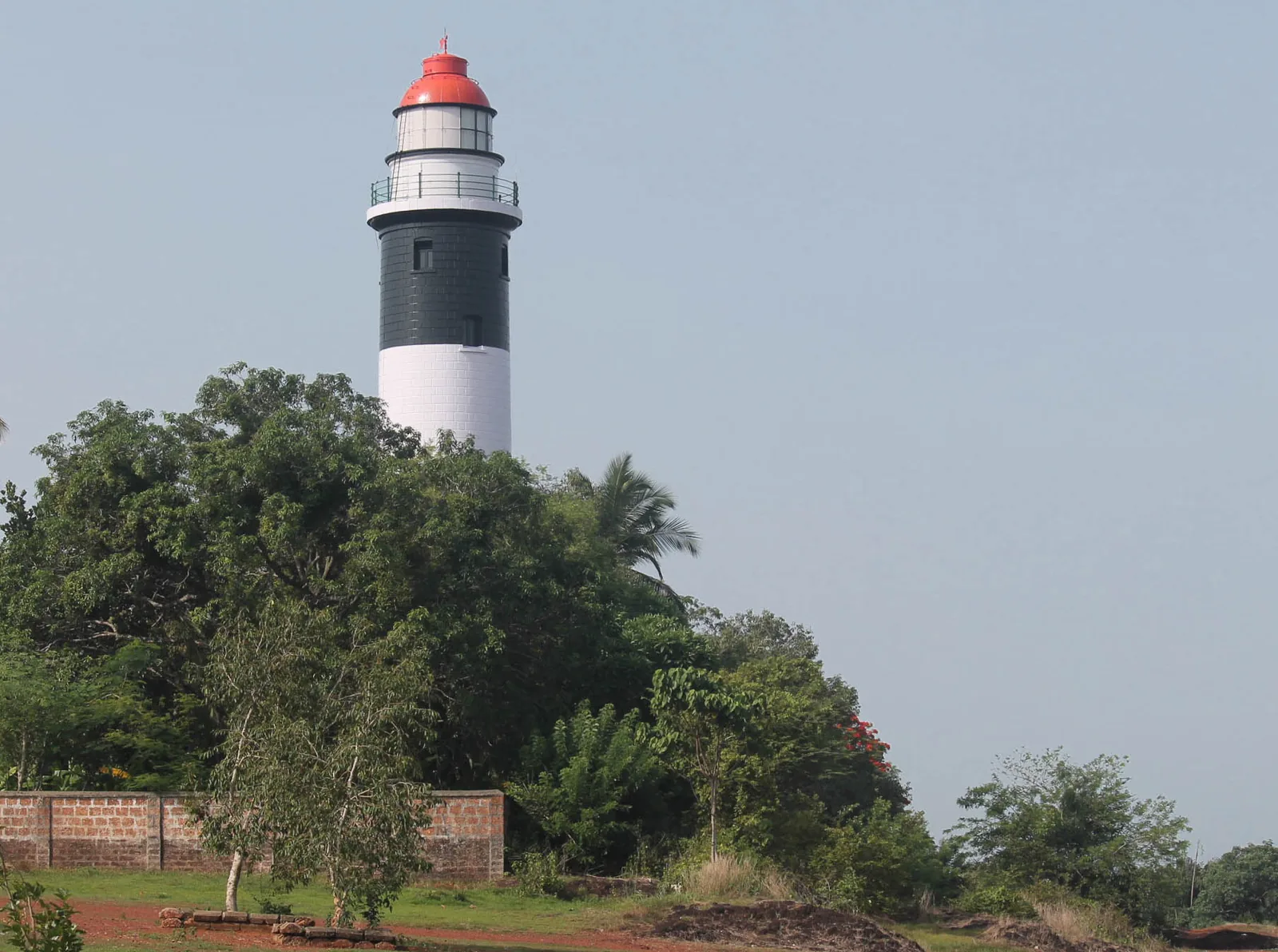
In February 1907 a Public Works engineer named Captain Smith took charge of building a lighthouse on Velliyamkallu, the rock eight kilometres off Kadalur Point, and set about hiring a workforce. His criteria were simple: natural skill, and the robust health to work long hours in bad conditions. Among the first men he picked was Ganapathi Kandy Koran, from the villages around the point, who was sent out in a fishing boat to dress and level the rock so a foundation could be laid on it.
The rock lighthouse was never built. Within three months the scheme collapsed over its cost, Government reverted to a decision it had taken in 1896, and the tower was moved ashore to a laterite hillock at Kadalur. Most of the workforce moved with it, Koran among them. He carried on as a skilled labourer on the mainland tower, and Captain Smith was impressed enough that when the light was commissioned on 20 October 1909, Koran was made one of the station’s two lascars. He would spend the rest of his working life at the Thikkoti lighthouse.
What the job actually was
It is worth understanding what that job was, because lighthouse keeper has softened into something picturesque and this was not picturesque. The light at Kadalur Point was a 55-millimetre petroleum vapour burner: kerosene under pressure, preheated, forced through a nozzle to convert it to gas, part of that gas diverted back to keep the kerosene hot, the rest mixed with air, passed through wire gauzes to even out the pressure, and burned beneath a silk mantle that turned a blue flame white. It gave many times the light of a wick lamp and it demanded constant attention. A capillary lamp sat alongside as an emergency source for the nights the vapour system failed.
Above the burner sat the optic, and the optic had to turn. It is a second-order revolving lens from Chance Brothers of England, seven hundred millimetres across, four lens panels set at right angles to one another, and the whole assembly floats on a bath of mercury — one hundred and nineteen kilograms of it — because mercury offers less resistance than any bearing ever made. Chance Brothers supplied a clockwork train to drive it: a dead weight on a long wire rope, wound by hand onto a drum, its descent transmitted through gears and regulated by a speed governor so that the lens turned at exactly three revolutions a minute and a mariner counting flashes saw one white flash every five seconds. One winding lasted four hours.
A night measured in windings
So a keeper’s night was divided into windings. Light the burner at dusk, wind the weight, watch, wind again four hours later, wind again, and put the light out at dawn. Do it every night. The system ran without failure for eighty-seven years. That is not a statement about Victorian engineering alone; it is a statement about the men who wound it. Koran was one of them from 1909, on a lascar’s pay — the first head keeper, a Mr Joseph, drew Rs 60 a month, the lascars considerably less.
Koran’s second son, Kanaran, grew up around the compound and was drawn to the work from childhood, helping his father whenever he was allowed to. As he grew he was engaged temporarily whenever the other lascar was absent, so that by the time his father retired in 1951 he had been doing the job on and off for years. He was appointed lascar at Kadalur Point that year and served for thirty years, retiring in 1981.
By then the recruitment rules had changed and hereditary succession was no longer a thing that simply happened. Kanaran’s fourth son, Govindan, wanted the work anyway, and the revised rules put several hurdles in front of him. He cleared them. In 1984 he was appointed an assistant lightkeeper, and although his service took him to other lighthouses over the following quarter-century, most of it was spent at Kadalur Point.
The station changed under him
The petroleum vapour burner that his grandfather had tended was finally retired on 16 March 1995, when the light was electrified; a 400-watt metal halide lamp followed in 1996, and a three-point lamp changer with a battery-backed halogen emergency source was commissioned in November 1998. In February 2003 the arrangement changed again to a cluster of metal halide lamps, each on its own uninterruptible supply, which is broadly what burns there now at an effective beam intensity of 340,000 candelas. On 9 August 1996 electronic pulse motors replaced the falling weight and the clockwork, with a standby motor and automatic changeover. The last hand-winding at Kadalur Point happened that summer, eighty-seven years after the first.
What did not change was the optic. The lens Chance Brothers shipped from England in 1909 is still up there, still floating on its mercury, still turning three times a minute. The centenary account notes that the equipment installed then remains in service without major wear — which, for a machine that has run most nights for well over a century in salt air, is a remarkable line to be able to write. The single significant alteration in the first century was in the lantern room, where the visibility arc was reduced from 360 degrees to 240, there being no useful purpose in throwing light inland.
The quieter pieces
The station’s other bits of history are smaller. The lighthouse had its own railway level crossing — the approach road from the main Calicut–Cannanore road had to cross the Mangalore–Madras line, so a gate was provided for the lighthouse’s exclusive use in 1907. It served until 1985, when the panchayat built a road that reached the site without crossing the track, and the gate was abandoned and later removed. The black and white bands, which everyone assumes are original, were applied in 1968; before that the tower stood in plain cement plaster for fifty-nine years.
A hundred and two years, one family
On the day of the centenary in 2009, when the Kadalur Point lighthouse was rededicated at a ceremony in its own compound, the acting head lightkeeper was N. K. Govindan. His grandfather had been one of the men Captain Smith put into a fishing boat in February 1907 and sent out to Velliyamkallu to level a rock for a lighthouse that was never built there. A hundred and two years separate those two facts, and one family covers the whole distance.
There is no plaque for this at the gate, and there is nothing to see. But it is worth carrying up the hundred and thirty-three granite steps, because it changes what the machine at the top means. The optic is not just a fine piece of Victorian glass. It is a thing that three men from the same family, across a century, climbed a staircase in the dark to keep turning.
Frequently asked questions
How long was the lighthouse wound by hand?
Eighty-seven years, from the commissioning on 20 October 1909 until electronic pulse motors took over on 9 August 1996. A falling weight on a wire rope drove a clockwork train through a speed governor, turning the optic three times a minute; one winding lasted four hours, so a keeper’s night was divided into windings.
Is the original lens still in use?
Yes. The second-order revolving optic supplied by Chance Brothers of England in 1909 — 700 mm across, four lens panels at right angles, floating on 119 kg of mercury — is still in service and still turning at three revolutions a minute. Only the illuminant and the drive have changed: electrification came in 1995 and the current metal halide arrangement dates from February 2003.
Did one family really keep the light for three generations?
Yes. Ganapathi Kandy Koran was hired in 1907 to level the offshore rock, became a lascar at the new mainland station in 1909 and served until 1951. His son Kanaran served as lascar from 1951 to 1981. Kanaran’s son N. K. Govindan was appointed assistant lightkeeper in 1984 and was acting head keeper at the lighthouse’s centenary in 2009.