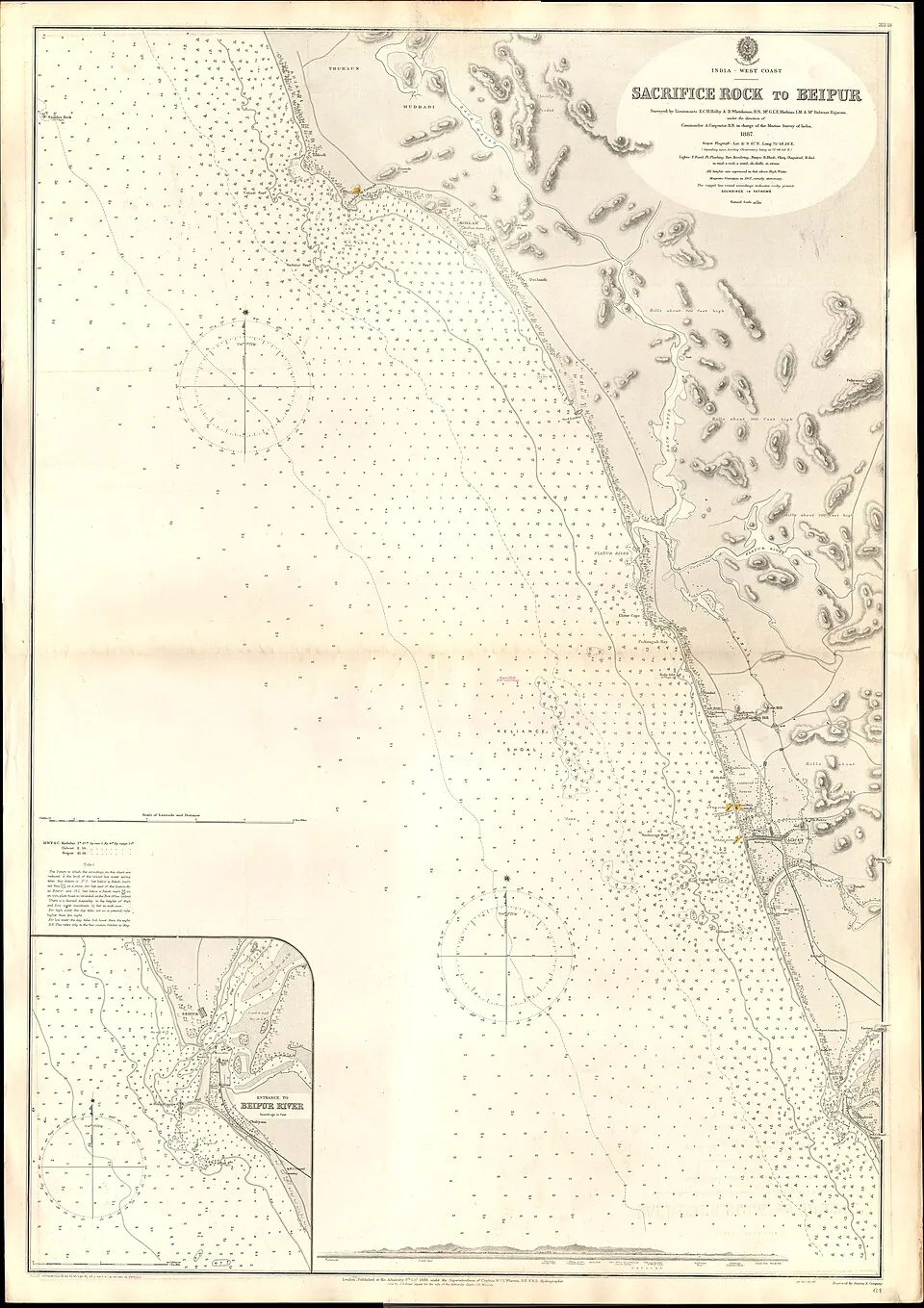
Every visitor to the Thikkoti lighthouse is told about the rock. It sits about eight kilometres offshore, about a hectare in area, rising perhaps six metres above the sea — Ashpitel, the engineer who surveyed it in 1896, called it forty feet high with deep water all round — and it is the single reason this tower stands where it does. Its Malayalam name is Velliyamkallu. On English charts it is Sacrifice Rock. The stories attached to that second name are the most-repeated piece of folklore on this stretch of coast, and almost none of it stands up to a check.
Start with the boring explanation
Begin with the plain reading, because it is the one most likely to be true and the one guides skip. Velli means white, or silver. Kallu means rock. It is a white rock, and it is white for the least romantic reason in nature: generations of seabirds have coated it in guano, and salt spray has bleached what the birds left. There is a possibility that this is a very old observation indeed — some writers have wondered whether the Leuke, or White Island, mentioned in the Periplus of the Erythraean Sea is this rock, though the identification is contested and should be treated as speculation rather than fact. What is not speculative is the colour, or its cause.
The dramatic name arrives with the Europeans. The Portuguese form Rochedo do Sacrifício is reported, and Sacrifice Rock is what appears in English usage — officers of East India Company ships sketched the rock’s profile through the eighteenth century precisely so that a master running east from the Cape on dead reckoning could recognise his landfall by its silhouette. By 1888 the Admiralty had published chart sheet 64 under the title Sacrifice Rock to Beipur, surveyed the previous year by the Marine Survey of India. The name was, by then, simply the name of a place.
Four stories, two directions
But why sacrifice? Here the sources diverge completely, and it is worth setting the versions side by side rather than choosing between them. The most popular in Kerala today holds that Kunhali Marakkar — the Zamorin’s naval commander, whose fleet fought the Portuguese through the sixteenth century — used the rock as a base, hid his war-paroes among its outcrops, and on one occasion killed the entire crew of a Portuguese ship there. The pockmarks on the rock, this version adds, are cannon scars from Portuguese retaliation.
The second version reverses the actors entirely: once the Portuguese had the upper hand on this coast, they used the rock as an execution ground, throwing troublemakers into the sea from it, and it is from this that the rock also took the name Balikkallu, the sacrificial stone. A third version, attributed to the historian M. G. S. Narayanan (1932–2025), suggests the name commemorates Portuguese mass killings of Mappila Muslims attempting the pilgrimage to Mecca. And a fourth, in the centenary history of the lighthouse compiled from the Madras archives, has it that pirates operating among these rocks used Velliyamkallu to divide their loot and dispose of prisoners, and that the British named it Sacrifice Rock after English captives taken from a looted vessel were beheaded on it. Hyder Ali, separately, is said to have marooned state prisoners there to die of hunger and thirst.
Four stories, running in at least two opposite directions, for one name. None is documented in the way a historian would want — no ship’s log, no dated account, no trial record. That does not make any of them false; the sixteenth-century sea war between the Marakkars and the Portuguese was ferocious and much of it went unrecorded, and Velliyamkallu genuinely was a strategic position, a rock that navigators dreaded and that consequently made good cover for anyone who knew it. But a page that tells you flatly that Kunhali Marakkar slaughtered a Portuguese crew here is presenting one candidate explanation as settled history, and it is not.
The older stories announce themselves
The rock has legends that are easier to handle honestly, because they arrive labelled as legends. One holds that it is a fragment of the Himalayan hillock Hanuman was carrying south for the herbs that would save Lakshmana, dropped in passing — the same story places other fragments near Cape Comorin and at Unawatuna in Sri Lanka. Another concerns a footprint chiselled into the rock, which William Logan noted in his Malabar Manual of 1887 was said locally to be Adam’s, left where he paused before going on to Adam’s Peak in Ceylon. And in North Malabar there is a widely held belief that the souls of the dead travel to Velliyamkallu as dragonflies — a belief the novelist M. Mukundan wove into Mayyazhippuzhayude Theerangalil, which is where most Malayali readers first met the rock.
The birds are misdescribed
Tourism copy will tell you Velliyamkallu is a haunt of rare migratory birds. Migratory shorebirds do work this coast between roughly November and March, and they are pleasant to watch from the shore below the lighthouse. But the rock’s actual claim on the ornithological record is a resident: the Indian edible-nest swiftlet, Aerodramus unicolor, a small colonial breeder of the Western Ghats and the south-west coast that builds a half-cup nest of hardened saliva on vertical cave walls. Velliyamkallu, riddled with caverns, suited it exactly.
That mattered commercially. Swiftlet nests are the raw material of bird’s-nest soup, and the colonies of the Malabar coast were harvested for the trade. Nineteenth-century accounts credit the naturalist Thomas Caverhill Jerdon — who described the species and gave it its scientific name — with observing perhaps fifty to a hundred nests in the rock’s caves in the 1840s, and with noting that very few were of the first make, because the good ones were taken away every year. It is a small, precise, slightly melancholy observation, and it tells you more about Velliyamkallu than any number of Portuguese massacres. We are relying on secondary accounts of Jerdon here rather than his original text, and we found no evidence the rock holds any formal protected status, Important Bird Area designation or recognised birding-hotspot listing today.
What is actually documented
The rock’s practical history is easier to pin down. It sat in the direct path of coastal steamers running between Calicut and Bombay, and as that traffic grew under British administration, so did the wrecks. The last documented one came on 30 January 1909: a vessel loaded with wooden logs and bamboo left Beypore at four in the morning bound for Cannanore and struck a submerged rock at four that afternoon. Local fishermen brought the captain and crew ashore safely. There was no time to salvage ship or cargo — the sea broke her up almost at once. Nine months later, on 20 October, the light at Kadalur Point was shown for the first time, and the Directorate’s centenary account claims, with some pride, that no ship has been wrecked on Sacrifice Rock since.
You cannot get to Velliyamkallu from the lighthouse. Boats run out from the Payyoli side, it takes about an hour, and the landing is rough enough that you may have to swim the last stretch. For most visitors the rock stays what it has been to mariners for four hundred years: a pale shape on the western horizon, best seen from a high gallery on a clear afternoon, holding more stories than it can possibly verify.
Frequently asked questions
Why is Velliyamkallu called Sacrifice Rock?
No one can say for certain. At least four undocumented explanations circulate: a Marakkar massacre of a Portuguese crew, Portuguese executions from the rock, Portuguese killings of Mappila Hajj pilgrims, and pirates beheading English captives on it. None has a log, a dated account or a record behind it. The plainer Malayalam name is better founded — velli means white, and the rock is white with guano and salt.
Are there rare migratory birds on the rock?
That claim does not survive scrutiny. Migratory shorebirds work this coast in winter, but the rock’s documented ornithological interest is a resident species: the Indian edible-nest swiftlet, whose saliva nests were harvested commercially here in the nineteenth century. We found no evidence that Velliyamkallu is a designated sanctuary, an Important Bird Area or a recognised birding hotspot.
Can you visit Velliyamkallu?
Not from the lighthouse. Boats go out from the Payyoli side and take about an hour, but the rock is only about a hectare and some six metres high with no proper landing, so the last stretch can involve getting wet. It is not a trip for children or anyone unsteady, and conditions depend entirely on the sea.