The Thiruvallam Parasurama Temple is known for one thing: it appears to be the only temple in Kerala with Parasurama as its principal deity, which is a strange gap for the figure the state’s own founding legend credits with creating it. That much is repeated everywhere. What is repeated far less is that he does not stand alone in the compound, and that the building around him has an age nobody can agree on to within about eighteen centuries.
The Trimurti, together
Alongside the Parasurama shrine, the compound carries separate shrines for Vishnu, Shiva and Brahma. That is a genuinely uncommon arrangement. Brahma in particular is very rarely enshrined anywhere in India, so a small temple that holds all three of the Trimurti with their own shrines is unusual before you add the Parasurama singularity on top of it. Some descriptions specify the Vishnu shrine as Matsya, the fish avatar, rather than Vishnu in a general form — a detail we flag rather than assert, since sources are not consistent about it and it is the sort of thing worth confirming at the temple itself rather than from a listing.
Which is a lot of theology for a small building
It is worth pausing on how much is packed into a modest riverside compound. You have the deity of Kerala’s origin story, present almost nowhere else. You have the three great gods of the classical scheme, each with their own shrine. You have a Triveni Sangamam outside the wall, and the district’s principal function for rites for the dead. And the temple is counted among the 108 Abhimana Kshethrams of the Vaishnava tradition — a set of shrines held in particular regard within that tradition without belonging to the Divya Desam canon. None of it is signposted for visitors, and the building itself is small and plain enough that you could walk through in five minutes without registering any of it.
Eighteen centuries of disagreement
Then there is the age, which is the most quietly remarkable thing on the page. Thiruvallam is very commonly described as two thousand years old. It is also dated, in other accounts, to the twelfth or thirteenth century. Those are not variant estimates of the same event; they are roughly eighteen hundred years apart, and both circulate confidently. We have found no inscription or charter that settles it, and we are not going to pick one to make the page tidier.
What probably reconciles it
The likeliest explanation is that the two claims are about different objects. Sanctity attaches to the confluence, and a sacred confluence can be very old indeed — older than any structure, and not the sort of thing that leaves a foundation date. The black-granite building is a separate matter and can be dated on its fabric, which is where the medieval range comes from. Read that way, a site venerated for two millennia and a temple built in the thirteenth century are both true statements about Thiruvallam that happen to be answering different questions. Traditional accounts credit the founding to Vilwamangalam Swamiyar — the seer who appears in the origin stories of a great many Kerala shrines, including Sarkaradevi up the coast — and a reconstruction to the Chera king Athiyaman Perumal. Both are tradition rather than record, and the recurrence of Vilwamangalam across so many temples is itself a sign that he functions in these accounts as an authenticating figure rather than a datable builder.
What you can actually verify standing there
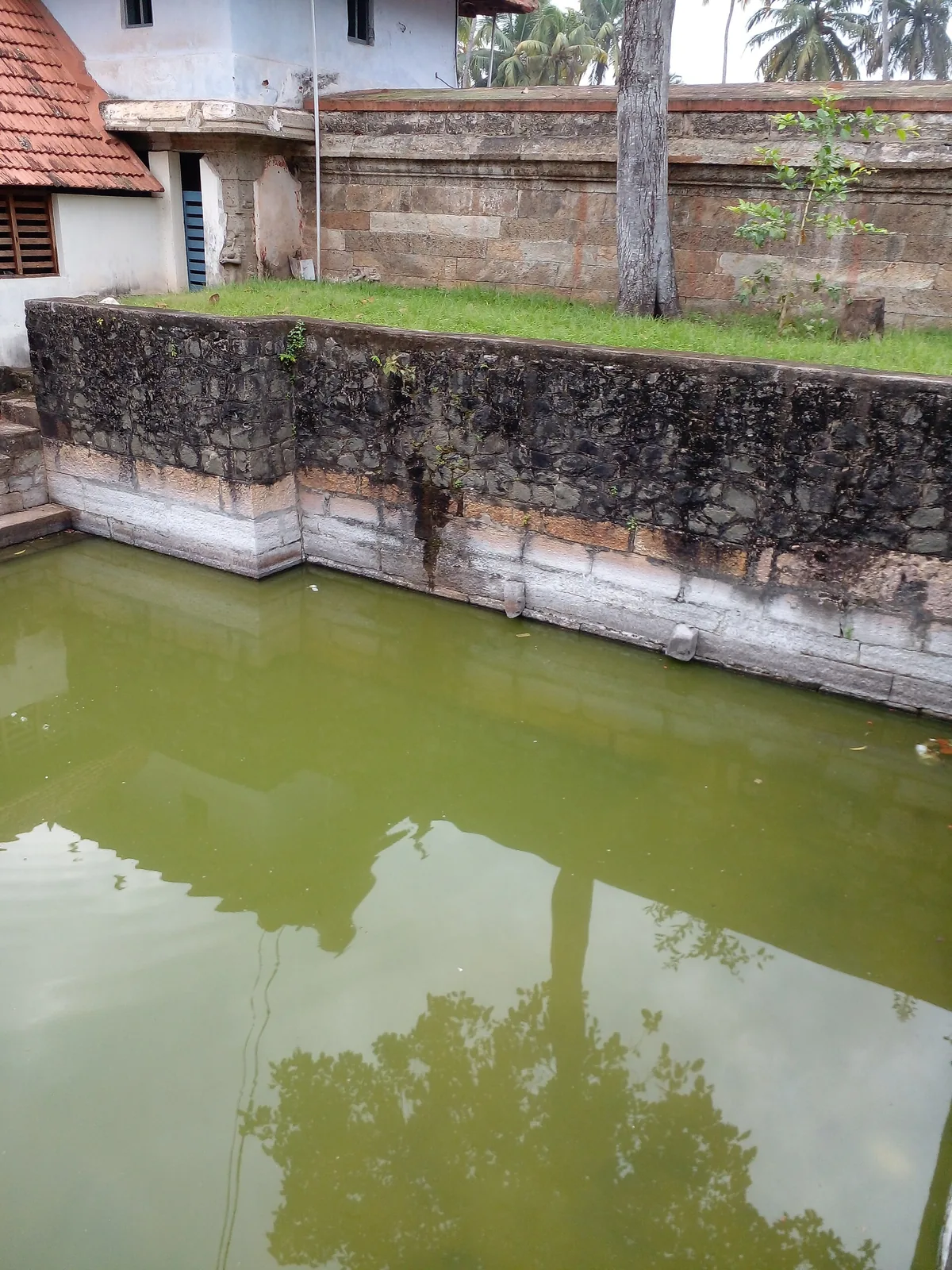
The fabric is old enough to be a protected monument under the Archaeology Department, and that is the firmest thing anyone can tell you about the age. Look at the black granite, the stone-lined tank and the laterite walling, note that this is a small working shrine rather than a monument, and give it twenty unhurried minutes. Then walk out to the confluence, which is the part that explains the rest of it and is covered in Where Three Rivers Meet. Practical detail is on the Thiruvallam Parasurama Temple page.
Frequently asked questions
Which deities are enshrined at Thiruvallam?
Parasurama is the principal deity — apparently uniquely in Kerala. The compound also carries separate shrines for Vishnu, Shiva and Brahma, so the Trimurti are present together. Some descriptions specify the Vishnu shrine as Matsya, the fish avatar; sources differ, so confirm at the temple.
How old is it?
Disputed by about eighteen centuries. It is commonly called two thousand years old, and also dated to the twelfth or thirteenth century. No inscription settles it. The likeliest reconciliation is that an ancient sanctity attaches to the river confluence while the black-granite building is medieval.
Who built it?
Traditional accounts credit the founding to Vilwamangalam Swamiyar and a reconstruction to the Chera king Athiyaman Perumal. Both attributions are tradition rather than documented record — and Vilwamangalam appears in the origin stories of so many Kerala temples that he functions as an authenticating figure rather than a datable builder.
What is an Abhimana Kshethram?
One of a set of 108 shrines held in particular regard within the Vaishnava tradition without belonging to the Divya Desam canon. Thiruvallam is counted among them.