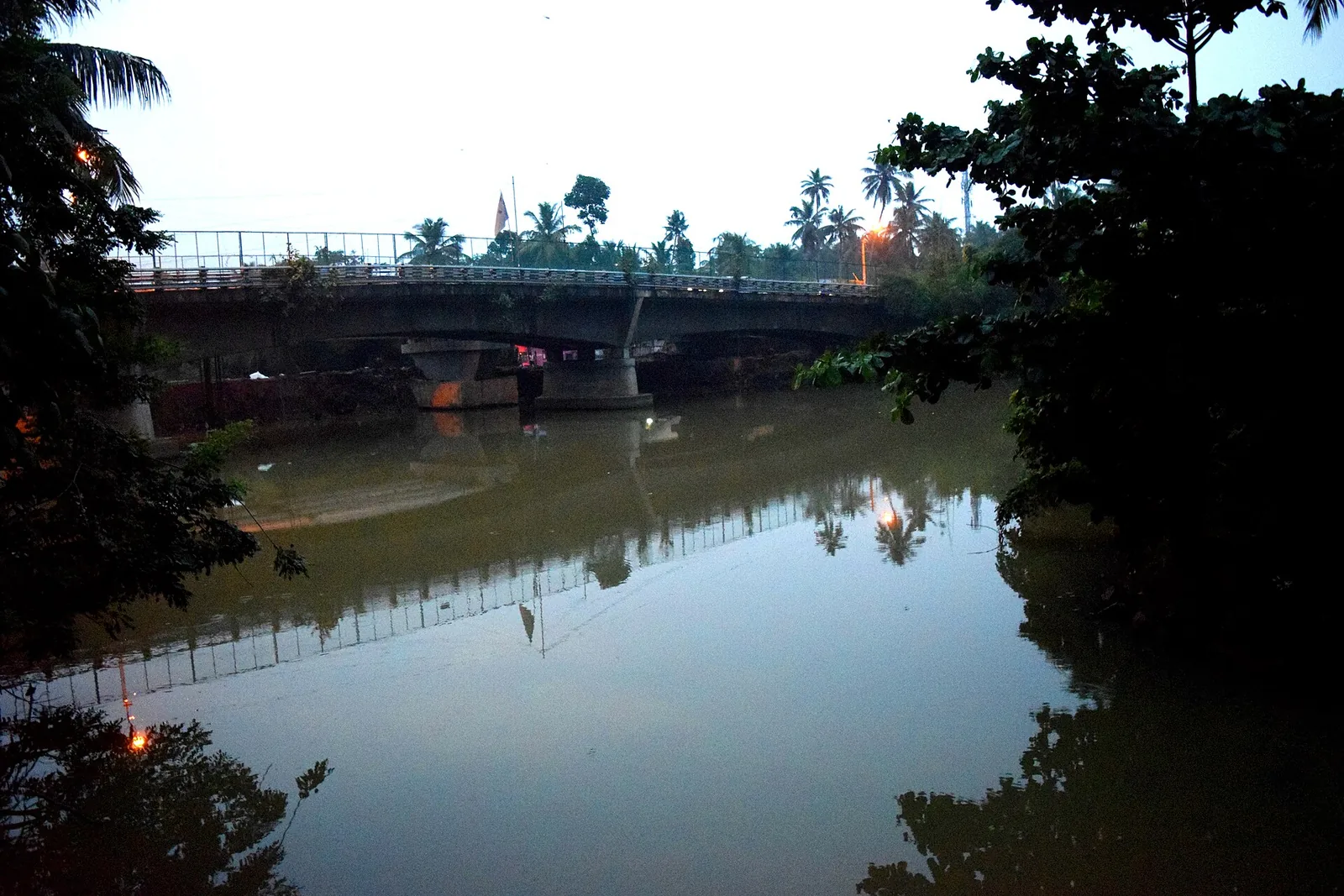
Most descriptions of the Thiruvallam Parasurama Temple — including, until recently, ours — call it a temple on the bank of the Karamana river. That is true and it misses the point. Thiruvallam stands at a Triveni Sangamam, a meeting of three rivers: the Karamana, the Killi and the Parvathiputhanar, joining a short way before the combined water reaches the backwater and the sea. Once you know that, the site stops being a pretty riverside shrine and becomes something with a reason.
Why a confluence
Ancestral rites in Hindu practice are directed to flowing water. The offering — bali tharpanam — is made and then given to the current, which carries it. Any river will serve, but a confluence carries particular weight, and the great examples in India are all sangamams. So the question of why the whole district of Thiruvananthapuram brings its rites for the dead to this specific point, rather than to any of the dozens of other places the Karamana passes on its way down, answers itself as soon as you know what the geography is doing. It is not that a temple happened to be built beside a river. It is that a confluence attracted a temple, and the temple acquired the function the confluence implied.
The right god in the right place
And then the deity closes the circuit. Parasurama, the axe-wielding sixth avatar of Vishnu, is central to Kerala’s account of its own origin — the sage who hurled his axe into the sea and raised the land — and yet almost never appears as the principal deity of a temple. Thiruvallam appears to be the only one in Kerala where he is. His own story is not one of triumph but of expiation: he killed his mother at his father’s command, and the penance for it shaped everything that followed. A deity defined by the working-off of an unbearable debt, installed at a meeting of three rivers, in a place people come to discharge their obligations to their own dead — the three things fit together so neatly that it is hard to read them as accidental.
Karkidaka Vavu
On an ordinary morning this is a quiet place: a handful of families with a priest under an awning by the water, and very little else. On Karkidaka Vavu — the new-moon day of the Malayalam month of Karkidakam, falling roughly mid-July to mid-August — it is one of the largest ritual gatherings in the district. People arrive from before dawn, take a purifying dip, and make the offering: rice balls, sesame, tulsi leaves, coconut. The banks fill and the priests work along them through the morning. The belief attached is that the rite helps the departed towards moksha, release; the feeling on the ground is of an enormous number of people each doing something small and specific for someone they have lost.
How to be there
This is the part that matters most and gets said least. These are funerary rites, and the people performing them are grieving — some of them recently. Karkidaka Vavu is an extraordinary thing to witness and it is not an attraction. Watch from a distance, stay well clear of the water’s edge where families are working, do not put a camera in anyone’s face, and do not photograph individual offerings or mourners at all. If that leaves you without pictures, that is the correct outcome. Nobody there has invited an audience, and the fact that a rite is performed in public does not make it public property.
The ordinary visit
Outside that one day, Thiruvallam is a small, modest, genuinely old shrine that most visitors to Thiruvananthapuram have never heard of, a few kilometres south of the centre on the way towards Kovalam. Twenty unhurried minutes covers it: the compound, the stone-lined tank, the black-granite fabric that is protected under the Archaeology Department, and the confluence itself, which is worth standing at whether or not you have anything to offer to it. Practical detail is on the Thiruvallam Parasurama Temple page, and the temple’s unusual roster of deities is covered in Four Gods in a Small Compound.
Frequently asked questions
Which rivers meet at Thiruvallam?
The Karamana, the Killi and the Parvathiputhanar. The meeting point is a Triveni Sangamam, a short way before the combined water reaches the backwater and the sea. The Killi is the same river that runs past the Attukal temple upstream.
Why are ancestral rites performed here?
Because offerings are directed to flowing water, and a confluence carries more weight than an ordinary stretch of river. The geography is very likely why this became the district’s principal site for bali tharpanam rather than any other point along the Karamana.
What is Karkidaka Vavu?
The new-moon day of the Malayalam month of Karkidakam, roughly mid-July to mid-August, on which Keralites perform bali tharpanam for their ancestors. At Thiruvallam it draws very large crowds from before dawn, with offerings of rice balls, sesame, tulsi and coconut.
Can visitors attend Karkidaka Vavu?
You can be present, but treat it with care. These are funerary rites and those performing them are grieving. Watch from a distance, keep clear of the water’s edge, and do not photograph mourners or individual offerings.