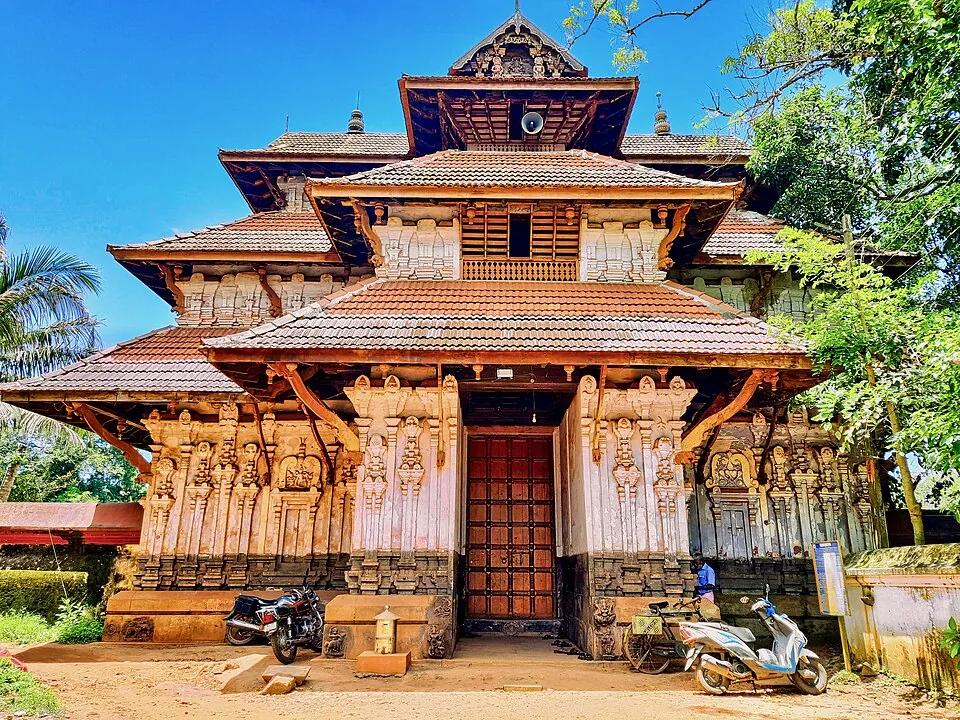
There is a moment in the sacred literature of the Tamil Shaiva saints that has made grown pilgrims weep for a thousand years — and it is said to have happened at a temple in Kerala. At Thiruvanchikulam Mahadeva Temple in Kodungallur, a poet was called to heaven, and his closest friend, a king, refused to be left behind. To understand that scene you first have to know how singular this temple is.
The only one of its kind in Kerala
Thiruvanchikulam enshrines Shiva as Mahadeva with his consort Parvati as Uma — the divine family together. What makes it extraordinary is its place in the Tamil canon: it is a Paadal Petra Sthalam, one of the 276 temples sung in the Tevaram, the hymns of the Nayanmar saints from the sixth to ninth centuries — and it is the only temple in all of Kerala on that revered list. Every other one of those 276 shrines lies to the east, in the Tamil country; this single Malayali temple stands among them because of the two saints whose story ends here.
The saint-king of Kerala
The temple stood at the heart of Mahodayapuram — Makotai — the capital of the Chera Perumals, whose kingdom once ruled much of Kerala; the great fortified city with its palaces and pathways is said to have been built around this very shrine, at what is now Kodungallur. One of those Chera kings became something rarer than an emperor: a saint. He is remembered as Cheraman Perumal Nayanar, counted among the sixty-three Nayanmars, the canonised devotees of Shiva — a crowned ruler who was also a poet of pure devotion.
The white elephant and the galloping horse
His dearest friend was Sundaramurti Nayanar — Sundarar — one of the four greatest of all the Shaiva saints. As the Periyapuranam tells it, when Sundarar’s time on earth was done, Shiva sent a white elephant from Kailasa to carry him home to heaven. Cheraman Perumal, at Thiruvanchikulam, saw his friend rising into the sky — and could not bear the parting. He leapt onto his horse, whispered a sacred hymn into its ear, and spurred it upward after the elephant, riding into the heavens to join Sundarar on the road to Kailasa. The two of them, poet and king, are believed to have spent their last days here and ascended from this place together. It is one of the most beloved images in the whole of Tamil Shaiva devotion — and it belongs to Kerala.
Standing where the road went up
Kodungallur is a town thick with the beginnings of things — India’s first mosque, one of its earliest churches, an ancient goddess temple, the old Chera capital — all within a few miles. Thiruvanchikulam is its quiet Shaiva heart, less famous than its neighbours but, for anyone who knows the story, almost unbearably moving: the exact patch of Kerala earth from which a king is said to have ridden his horse into the sky rather than lose his friend.
Visiting Thiruvanchikulam
The temple stands at Kodungallur in Thrissur district, easily combined with the town’s other great sites — the Bhagavathy temple, the Cheraman Juma Masjid and the Muziris heritage trail. Details are on the Thiruvanchikulam place page; more of the district is on the Thrissur hub.
Frequently asked questions
Why is Thiruvanchikulam temple important?
It is the only temple in Kerala counted among the 276 Paadal Petra Sthalams — the Shiva temples sung in the Tevaram hymns of the Tamil Nayanmar saints. It enshrines Shiva as Mahadeva with Parvati as Uma, and stood at the heart of the old Chera capital, Mahodayapuram, at present-day Kodungallur.
What is the legend of Cheraman Perumal at Thiruvanchikulam?
Cheraman Perumal Nayanar, a Chera saint-king, was the close friend of the saint-poet Sundaramurti Nayanar. When a white elephant from Kailasa came to carry Sundarar to heaven, Cheraman is said to have leapt on his horse and ridden up into the sky after him, so that the two ascended to Kailasa together from this temple.
Was Kodungallur the Chera capital?
Yes — Kodungallur is identified with Mahodayapuram (Makotai), the capital of the Chera Perumals of Kerala, which was built around the Thiruvanchikulam temple and protected by high fortifications.