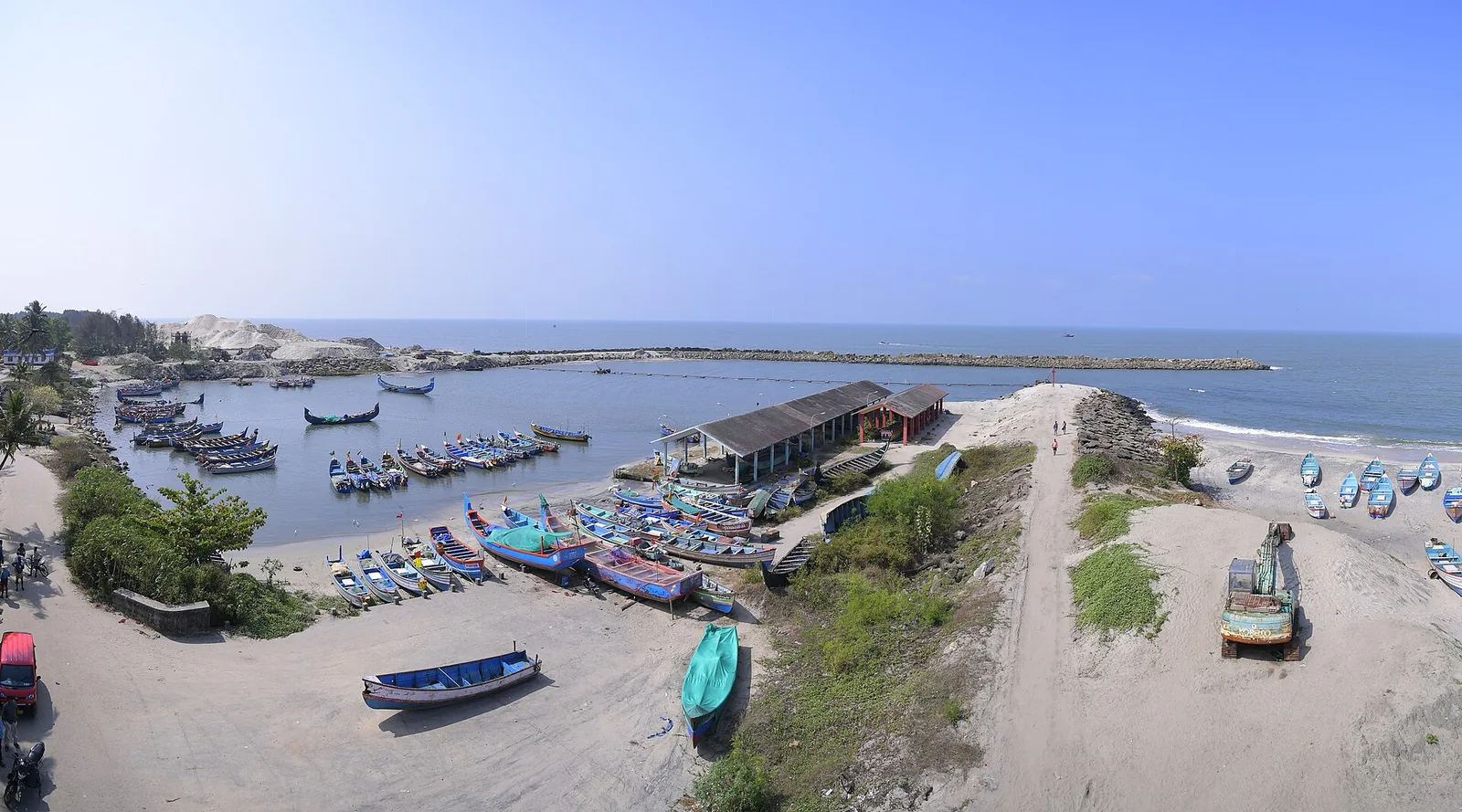
Stand above Thottappally harbour and you see two things in one frame: a fishing fleet, and heaps of very dark sand with an excavator working them.
What is being moved, and why
The dredging is flood-control work. The Irrigation Department’s current programme removes obstructions over roughly 500 metres downstream of the spillway near the pozhi mouth, and it assesses the removable sand at 249,121.5 cubic metres across 179,700 square metres.
That is a precisely stated quantity, which is itself worth noticing — this is not a rough clearance, it is a measured extraction.
Where it goes
The removed sand is transported to the KMML unit at Chavara.
KMML is the Kerala Minerals and Metals Limited plant, and the black sand of this coast is titanium-bearing mineral sand. What is being dredged out of the flood channel is not spoil to be dumped somewhere convenient. It is industrial feedstock with a market, and it is going to a state-owned processor down the coast.
Why that makes everything harder
Here is the knot, and it is the reason Thottappally is genuinely interesting rather than merely a piece of infrastructure.
In most places, dredging a channel and mining a mineral are separate activities with separate justifications, separate permissions and separate opponents. At Thottappally they are the same operation. The identical bucket of sand is simultaneously an obstruction that must be removed to stop villages flooding, and a valuable raw material being extracted from a coastline.
That means any argument about one is automatically an argument about the other. Advocate for more dredging and you are advocating for more extraction. Object to extraction and you are objecting to flood works. There is no position available here that is only about one of them.
Sand mining on the Kerala coast is a live and contested political subject, and we are deliberately not going further than the department’s own published figures and wording. We are not in a position to adjudicate it from a travel page, and we would distrust anyone who claimed to be.
What we would say is this: if you visit and see the excavators, you now know that you are not looking at simple maintenance, and you are not looking at simple mining either. You are looking at the place where those two things are the same act — which is why nothing about it gets resolved quickly.
Frequently asked questions
Why is the sand at Thottappally dark?
Because it is mineral sand — titanium-bearing black sand, which occurs along this stretch of the Kerala coast and is the raw material for the state-owned KMML plant at Chavara.
How much sand is being removed?
The Kerala Irrigation Department assesses the removable sand at 249,121.5 cubic metres across 179,700 square metres, over roughly 500 m downstream of the spillway near the pozhi mouth.
Is the dredging flood control or mining?
Both, and that is the difficulty. Clearing the channel is necessary flood work; the material removed is valuable mineral feedstock and goes to KMML at Chavara. At Thottappally the two are physically the same operation, so arguments about one are unavoidably arguments about the other.