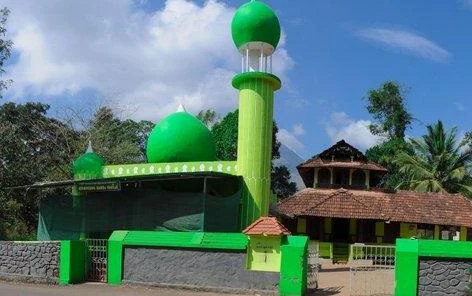
The wider photograph is the useful one for finding Varambetta. A dome and minaret rise on the left; a lower tiled building occupies the right. A roadside boundary holds the two within one setting. Someone familiar only with the tiled façade may overlook the larger prayer building, while someone searching only for a dome may miss the shrine that gives so many photographs their subject.
Keep the compound and the shrine distinct
Varambetta Mosque is used as the destination name for the mosque-and-maqaam complex. Makham and maqaam are also used when referring to its shrine component. These names overlap in everyday directions, but the distinction is useful in a visit: the whole compound is not one room, and reaching its entrance does not establish access to every interior.
The tiled structure is recognisable through its layered roof. Broad eaves extend beyond the painted walls; a smaller upper section repeats the roof form above. Dark timber openings sit beneath the tiles. The building’s outline spreads horizontally, so the shadow under the eaves is as noticeable as any feature placed on top.
The adjoining mosque makes a different silhouette. Its dome and tall minaret draw the eye upwards beside the lower tiled roof of the maqaam. Seen together, the buildings give the compound both a vertical landmark and a more sheltered, horizontal form. That pairing is useful to recognise at the approach before asking which spaces are available to visitors.
Read the entrance before moving closer
In a closer exterior view, a low gate and the porch organise the approach to the tiled building. The porch is a threshold between public arrival and religious use. People may be seated within it, and the central door may be in use. It should not be treated as an empty architectural display simply because the roof is the feature a visitor came to see.
The visible finish has changed between published photographs. Green walls, lighter wall areas and darker timber remain part of the visual record, but paint colour is a weak way to establish the date of a structure. Follow the roof arrangement, openings and relationship with the neighbouring mosque when comparing views. Those features provide a more coherent identification.
The locality name needs the shrine name
The Kerala Tourism destination account places the mosque in Wayanad’s visitor circuit. Padinjarathara and Varambetta are the useful names for the final journey; Kalpetta is the wider travel base. Varambetta also labels a school and appears in descriptions of Banasura-side forest activities. Neither is a substitute address for the religious complex.
For a driver, “Varambetta Mosque and Maqaam near Padinjarathara” is more informative than the locality alone. On arrival, the paired rooflines help confirm the setting. The final visitor route should then follow the caretaker’s guidance, particularly if prayers or a gathering are under way.
A good exterior visit does not require every door to be open. The low tiled shrine and the taller domed building already explain something specific about this place: different architectural forms sit beside one another within a shared religious compound. Keeping both in view gives Varambetta a clearer identity than a detached close-up of either one.
Plan the visit: Varambetta Mosque and Maqaam.