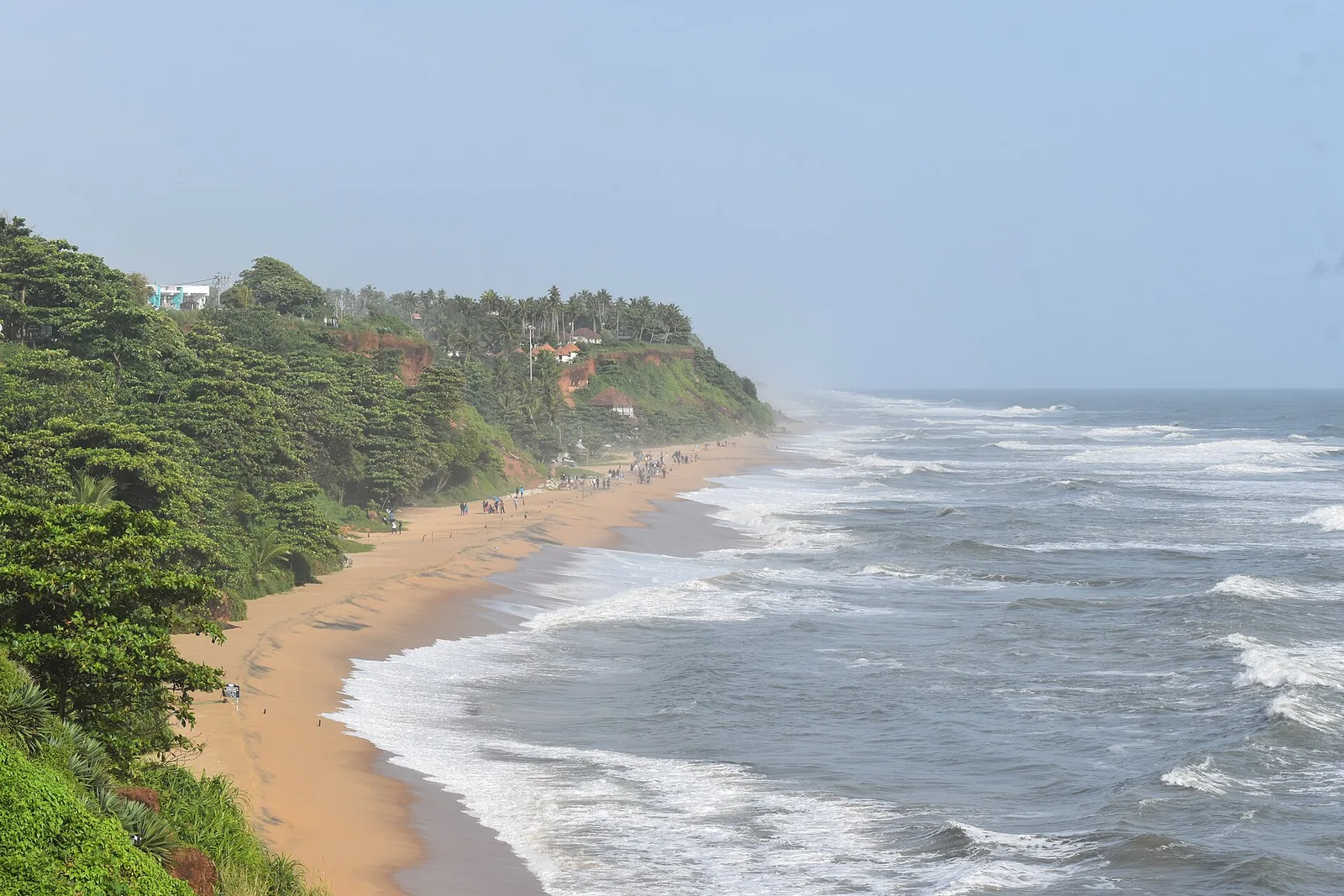
At Varkala Cliff, water can emerge from the rock only a short distance from the Arabian Sea. Kerala Tourism describes the springs and the belief that they have medicinal qualities. The geological explanation tells a different part of the story: why fresh water appears in a sea cliff at all.
A layer you can almost follow with your eye
A published model of Varkala’s coastal cliffs describes sandstone above less permeable carbonaceous clay. Groundwater moves through the sandstone and emerges where that contact reaches the exposed cliff face. The spring is the outlet of an aquifer, not proof that sea water has somehow become fresh at the beach.
The same study treats spring seepage as part of a cliff-recession mechanism alongside wave action. Water is therefore both a valued feature and a force relevant to slope stability. The earlier simple picture of a protective laterite “lid” and a guaranteed water supply missed that double role.
Belief and water testing answer different questions
Visitors have long associated the springs with healing, and that tradition belongs to the place. It is not a laboratory finding. A national earth-science centre report discusses spring-water quality and drinking-water potential as research questions. It does not make every outlet safe to drink today.
Look at the layers and seepage from a public path, without climbing an unstable cliff face. Do not assume that clear-looking spring water is potable or medically effective; water quality varies by outlet and time and needs current testing. The geology is striking enough without turning the spring into an unverified treatment.
Follow the water back from the outlet
A spring at the cliff face is the visible end of a hidden journey. Rain falling inland enters permeable ground and moves through the sandstone until a less permeable layer redirects it toward an opening. The coast cuts through those layers, making the outlet visible. This is why the spring is both a visitor curiosity and a window into the Warkalli Formation described in the geological monument story.
The same route through rock helps explain why water quality cannot be judged from a clear stream. Conditions in the catchment, the season and the particular outlet can differ. Nor does mineral content by itself prove a health benefit. The traditional healing account and a tested drinking-water claim answer different questions.
The spring gives Varkala an unusual meeting of geology and belief. Watch it from a safe public approach, then look at the layers around it. That view tells a richer story than collecting an untested bottle or repeating a medicinal promise.
Frequently asked questions
Why does water come out of the Varkala cliff?
Groundwater moving through sandstone meets a less permeable clay layer and emerges where the contact is exposed on the cliff face.
Are the springs medicinal?
Kerala Tourism describes a traditional belief in medicinal qualities. The cited research does not establish a medical treatment claim for the springs.
Can I drink the water?
Do not infer potability from appearance or tradition. A specific outlet needs current water-quality testing before it can be treated as drinking water.