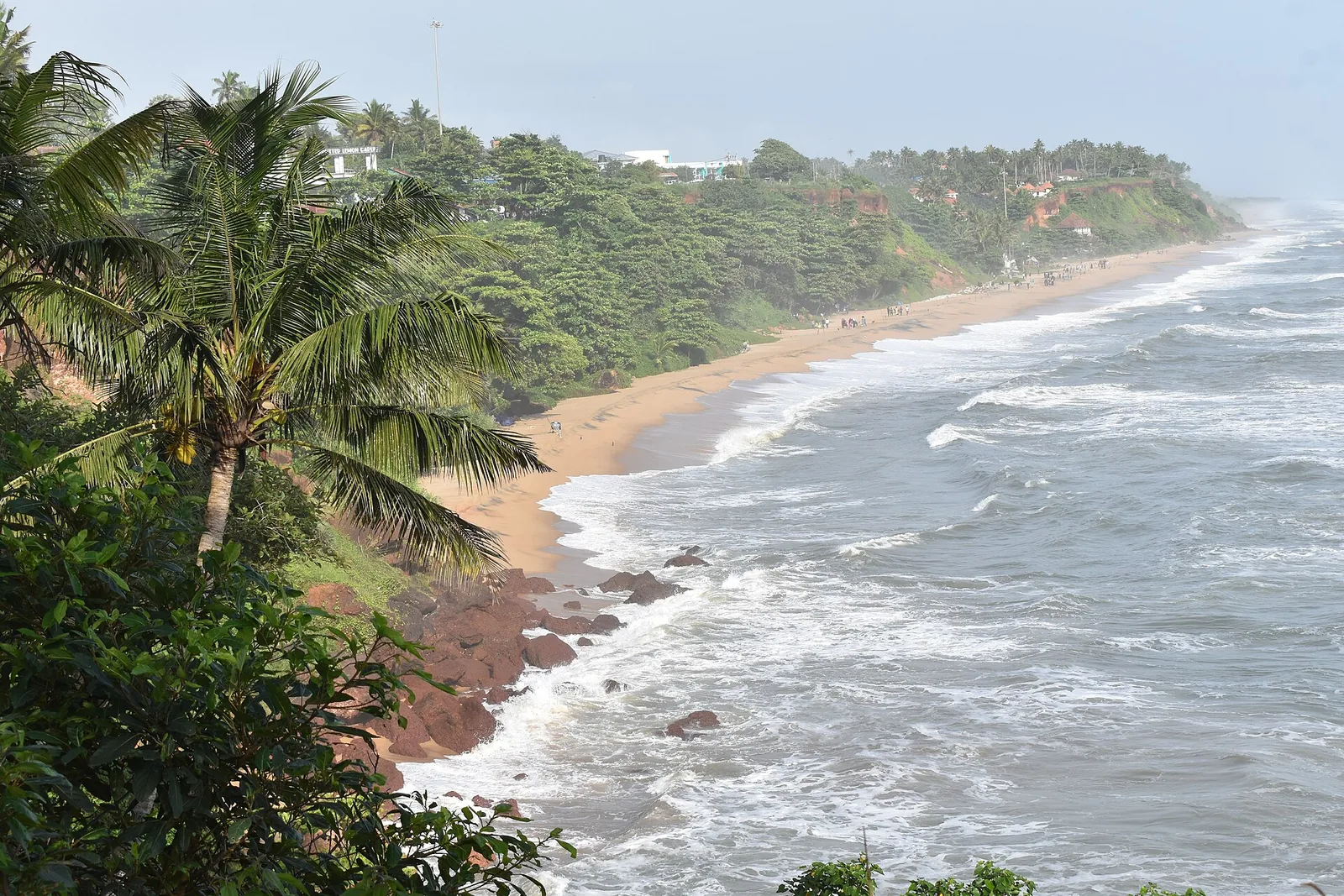
From the path above Varkala Cliff, the red edge and the Arabian Sea are enough to hold attention. Online, another claim often arrives first: “India’s first geopark.” The UNESCO record for Varkala tells a more precise story. It calls the site a National Geological Monument and records India’s 2025 submission to the World Heritage tentative list. It does not call Varkala a UNESCO Global Geopark.
The important rock is below the red lid
The red laterite cap gives the cliff its familiar colour. Below it, the Warkalli Formation exposes sandstone, clay and darker carbon-rich layers. The UNESCO nomination describes lignite lenses, marcasite, jarosite and microfossils in the sequence. These beds are the reason the cliff matters to geologists: Varkala is the type locality, a reference place for describing that formation.
That changes what to look for from the beach. The cap is conspicuous, but the succession underneath holds the longer record of changing coastal conditions. A photograph of a sunset tends to crop out the evidence.
The first recognition
Varkala Cliff Section is identified as a National Geological Monument by the Geological Survey of India, a status also acknowledged in India’s UNESCO tentative-list submission. The name sounds technical because it is: the exposed section of the Warkalli Formation is the object of interest. This designation is not the same thing as a UNESCO Global Geopark.
The second recognition, in 2025
On 27 August 2025, India submitted “Natural Heritage of Varkala” to the World Heritage tentative list. That is a public record of a possible future nomination. It is not inscription on the World Heritage List. The submission discusses both the scientific value and the pressures of erosion and tourism development, so the document reads as an argument for care as much as an argument for recognition.
What a name can hide
Calling the cliff a geopark makes a complicated place sound settled. The two documented statuses instead direct attention to something tangible: a reference exposure that is open to weather and visitor pressure. From an open public beach access point, look back at the layered face, keep away from closed or unstable edges and follow local barriers. The better story is there in the rock, whether or not another title is ever granted.
What a designation asks people to notice
A monument label can sound like a promise that a place is fixed. Varkala’s cliff is an exposed geological section, continually affected by water and waves. Its value lies partly in the layers being visible. Protecting that value therefore means paying attention to both natural recession and changes made for roads, buildings and visitor access.
The 2024 tribunal case shows how difficult intervention decisions can become. The spring story explains one route by which water moves through the section. Neither adds a new designation; they make the existing geological one more concrete.
Look from safe public access at the sequence beneath the red cap. The cliff deserves attention for what it exposes, independent of any future World Heritage decision.
Frequently asked questions
Is Varkala a UNESCO Global Geopark?
No. The UNESCO page for Varkala is a World Heritage tentative-list entry, not a Global Geopark designation.
Is Varkala already a World Heritage Site?
No. India submitted it to the tentative list on 27 August 2025. A tentative entry is a possible step towards nomination, not inscription.
Why is Varkala Cliff a geological monument?
It exposes the Warkalli Formation, with a sequence of sandstones, clays and carbon-rich layers. UNESCO’s nomination describes Varkala as the formation’s type locality.
Is the whole cliff made of laterite?
No. Laterite caps the older sedimentary layers that are exposed below it.