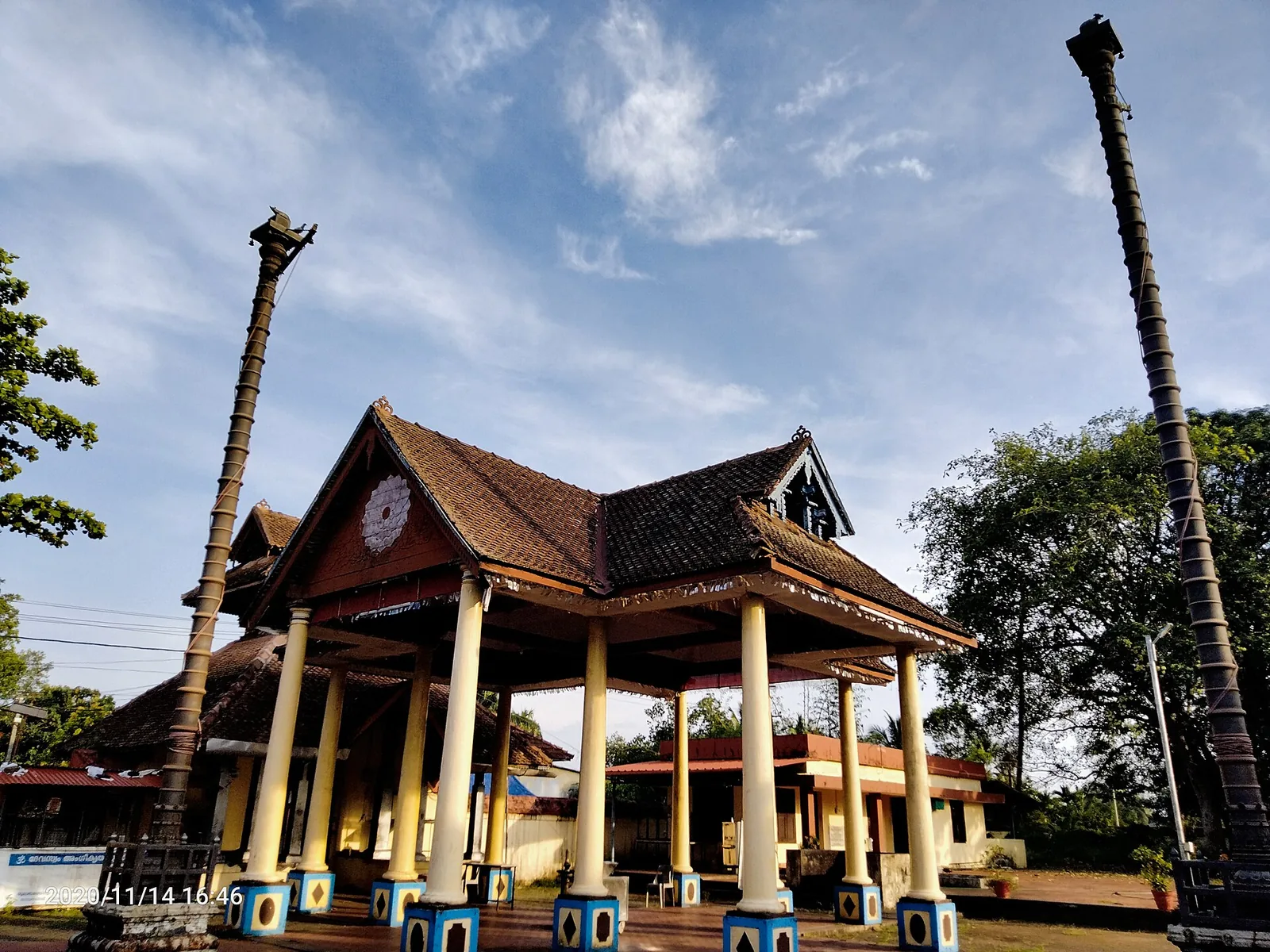
We know almost nothing, first-hand, about the kings who ruled this coast twelve hundred years ago — no diaries, no letters in their own words. Almost nothing. The single oldest royal record to survive from Kerala is a plate of copper barely bigger than a page, its five lines to a side scratched in a script most Malayalis today can no longer read — and it was issued for one temple you can still walk into, still worship in, this very afternoon: Vazhappally Maha Siva Temple near Changanassery.
A note written in metal
The Vazhappally copper plate dates to the ninth century. It was issued by the Chera king Rajasekhara Varma — whom many scholars identify with the Shaiva poet-saint Cheraman Perumal Nayanar — in his twelfth regnal year; exactly which year that maps to is still argued, some reading it around the 820s–830s CE, others as late as 882–83. In Old Malayalam, written in the looping Vattezhuthu script threaded with Grantha letters, it records something wonderfully, almost comically, ordinary: a resolution by the temple’s governing committee about land set aside to fund the daily worship, the grain it should yield across two harvests, and the fines — measured in gold dinaras — to be paid by anyone who let the rituals lapse. It is, in effect, the minutes of a temple committee meeting from the ninth century.
Why a temple memo became priceless
It is not grandeur that makes it matter — it is survival. This is, in effect, the earliest surviving sentence of administrative Malayalam, and a rare, precious window onto how an early-medieval Kerala temple was actually run: its lands and their grain (a granted yield reckoned at more than twelve thousand kilograms), its committee of managers, its rules and its penalties. Historians read it the way you would read the single surviving page of a very long book whose other pages are all gone. The original plate is preserved to this day by the Muvidathu Madham at Thiruvalla, and careful replicas are displayed at the Aksharam Museum in Kottayam, so the oldest voice in Malayalam has not been lost.
The temple the charter was written for
And the remarkable thing is that the temple is no ruin. Rebuilt by that same Rajasekhara Varma around 820 CE, Vazhappally is one of the oldest living Shiva temples in central Kerala — and one of its strangest in plan. It is among the very few temples in Kerala with two nalambalams and two flag-masts, twin shrines set together; within a single granite sanctum the Shiva linga and the goddess Parvati face opposite ways, east and west, with Dakshinamurthy and Ganapathi enshrined alongside and a sub-shrine to Sastha nearby. Its seventeenth-century woodwork carries carved scenes from the epics, and a Vattezhuthu inscription there records repairs done as recently — for a place this old — as 1665.
Still living, still keeping festival
For centuries ten Brahmin families managed its affairs; today it is under the Travancore Devaswom Board, and it still keeps its calendar of festivals — the Painkuni festival, the fierce Mudiyeduppu, Shivaratri, Vinayaka Chaturthi — on the very ground its ancient charter describes. To stand before it is to stand at the exact spot where written Malayalam and organised temple life leave their first clear footprint in history, and to realise the footprint is still warm.
Visiting Vazhappally
The temple sits near Changanassery in Kottayam district, an easy and rewarding stop on any central-Travancore itinerary. Timings and the dress code are on the Vazhappally place page; more of the district is on the Kottayam hub.
Frequently asked questions
What is the Vazhappally copper plate?
It is a 9th-century inscription on copper, issued by the Chera king Rajasekhara Varma, recording a temple committee’s resolution about land, grain yields and daily worship at the Vazhappally temple, including fines in gold dinaras for neglecting the rituals. It is regarded as the oldest surviving royal inscription from Kerala and one of the earliest records in the Old Malayalam language.
How old is Vazhappally Maha Siva Temple?
The temple was rebuilt by Rajasekhara Varma around 820 CE and is tied to his 9th-century copper-plate charter, making it one of the oldest documented and still-active Shiva temples in central Kerala.
What is unusual about the Vazhappally temple layout?
It is one of the very few temples in Kerala with two nalambalams and two flag-masts. Within a single granite sanctum the Shiva linga and the goddess Parvati face opposite directions (east and west), with Dakshinamurthy and Ganapathi enshrined alongside and a sub-shrine to Sastha.
Does the original Vazhappally copper plate still exist?
Yes. The original plate is preserved by the Muvidathu Madham at Thiruvalla, and replicas are displayed at the Aksharam Museum in Kottayam. It is written in Old Malayalam using the Vattezhuthu script with Grantha characters, a few lines on each side.