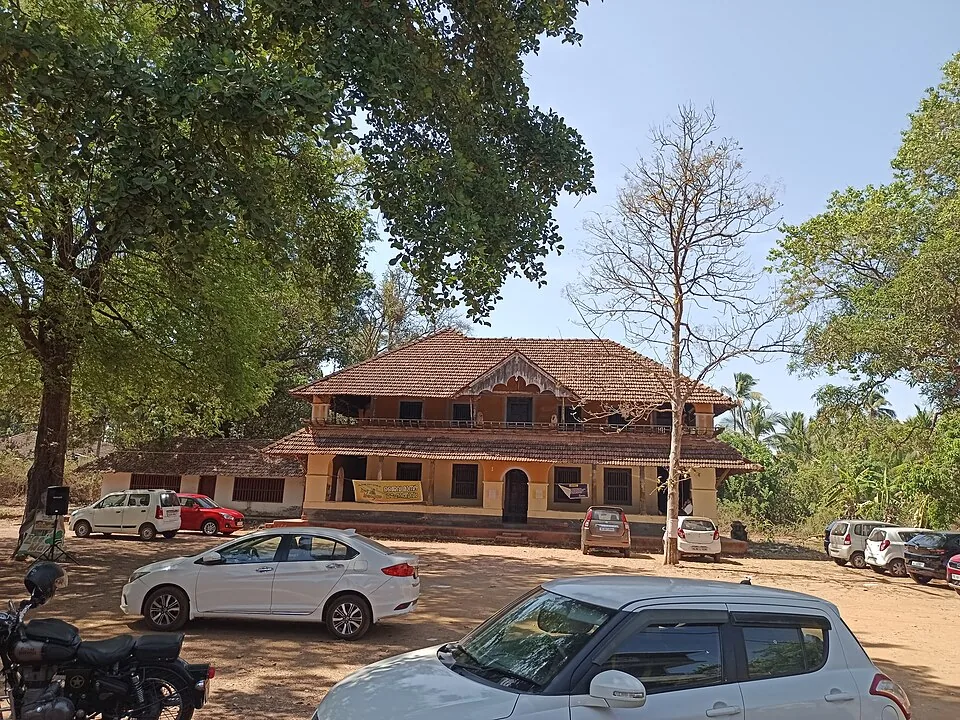
North Kerala’s medieval politics can be reduced, roughly and unfairly, to two names: Kolathunadu in the far north under the Kolathiri, and Calicut under the Zamorin. They were rivals for centuries. Nileshwar’s small ruling house is recorded as being related to both of them, and that single sentence is more interesting than anything else you will read about this town’s history.
What the sources say, with their hedges intact
The English Wikipedia article states that the Nileshwar Rajas “belonged to the clans of the Kolathiri and Zamorins” and were “relatives to both Kolathunadu as well as Zamorin of Calicut, in the early medieval period”. It also records that the Kolathiri dominion “emerged into independent 10 principalities in the late medieval period” — and it does not put a firm date on that emergence. We keep the vagueness, because it is real: the fragmentation of Kolathunadu into a set of related, semi-independent houses is well attested and badly dated.
Kerala Tourism’s official page adds that the Rajas “migrated from Kozhikode to Nileshwaram over 600 years ago”. That is travel-page arithmetic — a round number with no anchor date attached to it — and we mention it only to say that we are not going to convert “over 600 years ago” into a century and print it as history. The migration from the Zamorin’s country northward is the substance; the number is decoration.
And then the Nayaks came down the coast
Kerala Tourism also records that the Nileshwar Rajahs and the Bednore Nayaks fought in this area. That is worth pausing on, because it is the fact that explains where you are standing. Bednore — Keladi, in what is now Karnataka — was a power to the north, and Kasaragod district is precisely the ground where the Malayalam-speaking south and the Tulu- and Kannada-speaking north grind against each other. A small house here was not merely a junior branch of two southern dynasties; it was a border state, and it got treated like one.
The palace, and a straight contradiction we are not going to resolve for you
The physical remains of all this are the kovilakoms — the palace buildings. And here the record disagrees with itself in a way that matters if you are planning to visit.
Two accounts of the same building
| Source | What it says |
|---|---|
| Kerala Tourism, official destination page | The two-storeyed Nileshwaram Palace “functions as the centre of folklore for the Department of Archaeology”, which conducts research projects there. |
| A photograph filed on Wikimedia Commons, taken 4 May 2023 | Described by the photographer as the “abandoned palace building of earlier regional Kingdom … known as Nileshwar Kingdom”. |
- Treat the folklore centre as something to confirm locally on the day, not as an opening time you can plan a morning around.
- A departmental research centre is not a museum. Even when active, it may not be a place with a ticket desk and a route through it.
- Do not travel to Nileshwar for the palace alone. Travel for the town, the estuary and — in season — a Theyyam night, and treat the palace as a stop.
- If you find it open and staffed, that is worth knowing; the record on the internet plainly needs updating.
Why a border town keeps its culture
There is a pattern here worth naming. Places at the edge of two language regions, ruled by small houses related to bigger ones on both sides, tend to hold onto ritual and performance longer than the centres do — partly because identity has to be asserted rather than assumed. Kasaragod is the district where Malayalam, Tulu, Kannada, Konkani and Beary all live within an hour of each other, and Nileshwaram, described by the state’s own tourism department as the district’s onetime cultural capital, sits in the middle of it. The palace may or may not be open. The reason it was built where it was is still visible in the language you hear at the bus stand.