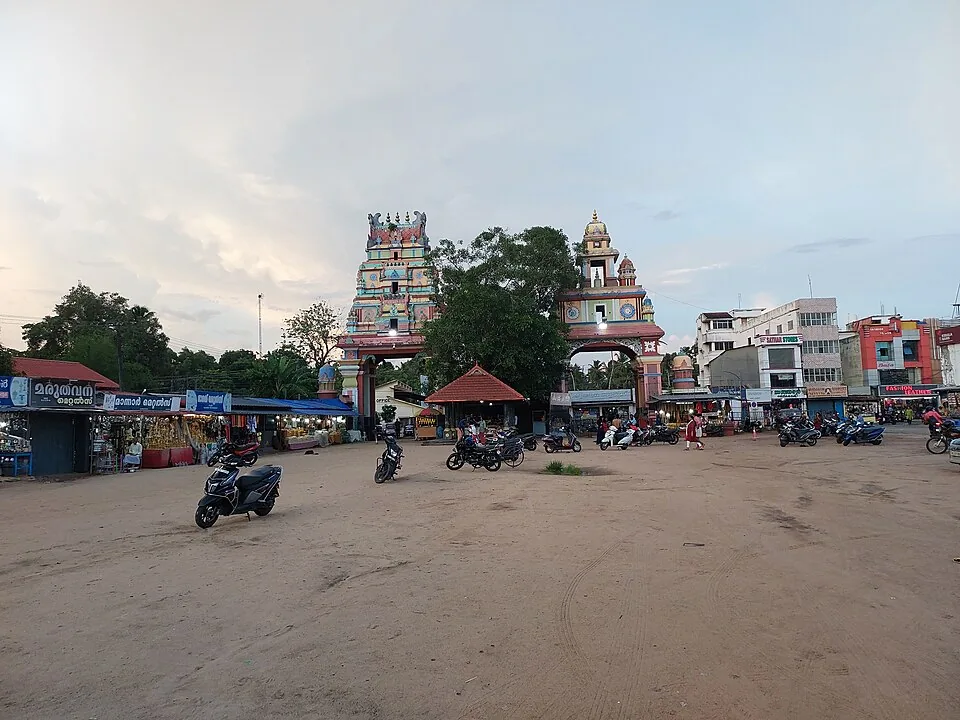
Most visitors arrive at Karunagappally with no reason to think of it as anything but a junction on NH-66. It is worth ten minutes of history, because the reason this stretch of coast holds together as a region — why Kayamkulam and Karunagappally feel related, why an inland temple twenty-five kilometres away is described as this coast’s capital shrine, why the Onattukara identity crosses a district line as if the line were not there — is a kingdom that ended in 1746 and that almost nobody outside Kerala has heard of.
What Odanad was
Odanad was a feudal state of late medieval Kerala, established in the eleventh century and dissolved in 1746, when it was absorbed into Travancore during Marthanda Varma’s northward expansion. At its dissolution it covered the present-day taluks of Mavelikkara, Karthikappally and Chengannur in Alappuzha district together with Karunagappally in Kollam. That is four taluks across two modern districts: a substantial polity, not a village chieftaincy.
It explains a good deal about a coast that otherwise looks arbitrarily drawn. Regions in Kerala are frequently older than districts, and this is one of the clearest cases: the modern boundary between Kollam and Alappuzha cuts straight through a tract that was governed as one thing for roughly seven centuries, and the people living in it have not stopped noticing.
The word that does two jobs
Here is the thing to hold carefully, because confusing it will scramble any history of this coast you read. Onattukara is one of the alternative names of Odanad the kingdom — alongside Kayamkulam, Onad, Kallikoilon and Chirava Svaroopam. It is also, and still, the name of the modern regional tract covering roughly Mavelikkara, Karthikappally, Karunagappally and their surroundings, with its own agricultural identity and its own sesame.
So a sentence saying Karunagappally “was previously known as Onattukara” is using the kingdom sense. A sentence about Onattukara sesame is using the modern regional sense. Both are correct, and they are not the same thing. A reader who meets the two without being warned will conclude that one of the sources is wrong.
- Odanad · Onattukara · Onad · Kayamkulam · Kallikoilon · Chirava Svaroopam.
- These are all used for the same state in different sources and periods. Kayamkulam is the one most readers will recognise, because the Kayamkulam rajas are the actors in the eighteenth-century wars.
- If you meet them as though they were separate kingdoms, they are not.
A note on the date, and why we are careful with it
1746 is the year given for Odanad’s absorption into Travancore, and we have found no comparable disagreement over it. We flag it anyway, for a reason specific to this coast. One taluk north, the transfer of Karappuram at Cherthala is variously dated 1753, 1755 and 1762, and the Alappuzha district administration’s own page gives no year at all. A Travancore annexation in this period is a process rather than an event, and any single year for one is best read as the date of one step in it.
Where you can still see it
Not in a building. There is no Odanad fort, palace or museum at Karunagappally. What survives is the shape of the thing: the region people still name, the sesame that carries the name, the temple at Kandiyoor near Mavelikkara described as the capital shrine of the old kingdom, and the ground at Padayanarkulangara inside this town that was the Kayamkulam rajas’ military station and is now simply a part of the market. The kingdom is gone. Its outline is still the outline people here live inside.
Frequently asked questions
What was Odanad?
A feudal state of late medieval Kerala, established in the eleventh century and dissolved in 1746 when Travancore absorbed it. At its end it covered the present-day taluks of Mavelikkara, Karthikappally and Chengannur in Alappuzha district and Karunagappally in Kollam.
Is Onattukara the same as Odanad?
It is one of the kingdom’s alternative names, and it is also still the name of the modern agricultural region covering roughly the same tract. Both usages are current, which is why the two meanings get confused.
Why is Odanad also called Kayamkulam?
Kayamkulam was its seat and the name under which its rulers appear in the eighteenth-century wars with Travancore. Odanad, Onattukara, Onad, Kayamkulam, Kallikoilon and Chirava Svaroopam all name the same polity.
Is there anything of Odanad left to see at Karunagappally?
No building. Padayanarkulangara in the town was the Kayamkulam rajas’ military station and has no fort left standing; the clearest survivals are the regional name, the Onattukara farming identity and the temple at Kandiyoor near Mavelikkara.