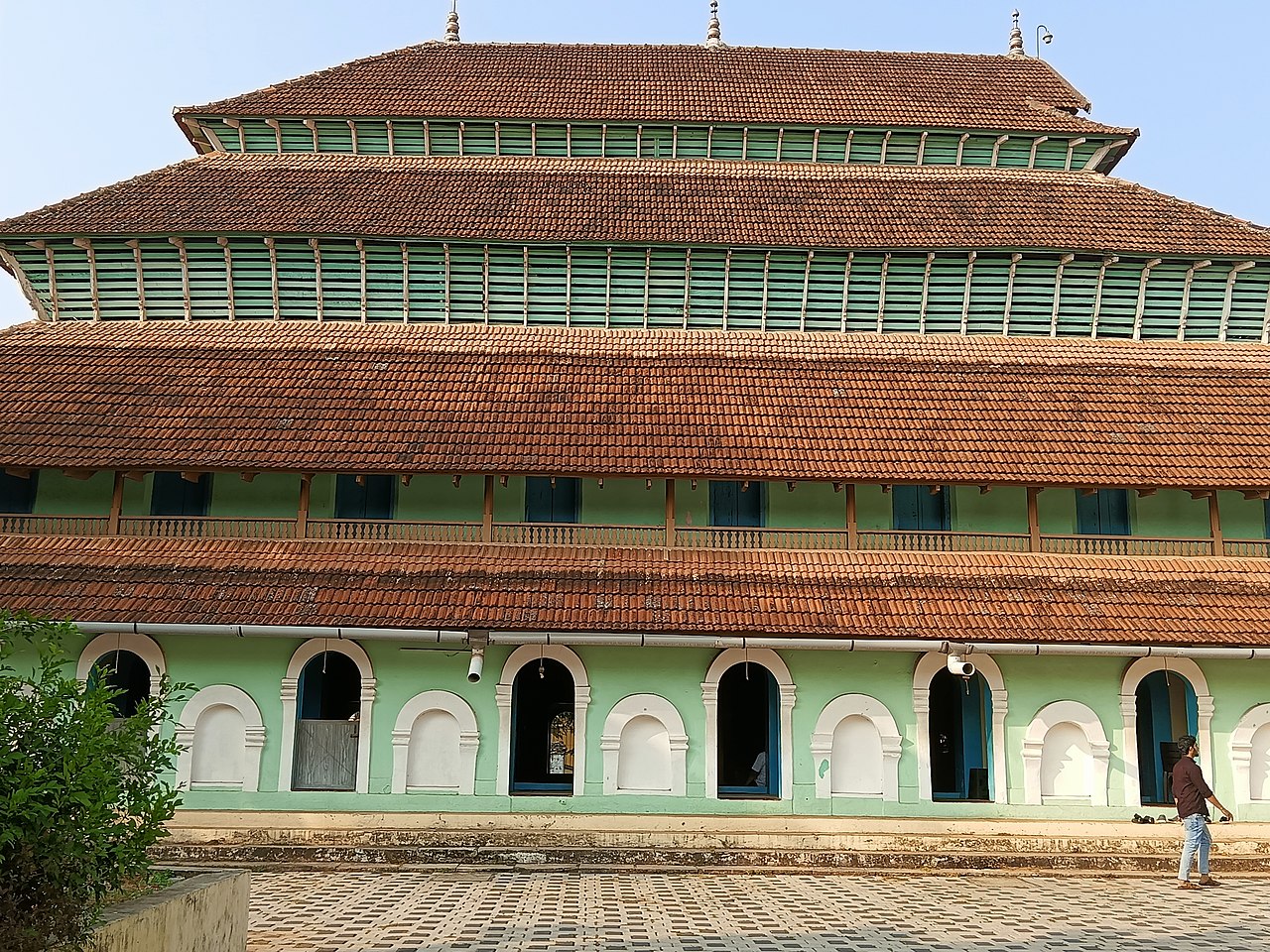
Walk into Kuttichira expecting a mosque and you will walk past this one, because it does not look like the idea of a mosque that most visitors arrive carrying. There is no dome. There is no minaret. What there is instead is a very large timber building with tiled roofs stacked one above another like a temple or a palace, and it has been standing, in one form or another, since the fourteenth century.
A shipowner’s mosque
It is named for the man who paid for it: Nakhuda Mishkal, a merchant and shipowner from Yemen who was active at Calicut in the 1340s and owned a fleet. Nakhuda is not a surname, it is a job — a ship’s master or owner — and that is the correct way to read this building. It was not built by a state or a dynasty. It was built by the shipping industry, in a port where the customs regime was famously honest and a foreign merchant could accumulate enough to put up something on this scale.
It was originally five storeys. Inside there are 47 doors and 24 carved pillars, and the prayer hall takes something like 400 people. The construction is Kerala building practice applied to an Islamic purpose — deep tiled roofs to throw off monsoon rain, timber framing, carved woodwork where another tradition would have put tile or plaster. The result is a mosque that a Kerala carpenter could have built, because a Kerala carpenter did.
January 1510
Afonso de Albuquerque attacked Calicut in January 1510. The mosque was set alight in that attack, and the upper storeys burned. The assault itself failed — the Zamorin’s Nair troops drove the Portuguese back with heavy losses, put at somewhere between 300 and 500 dead — but the building was left a ruin at the top, and it has never had its fifth storey back.
You can still see it. The fire damage on the upper levels was not erased during the repair, and it is pointed out to visitors as a matter of course. A building that carries the scorch marks of a specific week in 1510 is a rare thing anywhere.
The rebuilding, which is the part worth travelling for
The Portuguese later built a fort at Chaliyam, at the river mouth south of the city. In 1570 the Zamorin’s forces took it and demolished it completely — and the stone and timber of that fort were carried into Kozhikode and put down in the yard at Mishkal, for the rebuilding of the mosque his enemies had burnt sixty years earlier. The reconstruction is dated to 1578 or 1579.
Sit with the sequence for a moment. A Hindu king demolishes a European fort and hauls its material several kilometres to rebuild a Muslim place of worship that had been burnt by the people who built the fort. It is not a parable anyone invented afterwards; it is what the material in the walls is.
- Fourteenth century — the founding, by Nakhuda Mishkal, active in the 1340s. Firm as a period, loose as a year.
- January 1510 — the Portuguese attack under Albuquerque. Firm.
- 1570 or 1571 — the taking and demolition of the Chaliyam fort. Sources give both years; we have not found one that settles it.
- 1578/79 — the rebuilding, at four storeys instead of five. Given as a pair of years in the sources, not as one.
What else is in the same few streets
Kuttichira is not a single monument, it is a quarter, and the mosque makes far more sense inside it. The Muchundi mosque is close by, with its own inscription and its own age; the great tank the quarter is named for sits open in the middle of it; and around them stand the tall wooden houses of the old Muslim trading families, which are private homes and not exhibits. The whole thing is perhaps a couple of kilometres from the temple and the bazaar, so the medieval city is genuinely legible on foot in a morning.
One practical note, and it matters. This is a working mosque in a residential quarter, not a monument with a ticket office. Prayer times take priority over your visit, access for non-Muslims and for women varies and is not something a webpage should promise you, and dressing conservatively is the minimum. Ask at the door rather than walking in, and accept the answer.