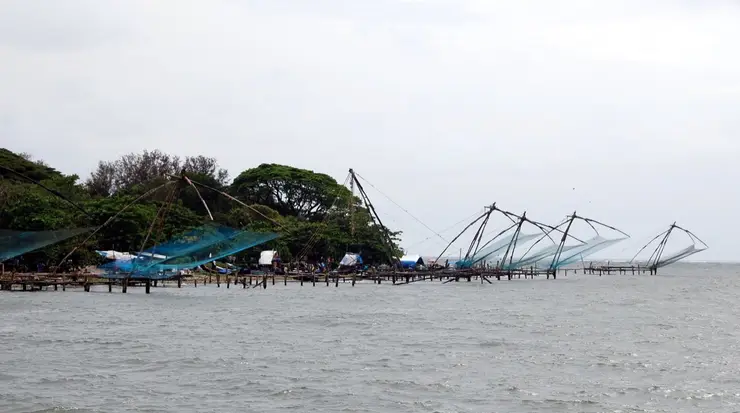
Kozhikode is the old Calicut: for roughly four centuries the pre-eminent port of the Malabar coast, capital of the Zamorins, and — on the evidence of the travellers who came here — one of the most hospitable places in the Indian Ocean to be a foreign merchant. It had no harbour worth the name and very little manufacturing of its own. What it had was an arrangement: a Hindu king who handed the running of his port to a Muslim merchant-official, a customs rate of one-fortieth charged only on sales, and a reputation that brought Arab dhows, Chinese treasure fleets and finally the Portuguese to the same open roadstead. This page is about that arrangement and what it left behind — an English word for cotton cloth, a timber river, a court full of poets, and a modern city that in 2023 became India’s first UNESCO City of Literature.
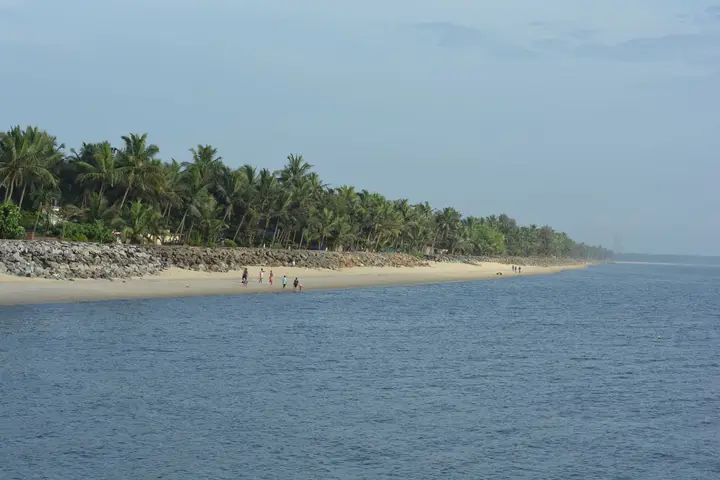
Begin with the thing the city did not have. Calicut had no natural harbour, no sheltered basin, no river mouth deep enough to take an ocean ship. Vessels lay off in the open roadstead and everything was ferried ashore through the surf by boat. Every other great port of the medieval Indian Ocean had some accident of geography working for it. Calicut had almost none, and it still became, in the words printed across Braun and Hogenberg’s 1572 panorama of the place, Calechut celeberrimum Indiae emporium — Calicut, the most celebrated emporium of India. If the geography did not do it, something else did, and that something is the subject of this page.
The dynasty came from inland. The Eradis of Nediyiruppu, in Eranad, were chiefs under the Cheras with no coast of their own; the Malayalam accounts, following the Kozhikode historian K. Balakrishna Kurup, say plainly that they went to war with the Porlathiri of Polanad in order to carry on sea trade directly rather than through somebody else. Having taken Polanad they built a fort and a great residence — a koyil — at a place called Velapuram, and moved their seat from Nediyiruppu to the new Koyilkotta. Koyil inside kotta, palace inside fort: that compound is the most widely accepted origin of the name Kozhikode. The kings themselves came to be known as Swami Thirumulpad, which contracted to Samoothiri, which Europeans heard as Zamorin. Timing helped as much as war did. Around 1341 a flood on the Periyar wrecked the old Chera port at Kodungallur, and the trade that had used it dispersed to smaller harbours up and down the coast. Arab and Middle Eastern merchants who had been working Chaliyam and Beypore moved their business to the Zamorin’s town. Historians place the rise of Calicut — both the port and the state — after the thirteenth century, and from then until the Portuguese arrived it held the first position on this coast outright, with Kollam, Kochi and Kannur as important but secondary ports.
The institution that made it work has an unglamorous name and deserves to be better known. Trade at the port of Calicut was run not by the king but by the Shahbandar Koya, a Muslim merchant serving as port commissioner — the second most important official in most Asian polities of the period, and certainly the second most important in this one. He supervised customs on the king’s behalf, fixed the prices of commodities, collected the treasury’s share, and as farmer of the customs took brokerage and poll tax as well. He was given the privileges and dignities of a Nair chief and jurisdiction over all the Muslims living in the bazaar of Calicut. Tradition holds that the first of them was a merchant from Muscat. A Hindu king had subcontracted his own revenue engine to a foreign trader’s community, and kept doing it for centuries.
What that bought is recorded in a number. Abdur Razzaq, envoy of the Timurid ruler Shah Rukh, was at Calicut from November 1442 to April 1443, and his verdict on the customs regime is worth quoting exactly: “As for duties, at one-fortieth, and that too, only on sales, they are even lower than at Hormuz.” One-fortieth is two and a half per cent, charged on what you actually sold rather than on what you brought — undercutting the Persian Gulf’s great entrepôt in a document written by a Persian envoy. That is the merchant law the city’s reputation rests on. Historians are also clear about what it was not: the Zamorin never ran a developed mercantilist state, and left the trade itself in the hands of Middle Eastern and Kerala Muslims.
The Chinese came for the same reasons. Marco Polo, at Calicut in 1293 or 1294, recorded that the Kerala trade was dominated by the Chinese; to Chinese writers the place was Kalifo or Quli, and the Zamorin was Shamitihsi. Then came the Ming treasure fleets. Calicut was a major objective of the very first expedition of 1405–1407, whose ships are thought to have lain here from December 1406 to April 1407, and it was visited by all seven. In the fifth year of the Yongle emperor — 1407 — the court ordered Zheng He to deliver a statement of formal investiture to the king of Calicut, and, by the account of members of his entourage, he erected a tablet with a pavilion over it bearing the words: “Though the journey from this country to the Middle Kingdom is more than a hundred thousand li, yet people are very similar, happy, and prosperous, with identical customs.” The investiture itself was carried out on the second expedition of 1408–09, on a stay thought to have run from about December 1408 to April 1409, on a Zamorin whose name the Chinese record as Mana Piehchialaman. Calicut sent tribute embassies of its own to Nanking and Peking in 1421, 1423 and 1433. Nothing of the tablet survives here; a modern replica of the Calicut stele stands in the Stele Pavilion of the Treasure Boat Shipyard at Nanjing, which is a long way to go to see a copy of something that was once outside your own front door.
The city’s other export to the world was a word. Calico — the plain, unbleached cotton cloth that went out of this port in quantity — carries the city’s European name, and has been in British usage since 1505, seven years after da Gama. The cloth itself was old: the polymath Hemachandra was describing printed calico with a lotus design by the twelfth century. In Europe the trade got large enough to frighten people, and from 1700 Britain passed a series of Calico Acts restricting imports of printed calicoes to protect its own weavers. It is a strange kind of monument. The Zamorins built almost nothing that has survived them, but a word coined from their capital sat in English statute law and is still in every draper’s vocabulary.
They did, however, strike coin. The Calicut mint produced the panam in gold, the taram in silver and the kasu in copper, and the official who ran it held the title Goldsmith of Manavikraman. The mint is the neatest possible index of what the port was: an independent Malabar state issuing its own money on the strength of pepper. It was destroyed in 1766, the year Hyder Ali took the city. In the settlement negotiations of 1792 the Zamorin’s hereditary territory was leased back to him together with the coin mint and the sea customs — the Company understanding perfectly well which two things had ever mattered here.
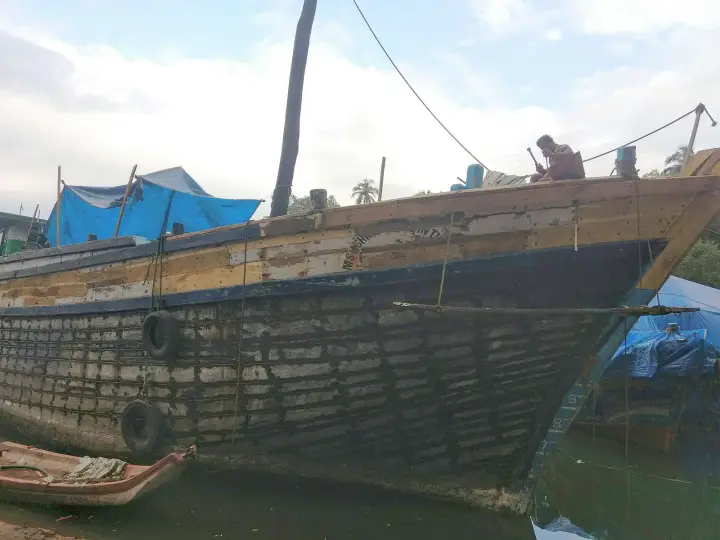
The last great trade was timber, and it came down a river. The Chaliyar rises in the Nilgiri hills, runs 169 kilometres, and in the late nineteenth and early twentieth centuries it was worked as a highway: teak and rosewood from the forests around Nilambur were made into rafts and floated down on the monsoon flood to the mills that lined the banks at Kallai, on the southern edge of the city, where a man-made canal links the Kallai river to the Chaliyar. What ended it was regulation rather than romance — through the second half of the twentieth century felling was banned or tightly controlled to stop deforestation, and the output collapsed. Many mills closed; a few still work. A separate disaster hit the same river in the same decades — the Gwalior Rayons pulp plant at Mavoor, downstream of Nilambur and upstream of here, which discharged into the Chaliyar for thirty-eight years until it closed in 2001. Our Nilambur page carries that story properly, including the agitation led from Vazhakkad by K. A. Rahman that ended it, and this page will not retell it. What this page will say is the thing the two stories invite and the sources do not support: every account we found attributes the collapse of the timber trade to felling bans and forestry control, not to the pollution. They share a river and a period and nothing else that we can demonstrate.
Which brings the city to what it is now, and to the least likely-sounding fact on this page. In 2023 Kozhikode was designated a UNESCO City of Literature — the first in India — and the citation is specific rather than sentimental: more than seventy publishing houses bringing out four to five hundred books a year, and 545 libraries. The Kerala Literature Festival, founded in 2016 and held on Kozhikode Beach each January, drew an audience given as five hundred thousand across four days in 2025; the Beypore festival runs forty days in honour of Vaikom Muhammad Basheer; the Abussabah Library keeps a well-stocked section in Braille. The city had also, on 7 June 2012, been given the state designation Shilpa Nagaram, city of sculptures, which explains a good deal of what you will pass on the pavements.
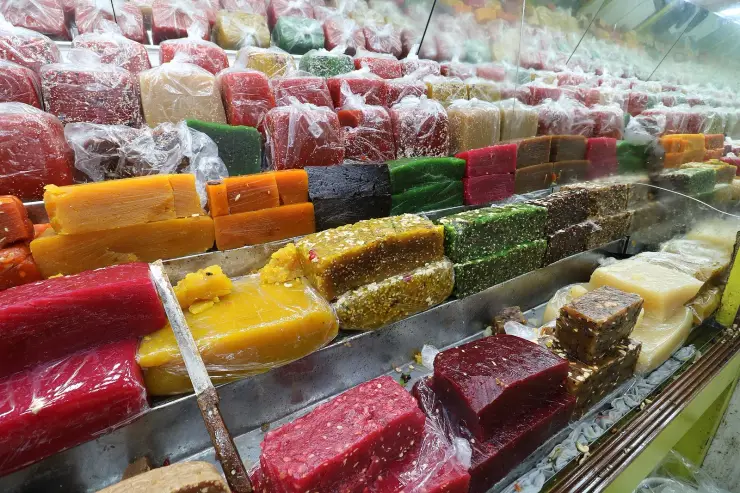
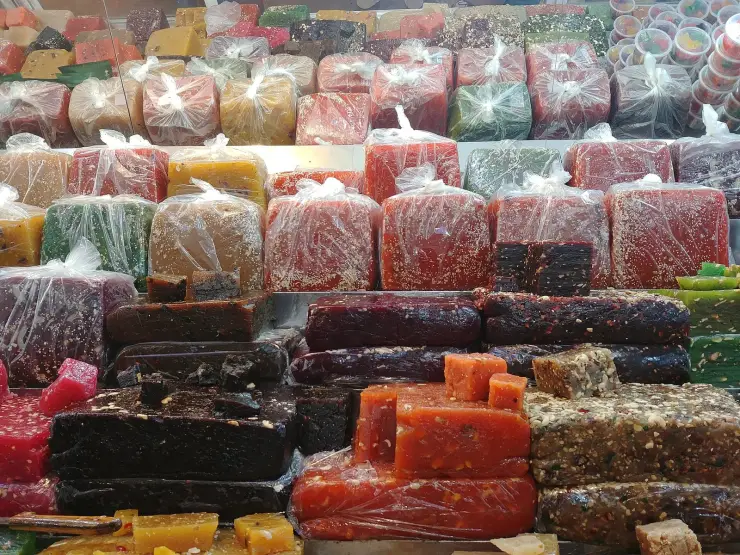
The food is the part visitors meet first, and it is the same history arriving on a plate. The Malabar biryani made here is a distinct thing from its Hyderabadi cousin — short-grained khaima or jeerakasala rice, fried onion and cashew, the rice and meat cooked separately and layered — and it belongs to the same Arab-Malabar kitchen that produced the sulaimani that ends the meal. Mussels, kallummakkaya, are a genuine local speciality rather than a menu decoration. The best-known address is Paragon, but the Kuttichira kitchens and the small tea shops are where the Mappila repertoire actually lives. The sweets belong to another street and another page.
Legend & myth
The city has a founding legend, it is in the Malayalam sources rather than the English ones, and it does something unexpected. There is a belief in Kozhikode that the prosperity of the place is owed to the Arabs, and a legend circulates that gives that belief a shape. A man called Ouvvaayi — described in the Malayalam Wikipedia article as a Jonakan, that is, a Muslim — performed penance, and the goddess Mahalakshmi appeared before him. She told him that she had blessings to give in other places too and could not stay here permanently. Ouvvaayi answered that he would return at once and that she must not leave until she had seen him again; and then he went off to another place and killed himself. Having given her word that she would not go until she had seen Ouvvaayi, Mahalakshmi has stayed in Kozhikode ever since, waiting for a man who can never come.
It is worth being clear about what that story is for. Lakshmi is the goddess of wealth, and the legend is an explanation of why wealth settled on this particular stretch of coast and did not move on. The device is a trap sprung by a promise — the deity is held not by devotion or by a temple but by a technicality, and the man who springs it is a Muslim. A Hindu goddess is bound to a port town by the self-sacrifice of a Muslim trader. That is the same relationship the Shahbandar Koya describes in administrative language, told as a story. The same legend, the Malayalam article notes, also circulates in another form connected with the Zamorin himself, which is what usually happens to a good legend near a throne.
Now the correction that touches most of what is written about this city, including our own pages. The title Samoothiri is very widely explained as samudra-thiri, lord of the sea, which is a magnificent thing to call a king whose fortune came off the water. Modern scholarship does not support it. The derivation is from Sanskrit svami and sri, which in combined form becomes tiri — the reading set out by J. A. Thorne in his appendix on royal titles in Malabar for Dames’s edition of The Book of Duarte Barbosa, and glossed by the Calicut court historian K. V. Krishna Iyer as “emperor”, with the full title given as Svami Tiri Tirumulapad, august emperor. The Malayalam sources arrive at the same place by a slightly different road: Swami Thirumulpad, contracted to Samoothiri. We should say honestly that the sea reading has not been abandoned by everyone — the Malayalam Wikipedia still lists samudra adheesan as a competing theory — but the two-theory position is the honest one, and “lord of the sea” stated flatly is not.
The city’s own name has the same problem twice over. The usual derivation is koyil plus kotta, the fortified palace, and it fits the recorded history of the move from Nediyiruppu to Velapuram. A rival reading breaks it as ko, fort, azhi, estuary, and kodu, land. And then there is the European name, where the direction of travel is genuinely disputed. English-language sources say calico the cloth is named after Calicut the city. The Malayalam Wikipedia says the reverse: that the Arabs called the famous cotton cloth kaliko, that the place where you got kaliko became Kalikat, and that the British smoothed it into Calicut. Both cannot be right, and we have not found the evidence that settles it. What is not in doubt is that the city and the cloth share a name, and that the cloth carried it into English by 1505.
A name that did not stick is worth recording too. After Tipu Sultan’s conquest of Malabar the city was renamed Farooqabad. It did not last. What survives of the attempt is Feroke, the town just south of Kozhikode across the Chaliyar, whose name is the worn-down remnant of Farooqabad and where the remains of Tipu’s fort can still be seen — a whole imperial renaming reduced to a suburb and a railway station board.
The Zamorins themselves are routinely romanticised, and it is only fair to print the Malayalam dissent, because it is sharp. K. Balakrishna Kurup, whose book on the history of Kozhikode is subtitled myths and realities, wrote that although more than a hundred Zamorins ruled, no attempt came from their side — as the Cholas and others made — to improve agriculture, to build roads and bridges, or to organise a proper civil and criminal service; that it is a peculiarity that not even one notable temple was built as belonging to these Zamorins; that, functioning under the prompting and control of the Arabs and the Marakkars, it is not surprising they gave no attention to temple-building; and that the number of Zamorins who kept a personality of their own and won fame was extremely limited. That is one historian’s judgement rather than a settled verdict, and readers should weigh it against the court that produced the Pathinettarakavikal — the eighteen and a half poets, the half being Punam Namboothiri — under Manavikrama, who ruled from 1466 to 1478, wrote the Vikramiyam and commented on the Anargharaghavam. The dissent and the poets are both true, and a city of literature deserves to know both.
The most seductive claim we were offered about this city concerns a death. Zheng He most probably died in 1433, during or shortly after the seventh voyage, and his body is described as having been buried at sea off the Malabar coast near Calicut. That is Britannica’s position and Edward Dreyer’s. It is not the only one: a competing account has him continuing as defender of Nanjing and dying there in 1435. We are printing both because both are held by serious people, and we will not tell you that the greatest admiral of the Ming died in sight of this shore as though it were established. Note also the softer version that circulates locally — that it was one of Zheng He’s admirals who died at Calicut. We could find no source for that at all. The sourced claim is about Zheng He himself, and it is contested.
Finally, a claim about Kallai we are declining. It is very widely repeated that Kallai was among the largest timber markets in Asia, or in the world. The only place we could trace it to is an English Wikipedia article carrying a single-source warning, which says Kallai was one of the most important centres in the world for the timber business. The Kozhikode district administration’s own page is much more modest: a busy timber trade centre during the late nineteenth and early twentieth centuries, where today only a few mills remain and the view from the British-built Kallai bridge is the reason to stand there. We will say what the district says. Rankings of this kind are almost never sourced, and this one is not.
More about Kozhikode city
History
The ground here was under the Cheras until the early twelfth century — the Malayalam account gives 1122 — and in that period the great port of the coast was Kadalundi, to the south, not Kozhikode. After the Chera collapse the area passed under the Kolathiris, and then the chiefs of Eranad built it into a town. The Eradis of Nediyiruppu defeated the Porlathiri of Polanad, put up a fort at Velapuram, and moved their capital there. The traditional founding date given for the Zamorin kingdom is 1124, and a Punthurakkon Manavikrama already appears as chief of Eranad in a temple inscription of 1102.
The port’s real ascent belongs to the thirteenth century and after, helped by the ruin of Kodungallur around 1341 and by Chinese and Middle Eastern appetite for pepper. By the fourteenth century Calicut held the superior economic and political position on the Kerala coast. Ibn Battuta, on this coast in the early 1340s, supplies the first recorded use of the title zamorin. Abdur Razzaq came in 1442–43, Niccolò de’ Conti in 1444, and the Ming fleets across the whole span from 1405 to 1433.
Then the Portuguese. Vasco da Gama’s fleet reached this coast in 1498 — the landfall was off Kappad, and our Kappad page carries that story and the 1939 monument that marks it. The Zamorin sanctioned trade and assigned a small warehouse with Nairs to guard it. Pedro Álvares Cabral arrived in September 1500, exchanged rich presents, entered a treaty of friendship meant to hold as long as the sun and moon should endure, and obtained permission for a trading post. It endured about three months. The century that followed was war: a Portuguese factory and fort operated in the city between 1511 and 1525, and the Zamorin’s long naval resistance under the Kunjali Marakkars runs from about 1509 to 1560 and beyond. Those campaigns belong to our Mishkal Mosque and Iringal pages, not to this one.
The end came from inland, not from the sea. Travancore beat the Zamorin at Purakkad in 1755. Mysore had already been probing Malabar since 1732; in 1756 the Zamorin promised twelve lakh rupees he could not pay, and in 1766 Hyder Ali marched on the capital and took it. On learning that Chirakkal had fallen, the Zamorin set fire to his palace and burned himself alive inside it. The royal mint was destroyed in the same year. In 1792 the Company leased his hereditary territory back to him along with the mint and the sea customs; Malabar was transferred to the Madras Presidency on 1 July 1800; and on 15 November 1806 the agreement was executed that reduced the Zamorin to a pensioned landlord drawing the malikhana.
Under the British the city was the headquarters of Malabar district in the Madras Presidency, which is why so much of central Kozhikode is a nineteenth-century administrative town wearing a fifteenth-century street plan. The Conolly Canal was cut between 1848 and 1850 to move produce down to Kallai — our Sarovaram Bio Park page carries the canal and the murder of Conolly at the West Hill bungalow on 11 September 1855. Malabar joined the new state of Kerala in 1956 and Kozhikode district was created in the same reorganisation. The 2011 census gives the city 609,224 people within the corporation limits and an area of 118.58 square kilometres; the wider urban area is several times that.
Why visit
It is the only city in India whose name became an English word for cloth, and the only one in India that UNESCO has designated a City of Literature.
The whole medieval story is legible on foot: the tank, the temple, the bazaar street and the Kuttichira mosques sit within a couple of kilometres of one another.
The Malabar kitchen is at its best here, and the biryani, the mussels and the sulaimani are cheaper and better in the ordinary places than in the famous ones.
Kallai gives you a river that was once a timber highway and is now simply a wide, quiet stretch of water with a British bridge across it.
It is a city that has been receiving foreigners since the thirteenth century and shows no sign of finding it remarkable.
Late January puts you in the middle of the Kerala Literature Festival on the beach, which is free to attend and enormous.