What to expect
Highlights
- Wildlife or forest landscape around Sarovaram Bio Park
- Official eco-tourism activities where available
- Nature guides, birding and forest-edge stays
A 98-acre public eco-park on the Conolly Canal in central Kozhikode, the developed part of the Kottooli wetland — mature urban woodland and mangrove-fringed water, mid-renovation and partly not operating.
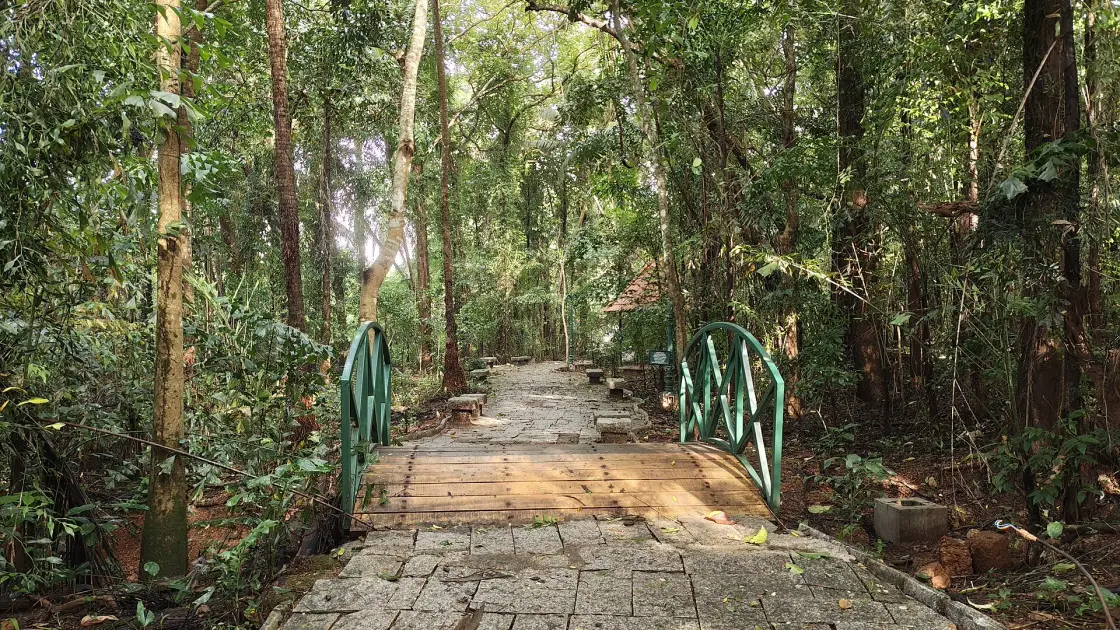
Sarovaram Bio Park is ninety-eight acres of secondary forest and mangrove-fringed water on the Conolly Canal, in the middle of Kozhikode city, between the Eranjipalam and Arayidathupalam bridges on the Mini Bypass Road. Locally it is Swapnanagari — Dream City. It is the developed public part of the much larger Kottooli wetland, the biggest surviving eco-patch inside the city limits, and in February 2026 a Division Bench of the Kerala High Court barred new construction across that wetland and ordered the Ramsar designation process completed. What a visitor finds is a mature urban woodland with laterite-slab paths, green iron footbridges and stone benches — and, as of early 2026, a boating jetty, a café and an open-air theatre that were reported not to be operating.
The name to start with is the local one. Swapnanagari means Dream City, and it is a genuine vernacular name rather than a brochure invention — Wikimedia Commons files of this park are filed under it, and Malayalam television has run explainers on where it came from. It attached to the place because the park was a component of an urban development initiative of that name: the aspiration was an eco-friendly public space carved out of a congested city.
The irony writes itself. A place called Dream City has spent most of its life being reported as not yet the dream. It opened in 2008. By May 2019 Manorama News was describing the bird area, the boating, the musical park and the pathways as on the brink of destruction, with streetlights installed years earlier simply not working; a ₹79 lakh revival followed, bringing twenty-four CCTV cameras across the ninety-eight acres, wheelchair access and accessible toilets, with the state tourism development corporation about to tender the boating back into life. In October 2024 a second and larger revival was approved at ₹2.19 crore, and by mid-2025 the minister was noting that ₹1.74 crore of it had been spent. In January 2026 a visitor recorded that the theatre, the café and the boats were still absent.
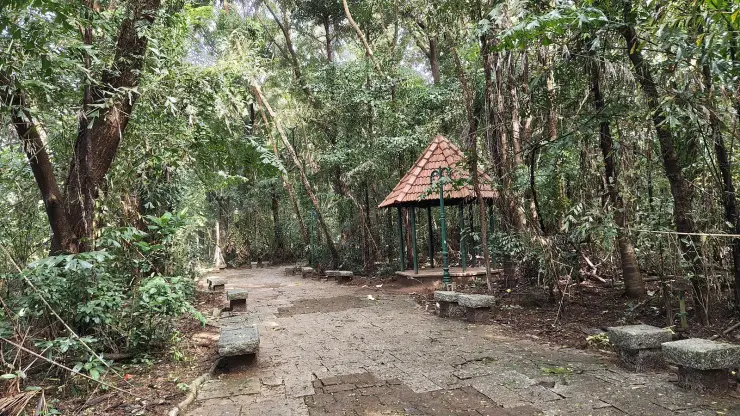
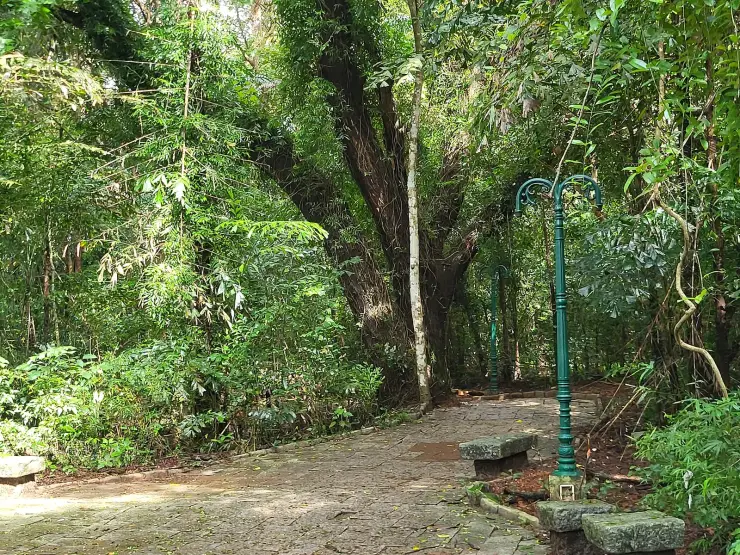
That sounds like a complaint and it is not meant as one, because the thing the neglect produced is the best reason to go. Photographs taken in July 2026 show closed-canopy forest with heavy liana growth, laterite and stone-slab walkways running through it, green cast-iron lamp standards, rough stone benches, a small tiled pyramidal-roofed pavilion, and green iron arch footbridges — one of them with a bright new timber deck laid across it. This is not a manicured municipal garden. It is a piece of city woodland that has been left alone long enough to become woodland, with paths through it.
The water is the other half. The park sits on the Conolly Canal, hand-dug between 1848 and 1850 on the orders of Henry Valentine Conolly, Collector of Malabar, to link the Korapuzha in the north to the Kallai river in the south — 11.4 kilometres, cut almost entirely without machinery. It carried coconut oil and coir down to Kallayi port and onward to Cochin for more than a century, and under the National Waterways Act of 2016 the canal north of Kottapuram became part of National Waterway 3, which is why national waterway maps now reach Kozhikode at all.
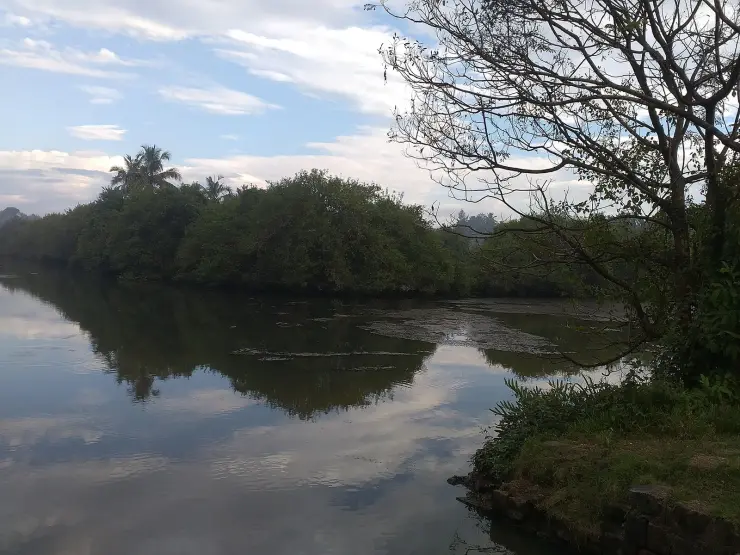
That canal is the park's ecological engine, and it is also its problem. Tidal water pushes in from the Kallai and Korapuzha estuaries, and that brackish influx is what makes mangroves possible this far inside a city. It is also, through Kozhikode, a documented sewage carrier — described in reference sources as a cess pool of drainage, untreated sewage and domestic waste, its navigation compromised by encroachment, siltation, collapsed stone lining and vegetation. Photographs of the open water here show it dark, still and opaque. The same water that sustains the mangroves is the water nobody would swim in.
There is a small, telling footnote to that. In September 2009 the Canoly Canal Development Samithi decided to start a speedboat service from Karaparamba to the park. We could find no evidence it ever ran. Boating at Sarovaram, when it has run, has been a small enclosed pedal-boat operation off a timber jetty — three or four canopied boats, tyres for fenders — not canal navigation.
And then, in February 2026, the wetland went to court and won. On 23 February a Division Bench of the Kerala High Court — Chief Justice Soumen Sen and Justice Syam Kumar V. M. — decided a writ petition brought by the Sarovaram Prakrithi Samrakshana Samiti, a citizens' body named after this place, against the Union Ministry of Environment, Forest and Climate Change among others. The petition alleged construction and reclamation in the Kottooli wetlands that would destroy the habitat and render any later protected-wetland declaration meaningless. The court barred new construction in the area designated under the Wetlands (Conservation and Management) Rules, 2017 while the process runs, directed that Ramsar designation be completed within three months, and ordered the Kozhikode Municipal Corporation to publicise the restrictions widely. Permitting construction during designation, it said, would defeat the ultimate objective of both the Rules and the Ramsar Convention.
So the plain description of this park is unusual: it is the public-facing ninety-eight acres of a legally contested wetland, and a visitor on the path is standing inside live litigation.
Almost every published description of this park gets its size wrong, and the error has a clean explanation. Kerala Tourism's own pages, the district tourism site and the aggregators downstream all say two hundred acres. The park is about ninety-eight — a figure given by the Malayalam Wikipedia and corroborated independently by the 2019 report on the CCTV rollout, which describes the cameras being installed across a ninety-eight-acre facility. Two hundred is the wetland, not the park: Kottooli wetland covers 87.04 hectares, which is 215 acres, of which 22.5 hectares has already been reclaimed for settlement. Once you know the park is the developed part of a larger wetland, the contradiction stops being a contradiction.
The same confusion runs through the ecology, and here it works against the place rather than for it. Tourism copy says the park is a habitat for thirty-four species of birds. The Malabar Natural History Society's preliminary checklist for the Kottooli wetland records 134 species, in 102 genera, 53 families and 15 orders, with the perching birds most diverse at 54 species, followed by pelicans and their relatives at 17 and waders at 14. The eBird hotspot inside the park gates lists only around two dozen, which is a measure of how many people have gone birding there rather than of what lives there, and Kerala Tourism's own second page on the site says over sixty. The honest framing is that the park is a viewing point onto a wetland with a documented checklist of 134 species, not a fenced collection of thirty-four.
A third claim is repeated with real confidence and we cannot find a source for it: that this is one of the twenty-seven wetlands of India. The sourced designation is different in both number and subject — Kottooli wetland is one of ninety-four wetlands of national importance identified by the Government of India under the National Wetland Conservation Programme in 2006–07. No list of twenty-seven containing it turned up anywhere.
And a fourth, which matters more than the others: this is not a Ramsar site. Designation was under way, and the High Court ordered in February 2026 that it be completed within three months. Whether it was granted, we do not know — we could find no reporting on the hearing that followed in May 2026. Until that is clear, the only accurate sentence is that designation was in process as of February 2026.
Two smaller points matter. The claim that the park was built on a former garbage dump is unsupported; the documented site was waterlogged former rice land with mangroves at its edges, serving as a flood receptacle and well-recharge zone. Boating, a musical fountain, open-air theatre, science centre and café still appear in travel lists, but their 2026 operating status is not established, and a January 2026 account says the theatre, café and boat rides were absent. A map marker labelled Sarovaram Boating shows where a facility existed, not whether boats are currently running.
Finally, two spellings worth getting right. The canal is the Conolly Canal — one n in the middle, two l's — after Henry Valentine Conolly; Canoli and Canoly are the common local transliterations and are used by Kerala Tourism and the district tourism body. Connolly, with a double n, is simply wrong. And beware the bare word Sarovaram: there is a private Ayurveda resort of that name on the Ashtamudi backwaters near Kollam, three hundred kilometres south, which markets lakeside cruises to Munroe Island. Nothing about it belongs on this page.
The wetland is older than the park by a long way, and it is agricultural rather than wild in origin. Kottooli was a water-logged tract under rice cultivation, with mangrove out-growths along its boundaries, and it has done three jobs for Kozhikode that nobody designed it to do: it takes the city's flood water, it recharges the wells around it, and it absorbs pollutants including city and hospital waste. It is described in the reference literature as the largest eco-patch within the city limits.
What connects it to the sea is the Conolly Canal. Henry Valentine Conolly was Collector of Malabar from 1841 until 1855, and the canal was dug between 1848 and 1850 to move Malabar's produce down to Kallayi port through the Kuttiyadi and Korapuzha systems. It runs 11.4 kilometres from the Korapuzha to the Kallai, between six and twenty metres wide, with a monsoon depth of half a metre to two metres, and it was cut essentially by hand.
Conolly himself was murdered at the Collector's residence, the West Hill bungalow in Calicut, at about nine o'clock on the evening of 11 September 1855, over his part in the exiling of Sayyid Fazal. His headstone is preserved at a church in the city. The man who ordered this canal dug was killed a few kilometres from it, seven years after it was finished. His name is also attached to the Nilambur teak plantation, and it is worth saying here what our Nilambur pages say at length: the plantation began under him, but the man who solved the germination problem and actually raised it was Chathu Menon.
The tidal exchange the canal brought is what allows mangroves to grow this far inland, and the wetland is credited with seven mangrove species and twenty-nine associated plant species. We are not going to name the seven. That count is consistent across Kerala Tourism, the reference sources and the district tourism body, but not one of them names a single species, and the Kerala government's own Kottuli wetland notification — which would settle it, along with the area and the fauna — could not be reached from this machine.
The park itself opened in 2008 and was built in phases, which is why reviews from the middle 2010s describe separate tickets for one phase or for both. Responsibility for it is genuinely layered rather than unclear: Kerala Tourism Infrastructure Ltd lists the development of the park among its completed projects; the state tourism development corporation was to tender the boating in 2019; the ₹2.19 crore renovation approved in October 2024 was executed by the Department of Tourism; and the Municipal Corporation is the local authority the High Court ordered to publicise the wetland restrictions. The safest single description is a government eco-tourism project with renovation works executed by the Kerala Department of Tourism.
Other life in the water: estuarine fish, prawns, crustaceans and molluscs, and otters — the district tourism body advertises an otter park. One widely copied reference gives the species as the Asian otter with a binomial that is a garbled form of the Eurasian otter's, and the animal most likely present in Kerala's backwaters is the smooth-coated otter. We have not resolved it and we are not going to assert live otters on a promotional line.
It is a genuine piece of forest inside a city of six hundred thousand — closed canopy, lianas, stone-slab paths — reachable on foot or by a short autorickshaw ride from the centre of Kozhikode.
It is the public part of the Kottooli wetland, whose documented bird checklist runs to 134 species, so it is a viewing point onto real wetland rather than a landscaped pond.
The Conolly Canal runs through it: 11.4 kilometres hand-dug between 1848 and 1850, now part of National Waterway 3, and the reason mangroves grow here at all.
The early morning is the local habit and the best time — the light through the canopy, and the birds, before the city is awake.
It is an unusually honest place to visit: mid-renovation, partly not working, and under a High Court order that stopped new construction across the wetland it sits in. What you see is what it is.
Road km to Kozhikode; ghat roads and traffic vary — allow extra.
Dryer months are easier for wildlife access; monsoon access depends on local rules.
Live forecast loads in your browser.
Check the official alert before you travel. Kerala’s beaches, waterfalls and trekking routes close at short notice during heavy rain, and district alert levels change day to day. We do not publish an alert level of our own — read it from the state authority: Kerala State Disaster Management Authority, or the district control room on 1077.
Sun and moon are calculated for this location and shown in IST. Photography windows are the hour around sunrise and sunset; the sunset bearing is degrees clockwise from true north. Moon phase is accurate to about half a day.
Verified hotels, homestays, restaurants, experiences, sights, shops and rentals around Sarovaram Bio Park — commission-free, with direct contact. Filter by what you need.
The Regional Science Centre near the new bus stand — galleries, a science park and 3D shows, open all seven days. The planetarium dome itself has been suspended; phone ahead rather than plan around it.
Victorian-era heritage hotel steps from Kozhikode Beach. The 1890 Malabar-club building became a hotel in the 1930s and keeps its period architecture.
Third-generation family-run hotel in central Palayam, near Calicut railway station. Established in 1958, it offers multi-cuisine dining and banquet halls.
Sweet Meat Street itself — SM Street — the bazaar spine of the city and the home of Kozhikode halwa. The name was never about meat: sweetmeat is plain old English for confectionery.
The city’s evening room rather than a swimming beach — food stalls, families, and the two ruined piers that carried the pepper trade standing out in the water.
The Zamorins’ palace tank itself — the protected water body at the centre of the square, the reason the square exists. A thing to sit beside, not a boating lake.
The temple tank beside Thali — a ritual water body in active use. Look from the edge; bathing and conduct rules are the temple’s.
The square around the Zamorins’ palace tank, the point to read the old city outward from — the bazaar east, Kuttichira south, the beach west.
The Zamorins’ Shiva temple, where the Revathi Pattathanam scholarship assembly has been held since the fourteenth century. An active temple with its own access customs; visit outside puja times.
Kerala Tourism-classified Ayurveda and panchakarma hospital at Azhiyur in Kozhikode district, with 16 treatment rooms and full-time physicians. It runs panchakarma, classical treatments and Ayurveda, yoga and marma study courses over more than two decades.
Green Leaf-accredited Ayurveda and yoga retreat set in a 170-year-old heritage homestead at Bilathikkulam in Kozhikode. It offers physician-led panchakarma, classical treatments and yoga in a family-run heritage setting rather than a hotel spa.
Five-star riverside resort of The Raviz group on the banks of the Chaliyar near Kozhikode, with an Ayurveda spa, pools and river-view rooms. It is one of the district’s flagship luxury resorts, positioned for wellness and destination stays.
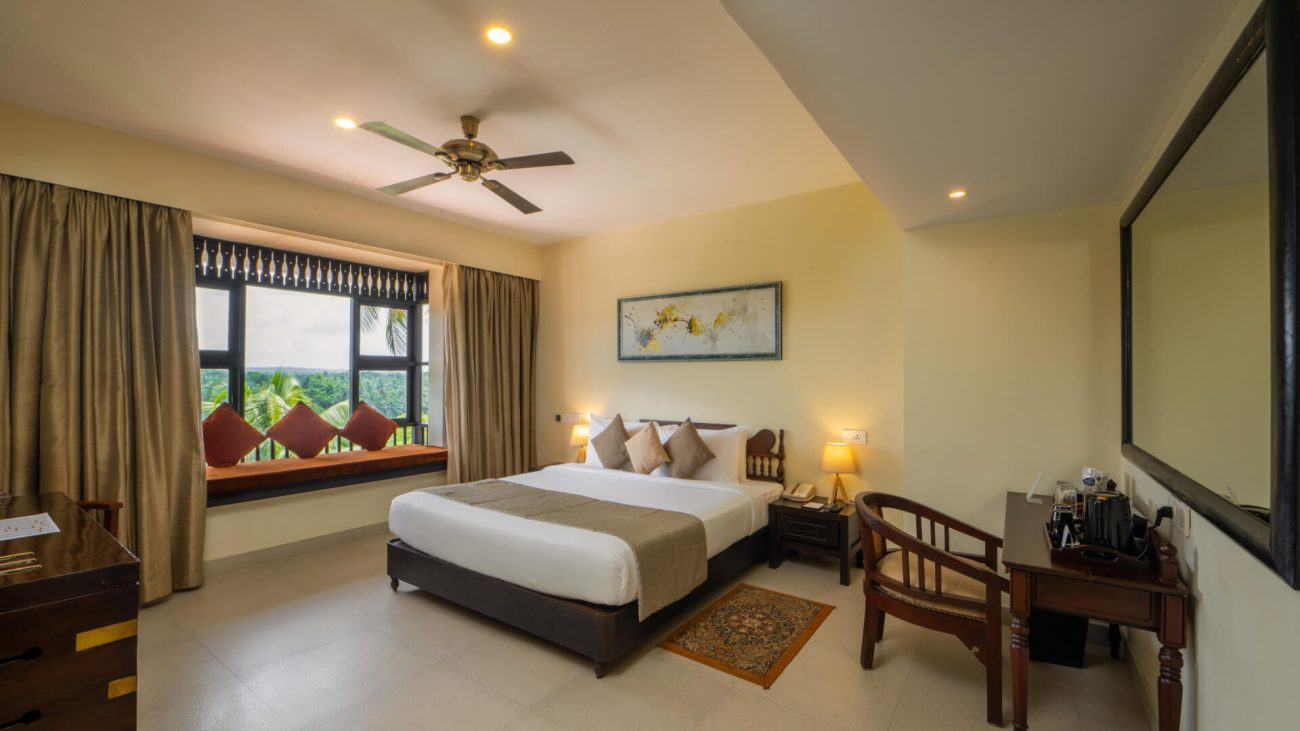
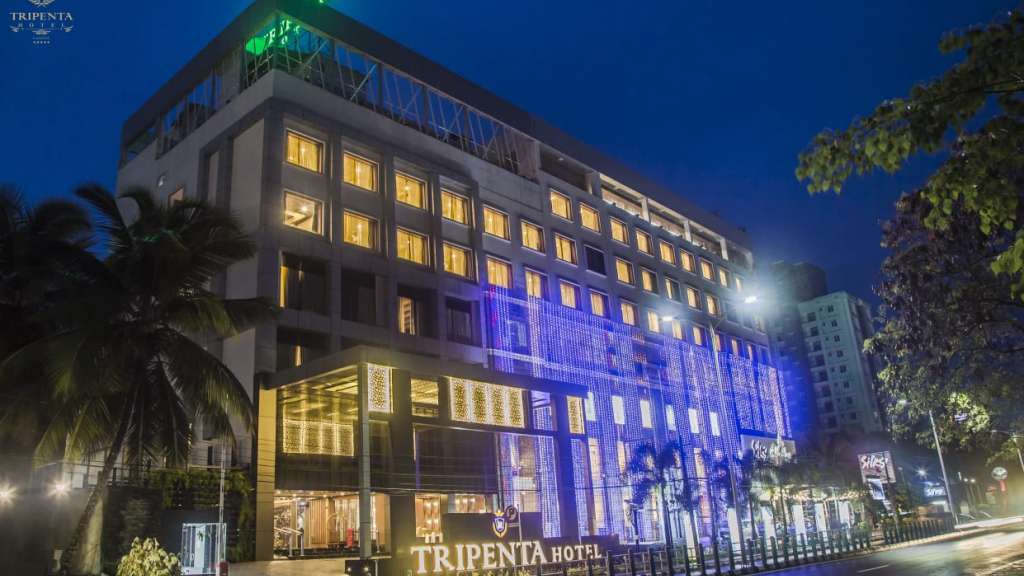
Five-star hotel opposite Sarovaram Bio Park on the Mini Bypass Road in Kozhikode, with a swimming pool, spa, health club and multi-cuisine dining. Its Kerala Tourism provider record classifies it as a five-star facility, one of the city’s top luxury business hotels.
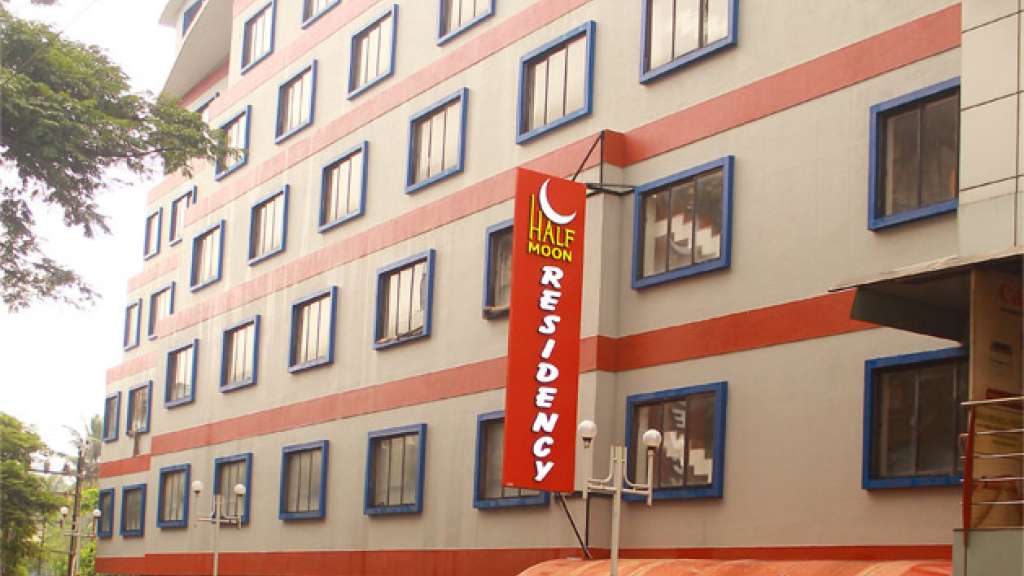
City hotel in the Markaz Complex on Mavoor Road, near the new bus stand. It offers air-conditioned rooms in several categories with an in-house restaurant.
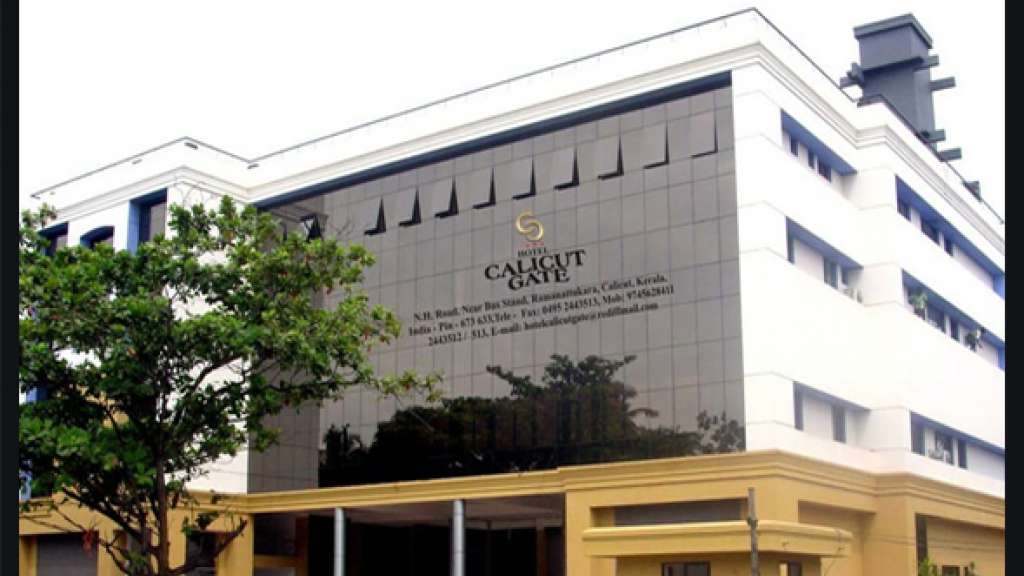
Affordable hotel on the N.H. road at Ramanattukara on the southern approach to Kozhikode, with 15 air-conditioned and non-air-conditioned rooms. Its Kerala Tourism provider record lists it as a budget-friendly option with quality service near the highway and bus stand.
Budget-class business hotel on Mavoor Road, behind Kalyan Jewellery, about 1.5 km from Kozhikode railway station. Its Kerala Tourism provider record lists air-conditioned rooms with high-speed Wi-Fi and LED TVs at affordable rates for corporate and transit travellers.
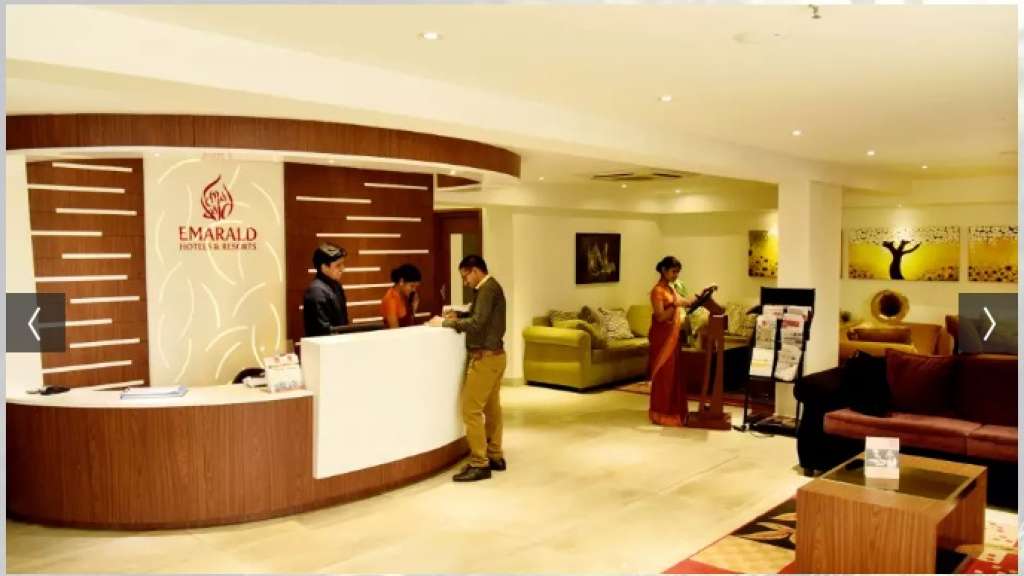
Three-star business hotel on Mavoor Road at Arayidathupalam, close to Kozhikode (Calicut) railway station, with air-conditioned rooms and a restaurant. Part of the Emarald Hotels & Resorts group, it is a convenient mid-range city base near transport.
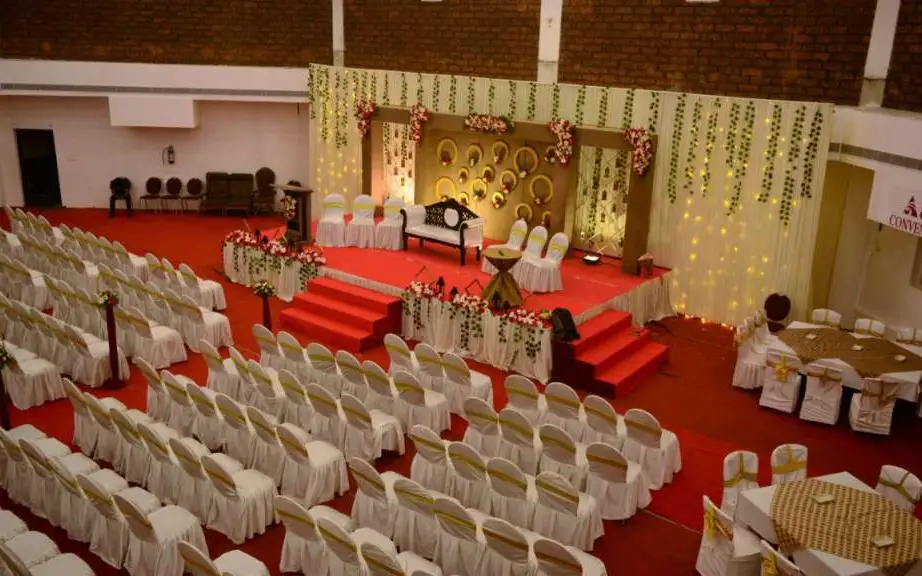
Large three-star business hotel on Jail Road, Puthiyara, in central Kozhikode, with air-conditioned rooms, a restaurant and event facilities. Its Kerala Tourism provider record lists it as a full-service city hotel, a practical mid-range base for Malabar city trips.
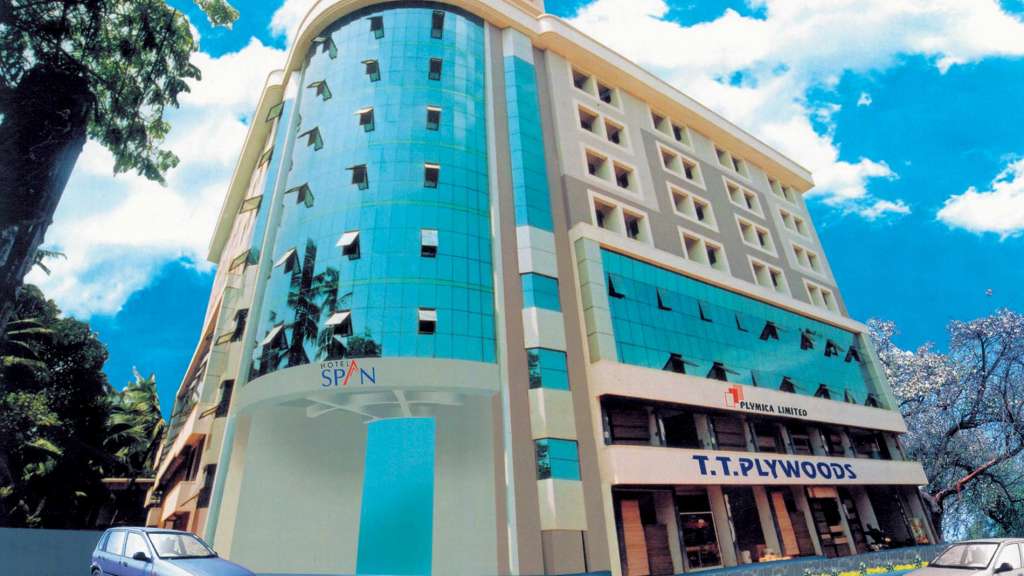
Government-of-India-approved three-star business hotel on the Mini Bypass opposite Aster MIMS in Kozhikode, with 27 standard, deluxe and suite rooms and a multi-cuisine restaurant. Its own website presents it as a dependable mid-range city base for business and hospital-side visitors.
Calicut taxi provider with direct address, phones and email. Bank Road, Calicut Town, Kerala 673006 · Calicut taxi, Airport transfer, Outstation cab.
Kerala Tourism-listed Kalaripayattu and Ayurveda centre at Puthiyara. Kalaripayattu, Hindustan Kalari, Puthiyara.
Kerala Tourism-listed Kalaripayattu training and Kalari Marma centre in Nadakkavu. Kalaripayattu, CVN Kalari, Nadakkavu.
Mayukaha Taxi Calicut Cabs is a local Kozhikode taxi service for airport, railway and city pickups, useful as a direct-contact transport option when app cabs are not enough. Kozhikode taxi, Calicut cabs, Airport taxi.
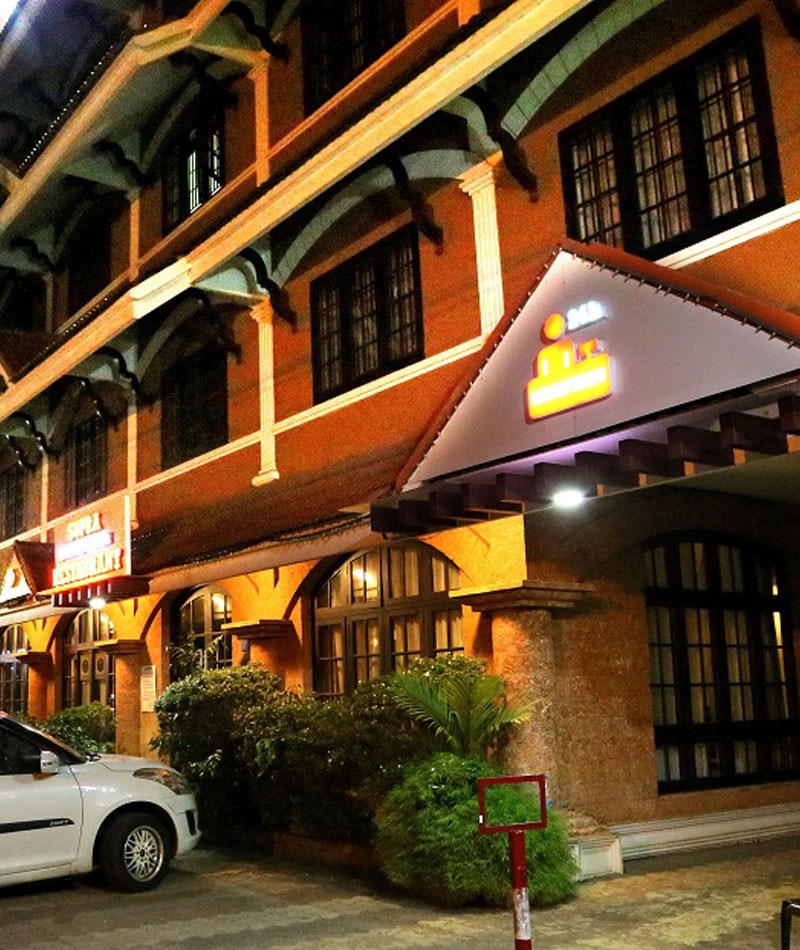
Kerala Tourism-listed three-star hotel on M. M. Ali Road, Kozhikode. Alakapuri Hotels, Kozhikode hotel, M M Ali Road.
Book with the place itself. India’s cyber-crime coordination centre warned in April 2025 that convincing copies of hotel and pilgrimage booking sites are being pushed through sponsored search and social ads, taking payment for rooms the property never hears about. Every listing here links to the business’s own contact details and its own Google or Bing profile — we take no commission and sit in nobody’s payment path. If a booking page reached you through an ad, check the address bar against the property’s own site before you pay. Fraud can be reported on cybercrime.gov.in or on 1930.
Find food, accommodation and activities across Kozhikode city. Browse the guides for places to eat, stay and explore along your route.
9 more places around Kozhikode city. Open a guide to plan the visit and onward journey.
A small historic mosque in Kuttichira with an important early Malayalam-Arabic inscription, distinct from the nearby and much larger Mishkal Mosque.
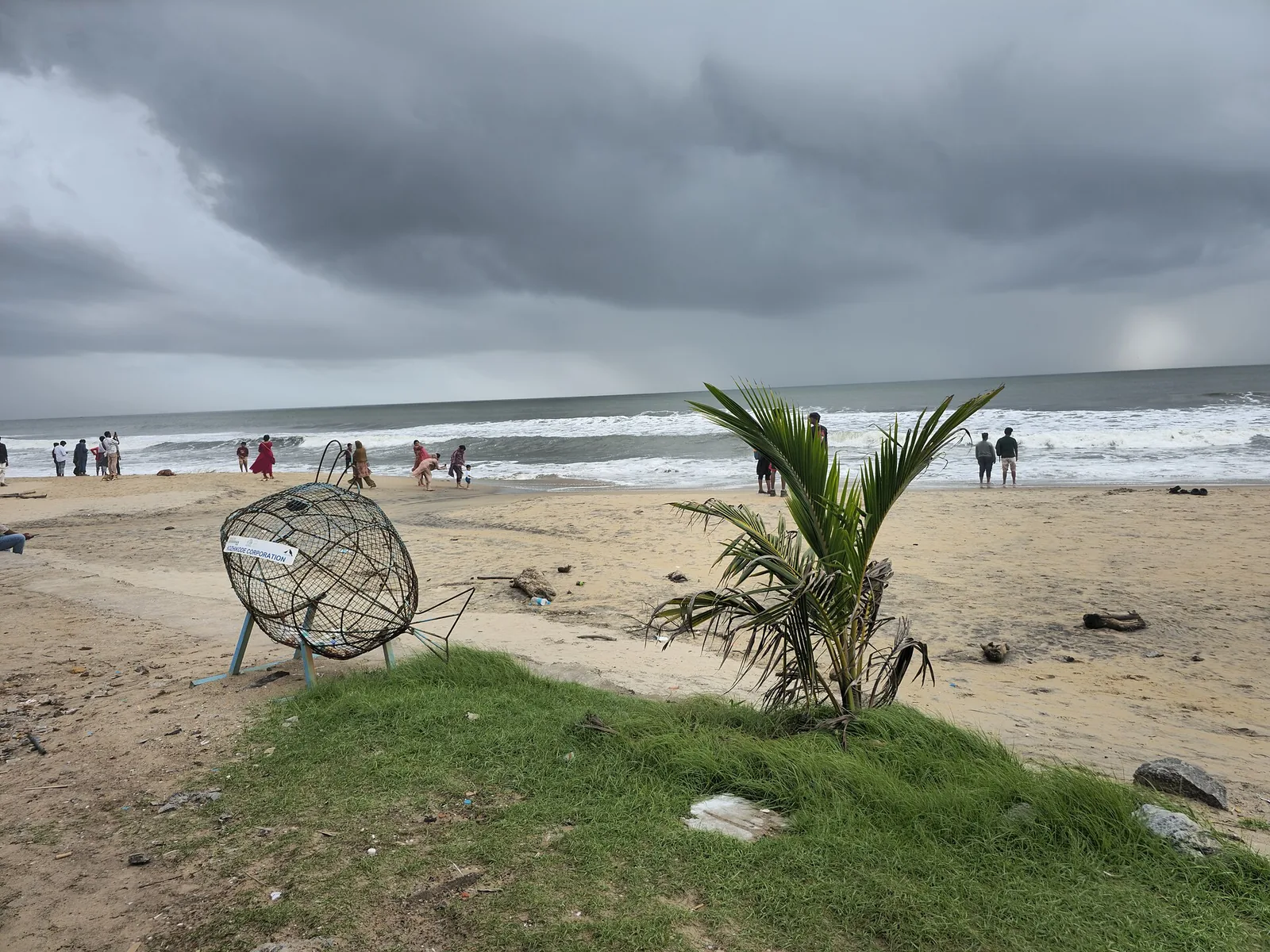
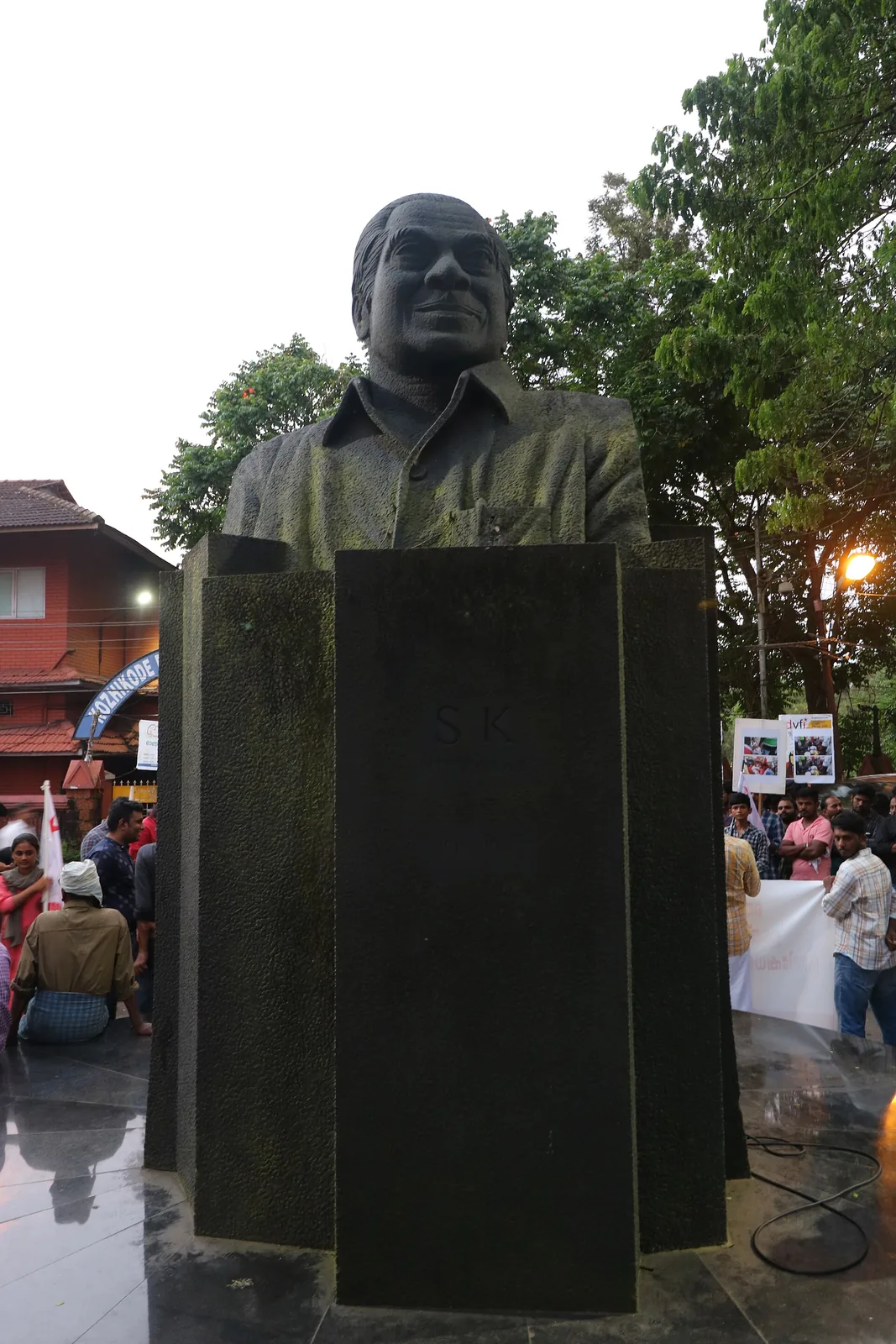
2.9 km · ~7 min by auto
Historic shopping street and sweet-stall area in Kozhikode city.
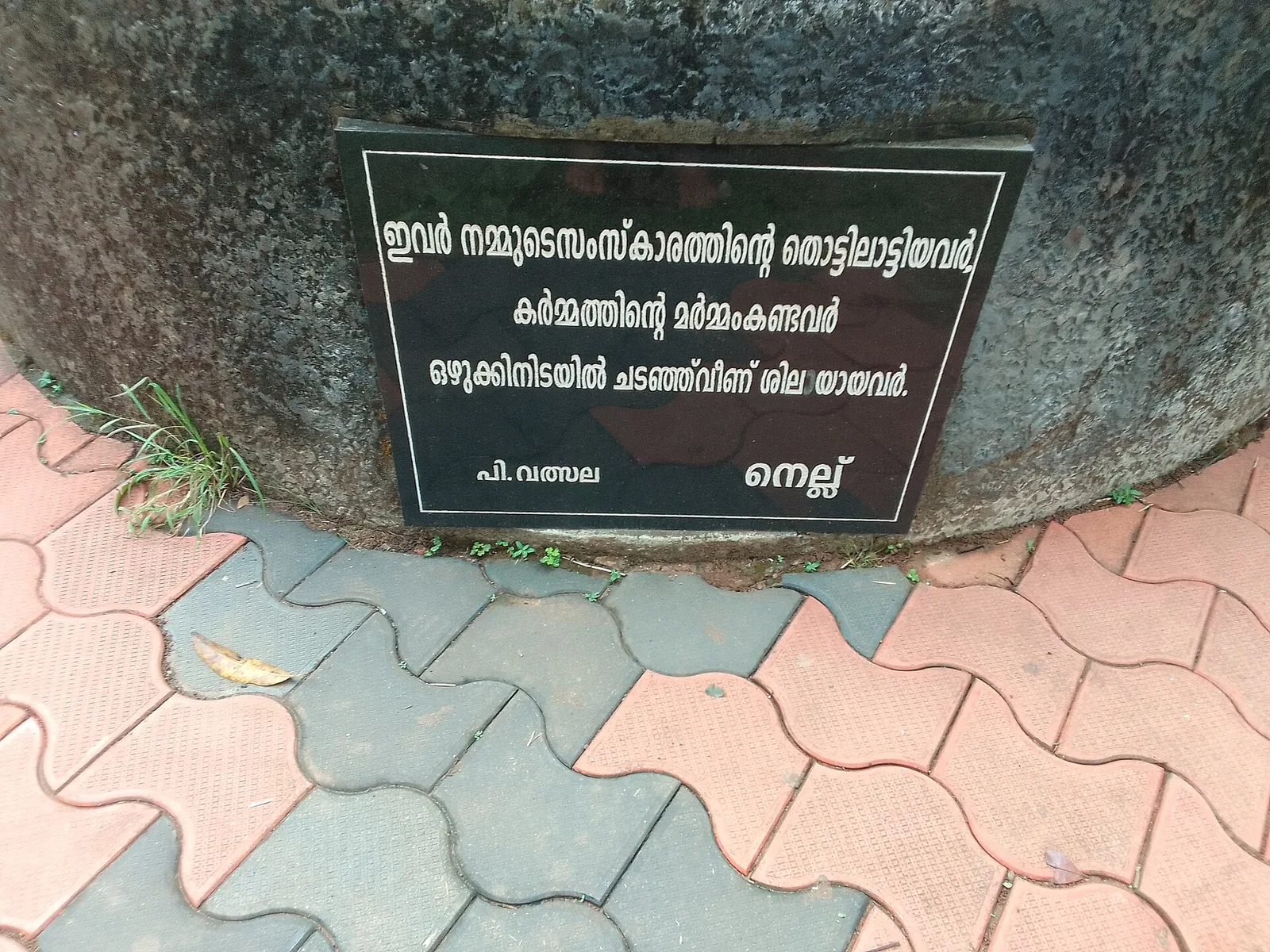
2.1 km · 27 min walk
Landmark park in the city centre on the old Zamorin palace grounds, around the Mananchira tank, with a musical fountain.
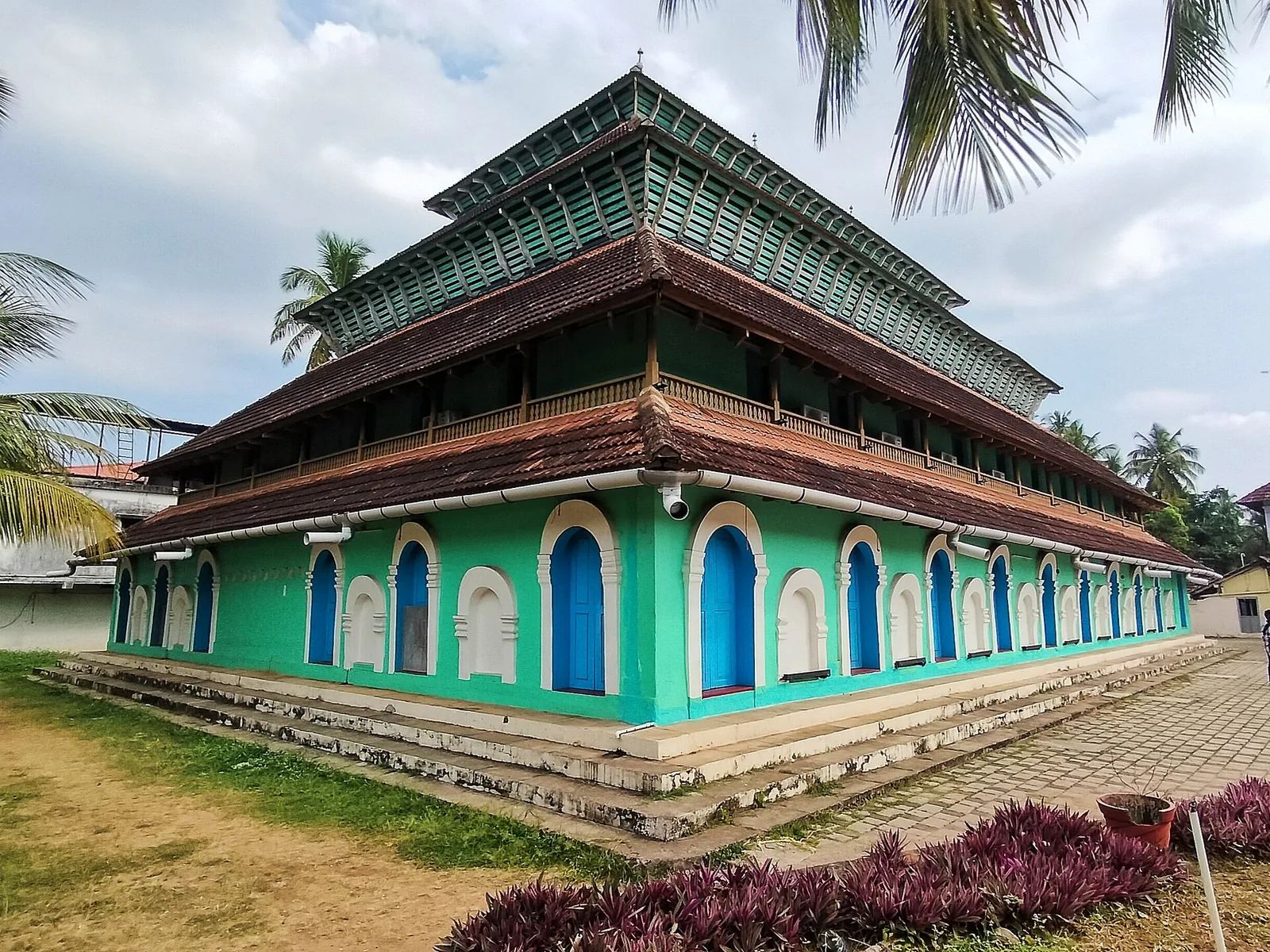
3.2 km · ~8 min by auto
Historic timber mosque at Kuttichira built by a 14th-century Yemeni trader, once five storeys, burned by the Portuguese in 1510 and rebuilt.
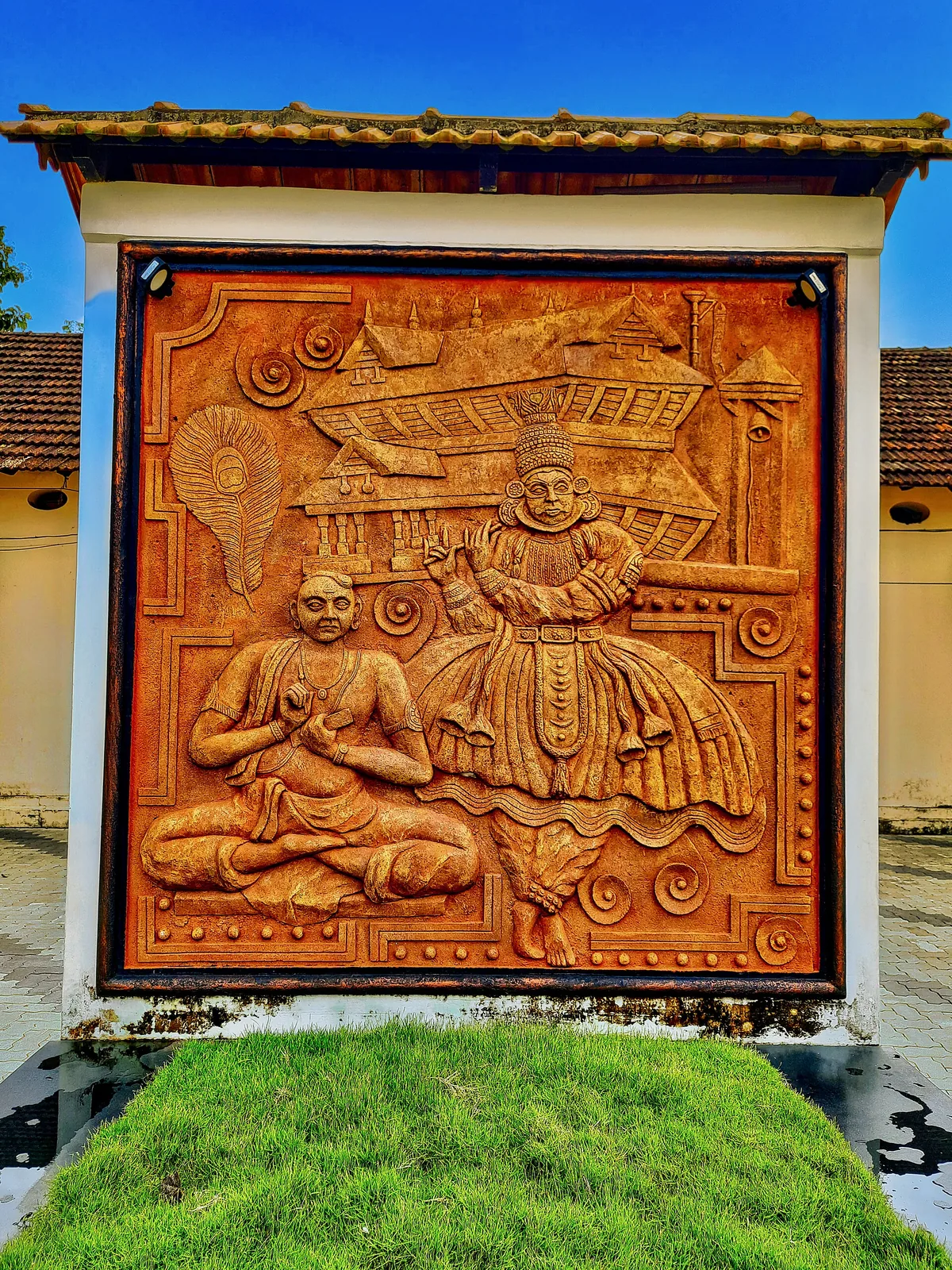
2.3 km · 29 min walk
One of Kozhikode’s oldest temples, a laterite-and-timber Shiva shrine near Mananchira long patronised by the Zamorins.
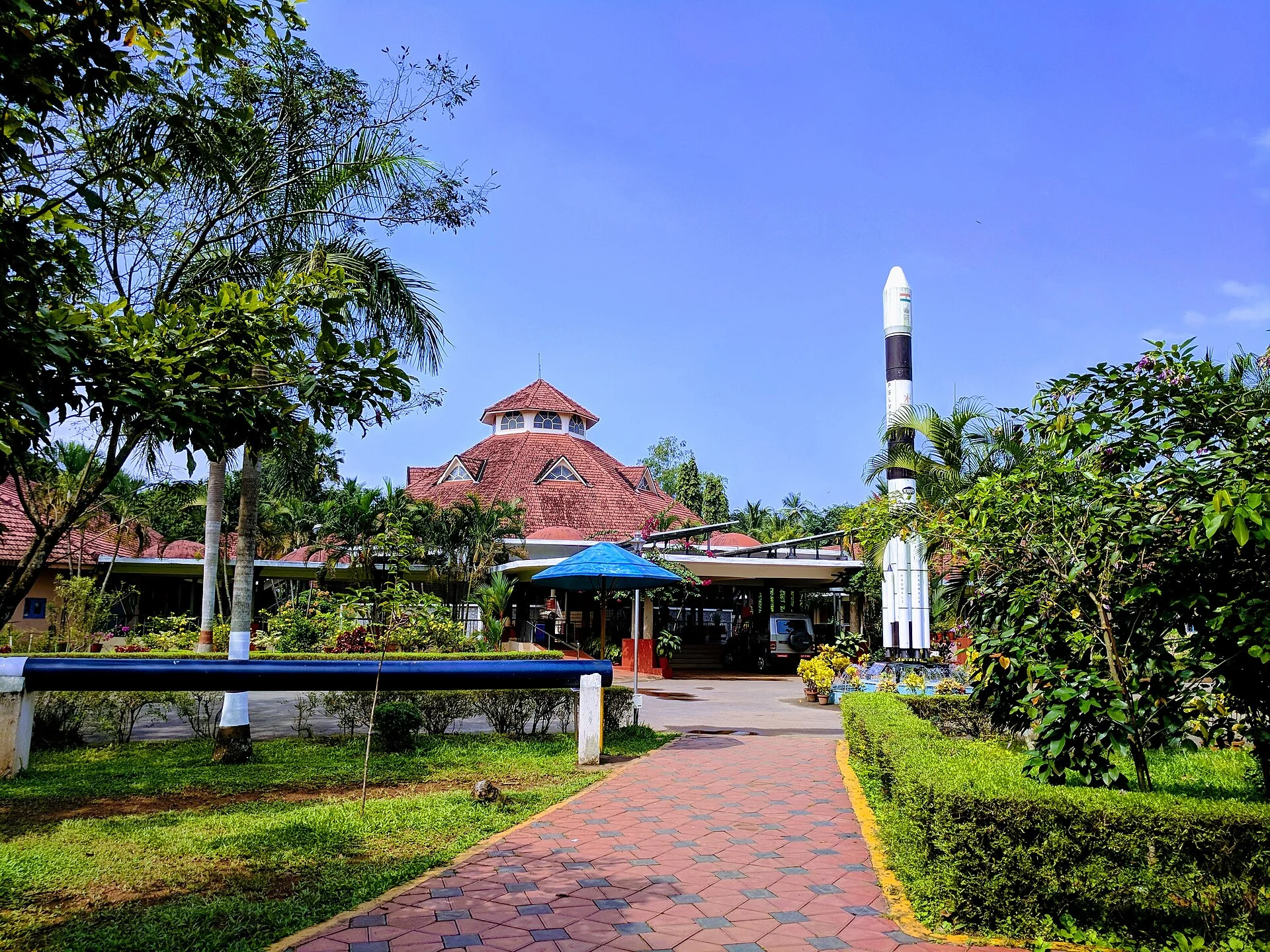
1.0 km · 12 min walk
Check the planetarium before you plan an afternoon around it: it has been shut since 13 July 2026 for a full projector replacement and no reopening date has been announced. The rest of the centre — a National Council of Science Museums site in central Kozhikode — is working: five galleries, a 3D theatre and an outdoor science park that is the real draw for children.
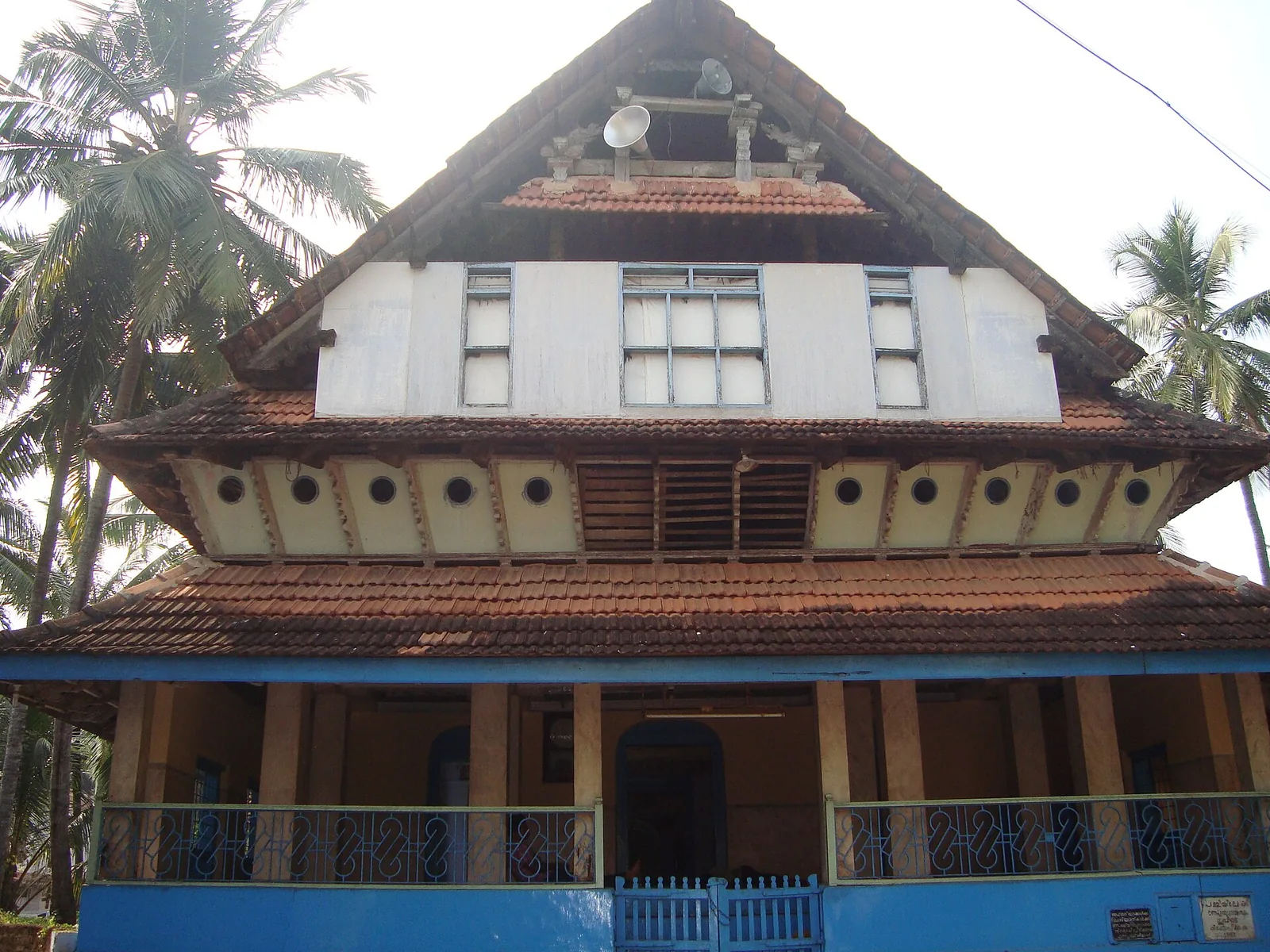
3.4 km · ~9 min by auto
Kuttichira mosque built by a freed slave and endowed by the Zamorin, holding a 13th-century bilingual Vattezhuthu–Arabic inscription; it has no minbar and holds no Friday prayers.
3.2 km · ~8 min by auto
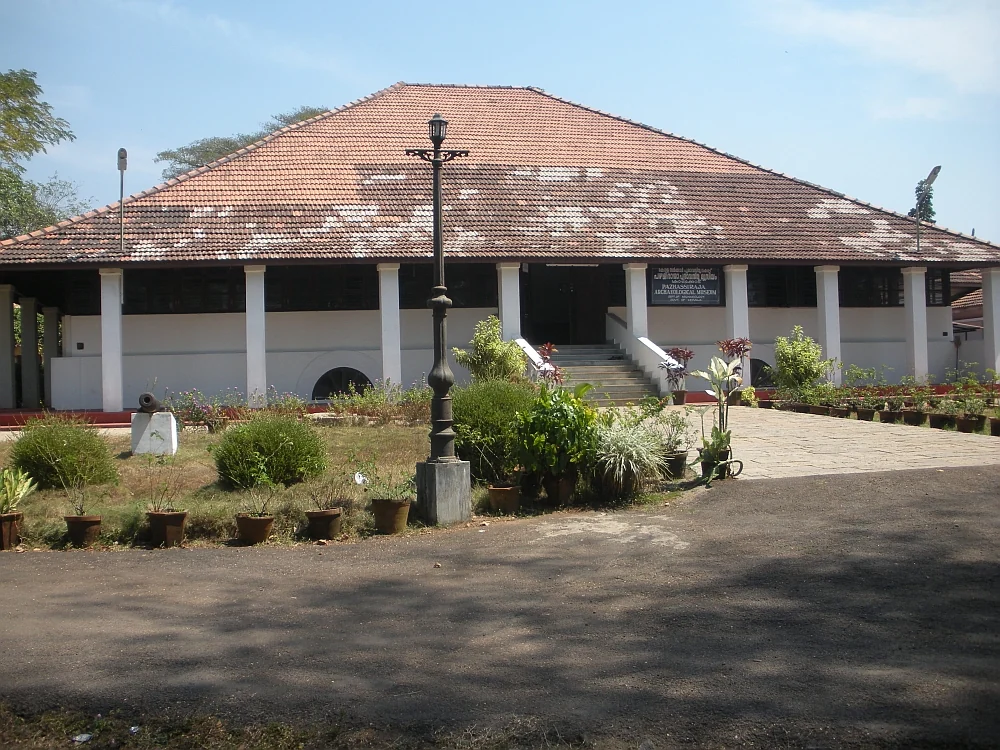
State archaeology museum at East Hill in an 1812 bungalow, with murals, bronzes, coins and megalithic monuments.
Roampedia is commission-free — own or know a stay, eatery, guide or shop near Sarovaram Bio Park? List it and it appears here once verified.
Add a nearby businessGovernment monuments, museums and forest reserves in India often charge foreign visitors more. We have not verified whether this site does — ask at the counter.
Fees change without notice. Check the current rate at the counter.
Entry: ₹30 per person, attributed to DTPC Kozhikode and observed in August 2026 on an undated page. Historic reviews show a phased, tiered structure — ₹10 for one phase, ₹20 for both — and free entry for the early-morning walking window. There is no operator-published tariff.
Dress code: None. Closed shoes are sensible on the stone-slab paths, and mosquito repellent is worth having near the water.
Festivals: None. This is a municipal eco-park, not a temple or a festival site.
Photography: No restriction found. This is an ordinary public park.
If you are travelling by bus or ferry, check the return service with the operator before setting out. Leave time to reach the stop or jetty after your visit.
Ask at the bus stand for the time of the last service back, not the next one. If you miss it, an auto or app cab is the fallback — agree the fare before you get in.
If you need step-free access, contact the site before travelling. Ask about a level entrance, steps along the route, the nearest drop-off point, seating and accessible toilets.
Emergency numbers are verified against official government and state tourism sources. 112 works anywhere in India.
A National Council of Science Museums centre in central Kozhikode — five galleries, a 3D theatre and an outdoor science park. ⚠ Its planetarium has been closed for a projector replacement since 13 July 2026 with no announced reopening date.
1.0 km · 12 min walk · straight lineLandmark park in the city centre on the old Zamorin palace grounds, around the Mananchira tank, with a musical fountain.
2.1 km · 27 min walk · straight lineOne of Kozhikode’s oldest temples, a laterite-and-timber Shiva shrine near Mananchira long patronised by the Zamorins.
2.3 km · 29 min walk · straight lineHistoric shopping street and sweet-stall area in Kozhikode city.
2.9 km · ~7 min by auto · straight lineCity beach with old pier remains and sunset food stalls.
3.0 km · ~7 min by auto · straight lineHistoric timber mosque at Kuttichira built by a 14th-century Yemeni trader, once five storeys, burned by the Portuguese in 1510 and rebuilt.
3.2 km · ~8 min by auto · straight lineState archaeology museum at East Hill in an 1812 bungalow, with murals, bronzes, coins and megalithic monuments.
3.2 km · ~8 min by auto · straight lineKuttichira mosque built by a freed slave and endowed by the Zamorin, holding a 13th-century bilingual Vattezhuthu–Arabic inscription; it has no minbar and holds no Friday prayers.
3.4 km · ~9 min by auto · straight line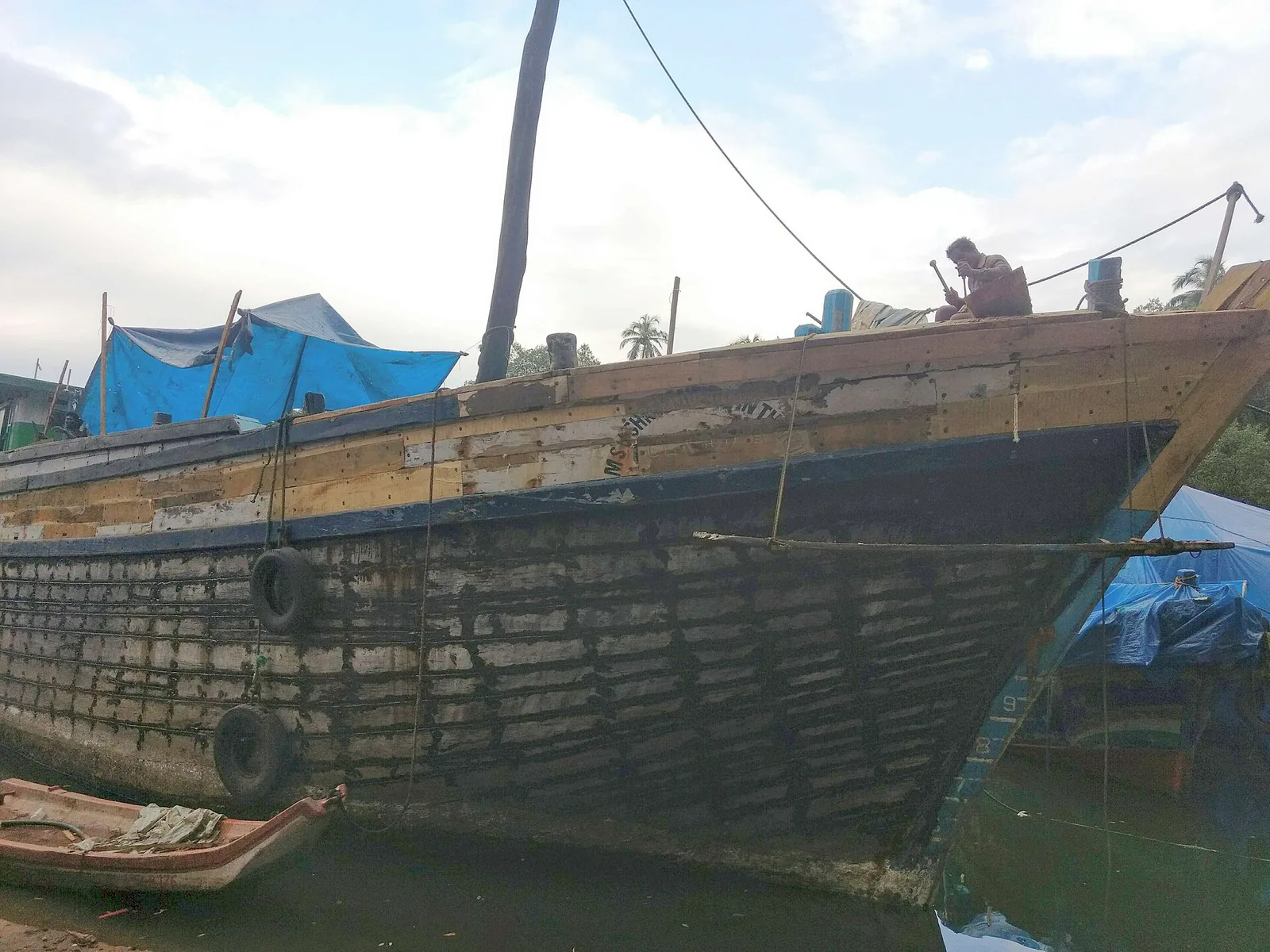
Old port and boat-building area known for uru construction.
10.0 km · ~17 min by cab · straight line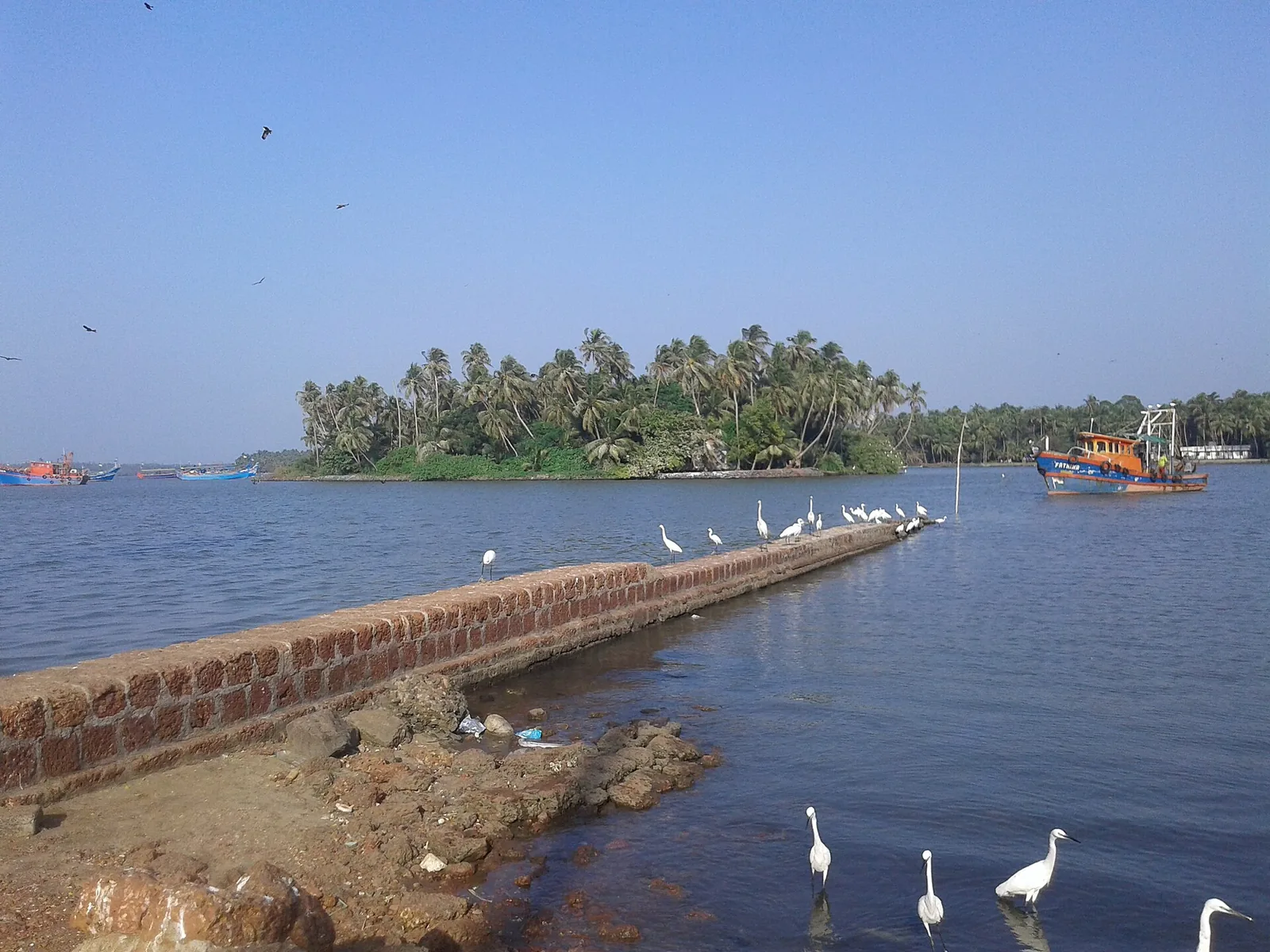
The south bank of the Chaliyar mouth, opposite Beypore — site of Kerala’s first railway terminus (1861) and of the Portuguese fort of 1532, both of which were demolished and carted to Kozhikode. One well and some laterite courses on the beach are what is left.
12.2 km · ~20 min by cab · straight line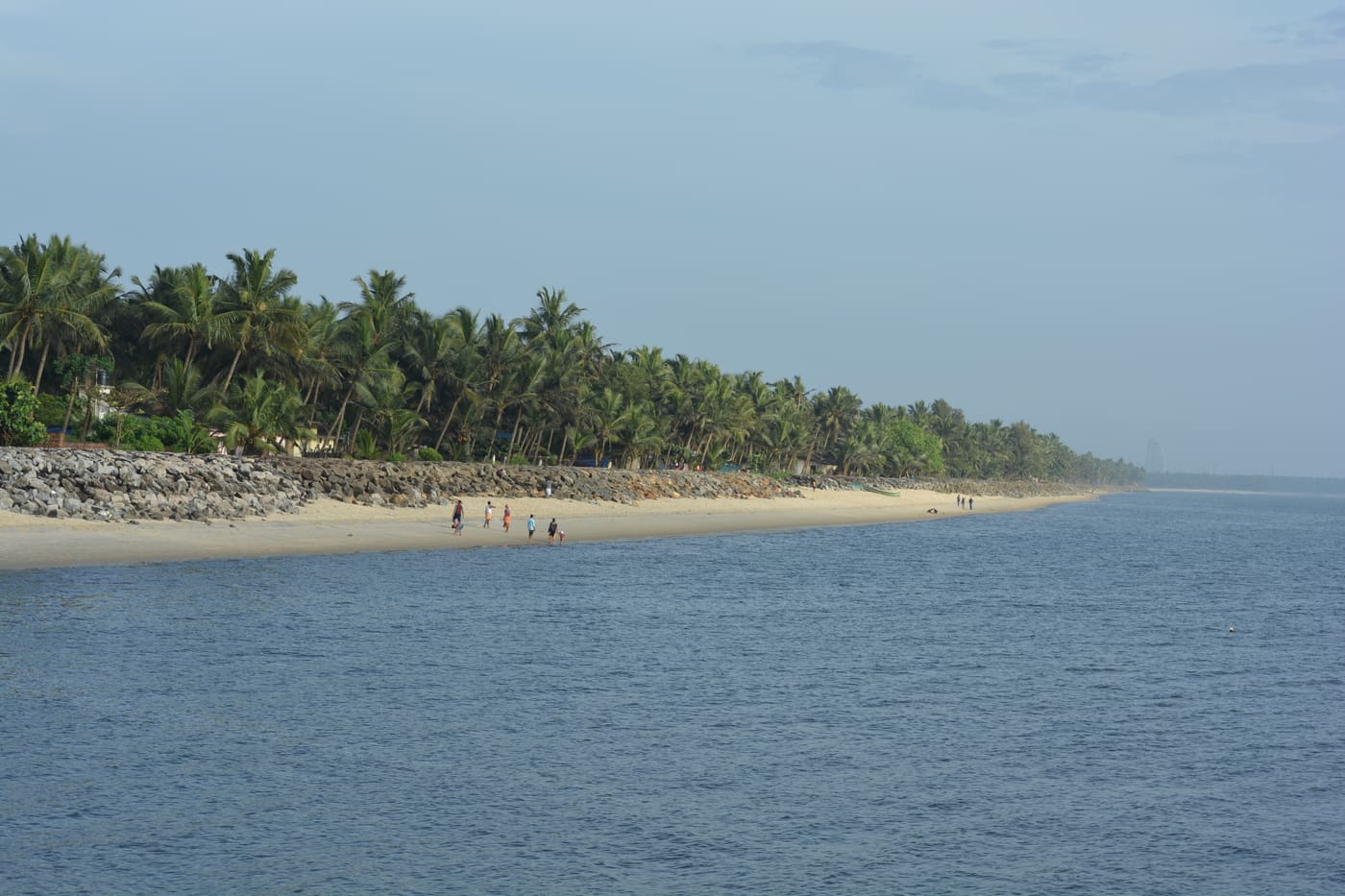
Historic beach associated with Vasco da Gama’s arrival on the Malabar coast.
15.4 km · ~26 min by cab · straight line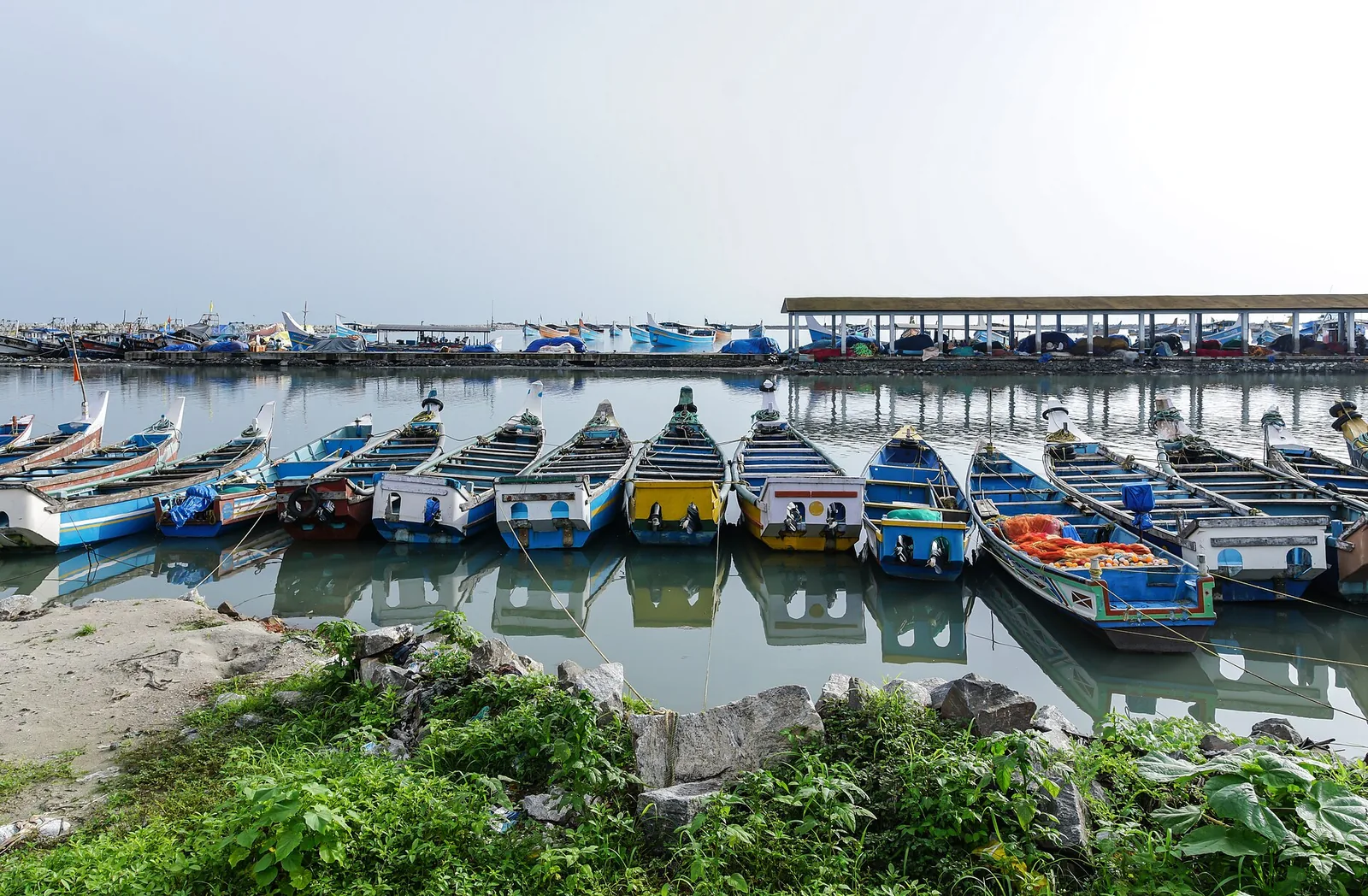
The medieval port of Panthalayani Kollam — Ibn Battuta’s Fandarayna, where Chinese junks wintered, and the anchorage where da Gama’s fleet lay 88 days in 1498. Nothing of the port survives above ground; the working fishing harbour is what you come for.
21.6 km · ~36 min by cab · straight lineAbout 98 acres. The 200-acre figure printed almost everywhere, including on official tourism pages, is the Kottooli wetland, which covers 87.04 hectares or about 215 acres and of which 22.5 hectares has been reclaimed. The park is the developed part inside the wetland.
No. Designation was under way, and on 23 February 2026 the Kerala High Court ordered that it be completed within three months. We could find no reporting on whether it was granted. Do not describe it as a Ramsar site until that is confirmed.
Not as of early 2026. A January 2026 account records that the open-air theatre, café and boat rides were all absent, with the site still under construction; an earlier review complains of poor maintenance. The park itself — paths, bridges, forest — is open. Confirm locally before travelling for the boating specifically.
The district tourism body gives ₹30 per person and 09:00 to 20:00 daily. That is an aggregator figure rather than an operator one — there is no park website, and Kerala Tourism's own page declines to state times. It also conflicts with a long-standing local practice of free entry for morning walkers from around 6 am. Treat both as indicative and confirm at the gate.
The Malabar Natural History Society's checklist for the Kottooli wetland records 134 species. Tourism copy saying 34 is both unsourced and a serious undercount; the eBird count of around two dozen reflects how little birding has been logged inside the gates rather than what is there.
It means Dream City, and it is the genuine local name — the park was part of an urban development initiative of that name. Wikimedia Commons files of the park are filed under it.
No, and the two are 300 km apart. The Kollam Sarovaram is a private Ayurvedic resort on the Ashtamudi backwaters that markets lakeside cruises to Munroe Island. This one is a public eco-park on the Conolly Canal in Kozhikode city.
It is on the Mini Bypass Road between the Eranjipalam and Arayidathupalam bridges, in the city. The district tourism body gives 2.1 km from the bus stand, 3.8 km from the railway station and 28.7 km from Calicut International Airport — walkable from the centre, or a short autorickshaw ride.
Dryer months are easier for wildlife access; monsoon access depends on local rules.
Entry: ₹30 per person, attributed to DTPC Kozhikode and observed in August 2026 on an undated page. Historic reviews show a phased, tiered structure — ₹10 for one phase, ₹20 for both — and free entry for the early-morning walking window. There is no operator-published tariff. Timings: The district tourism body gives 09:00 to 20:00 daily. That is an aggregator figure, not the operator's: there is no park website, and Kerala Tourism's own page declines to state times at all. It also conflicts with a long-standing local practice of free entry for morning walkers from around 6 am. No closed day could be established either way, so do not assume it is open every day. The rupee figure quoted is the Indian adult rate. Government monuments, museums and forest reserves in India often charge foreign visitors more, and we have not verified whether this site does.
Base yourself in Kozhikode city or a nearby town in Kozhikode, then confirm the last-mile route locally before leaving. Book official entry, safari, boat or eco-tourism slots first, then plan transport and stay. If the visit depends on forest, temple, boat, ferry, weather or seasonal access, check the official/local rule on the day before travel.
Half day to full day.
Nearby you can pair Regional Science Centre and Planetarium (1.0 km), Mananchira Square (2.1 km), Thali Temple (2.3 km), SM Street / Mittayi Theruvu (2.9 km).
Do not feed or approach wildlife. Use official routes and approved operators only.
Written about Sarovaram Bio Park itself — its history, its legends and the arguments about them.
Route-level itineraries and practical guides for the rest of Kerala.
Photographs: Ranjithsiji (CC BY-SA 4.0), Junior Cat MW (CC BY-SA 4.0), Anjalirnambiar (CC BY-SA 4.0), Outlander07 (CC BY-SA 4.0). Wikimedia Commons.