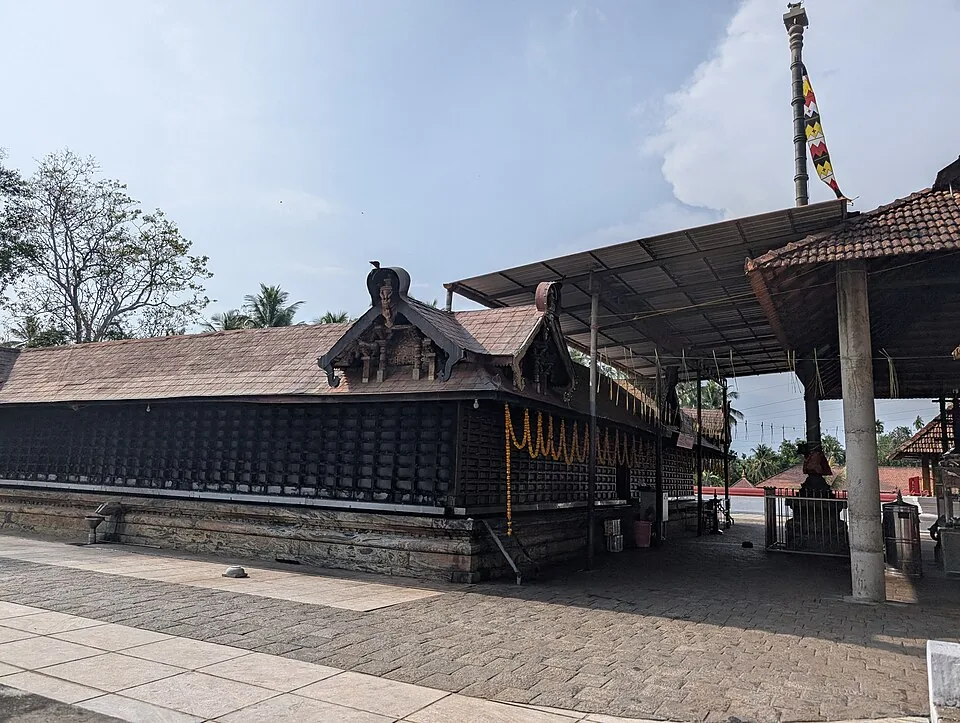
In the songs of North Malabar, a warrior about to fight walks first to a grove near Vadakara. There, the story goes, Thacholi Othenan bowed to the goddess Lokanarkavilamma before every one of his duels. Kerala Tourism repeats that belief about Lokanarkavu Temple, and it explains why this shrine is woven so tightly into the Vadakkan Pattukal, the Northern Ballads.
The ballads are the songs of North Malabar, and they tell of battles between princely states and of feuds fought between families with the help of kalaripayattu experts. Their heroes are drawn so vividly that they carry an almost divine aura, with Othenan, Aromal Chekavar, Kannappa Chekavar and Unniyarcha among them. These heroes even appear in Theyyam and Thira, the ritual art forms of Malabar.
That world is rooted in this town, which is why the temple matters so much. Kerala Tourism names Vadakara as Thacholi Othenan's birthplace. Thacholi Manikkoth, where Othenan practised his skills, is today a kalari that still draws large numbers of people.
The temple itself sits in the village of Memunda, about 4 km from Vadakara, and it is more than one shrine. Kerala Tourism describes a complex of temples to Durga, Shiva and Vishnu. Inside are mural paintings from the fifteenth century and carved wooden sculptures called Darusilpam. So historians come for the art as well as the songs.
The festivals bring the ballad world back to life on its own ground. The temple celebrates in November and December and again in March and April, and the eight-day Pooram in March is the biggest of its festivals. During the festivals the courtyard sees Poorakkali, a folk dance that resembles kalaripayattu, and Thacholikali, which acts out the fights of warriors like Othenan.
That link to the martial art is still alive today. Kalaripayattu artists still seek the goddess's blessing before their debut, because Othenan worshipped her before his duels. The custom ties the temple to the kalaris of the district in a line that runs back to the songs.
The ballads have also travelled far beyond the grove, which keeps them in people's minds. In 1964 the film Thacholi Othenan, with Sathyan in the title role, brought the hero to the cinema screen. Kerala Tourism notes that the C. V. N. Kalari in Kozhikode linked its fighting arts to Malayalam cinema from that film onward.
The songs met the screen again in 1989, and this time the story itself changed. In the ballad, Chandu Chekavar is the cheat, a man of greed and deceit. Then M.T. Vasudevan Nair wrote and Hariharan directed Oru Vadakkan Veeragatha, which told the same legend from Chandu's side. The film turned the old story upside down and found a hero in the villain. Many Malayalis now know Chandu through that film first, so a visitor who hears two very different Chandus in the grove is hearing the ballad and the 1989 film side by side. The grove at Memunda is still where the old songs feel most at home.
Visiting means coming quietly, in step with a working temple. Its courtyard sits among tall trees and greenery, and wood carvings and murals fill the shrines. The Lokanarkavu Temple page covers the visit, and the Vadakara hub gathers the nearby coast.
Frequently asked questions
Why is Lokanarkavu Temple famous?
It is linked to the Vadakkan Pattukal ballads, and in the ballads the hero Thacholi Othenan prays to its goddess before every fight.
What are the Vadakkan Pattukal?
The ballads of North Malabar, which tell of battles, family feuds and warrior heroes such as Thacholi Othenan and Unniyarcha.
Which deities are worshipped at Lokanarkavu?
The complex has temples to Durga, Shiva and Vishnu, with fifteenth-century murals and wooden sculptures.
When are the Lokanarkavu festivals?
November–December and March–April, with an eight-day Pooram in March.