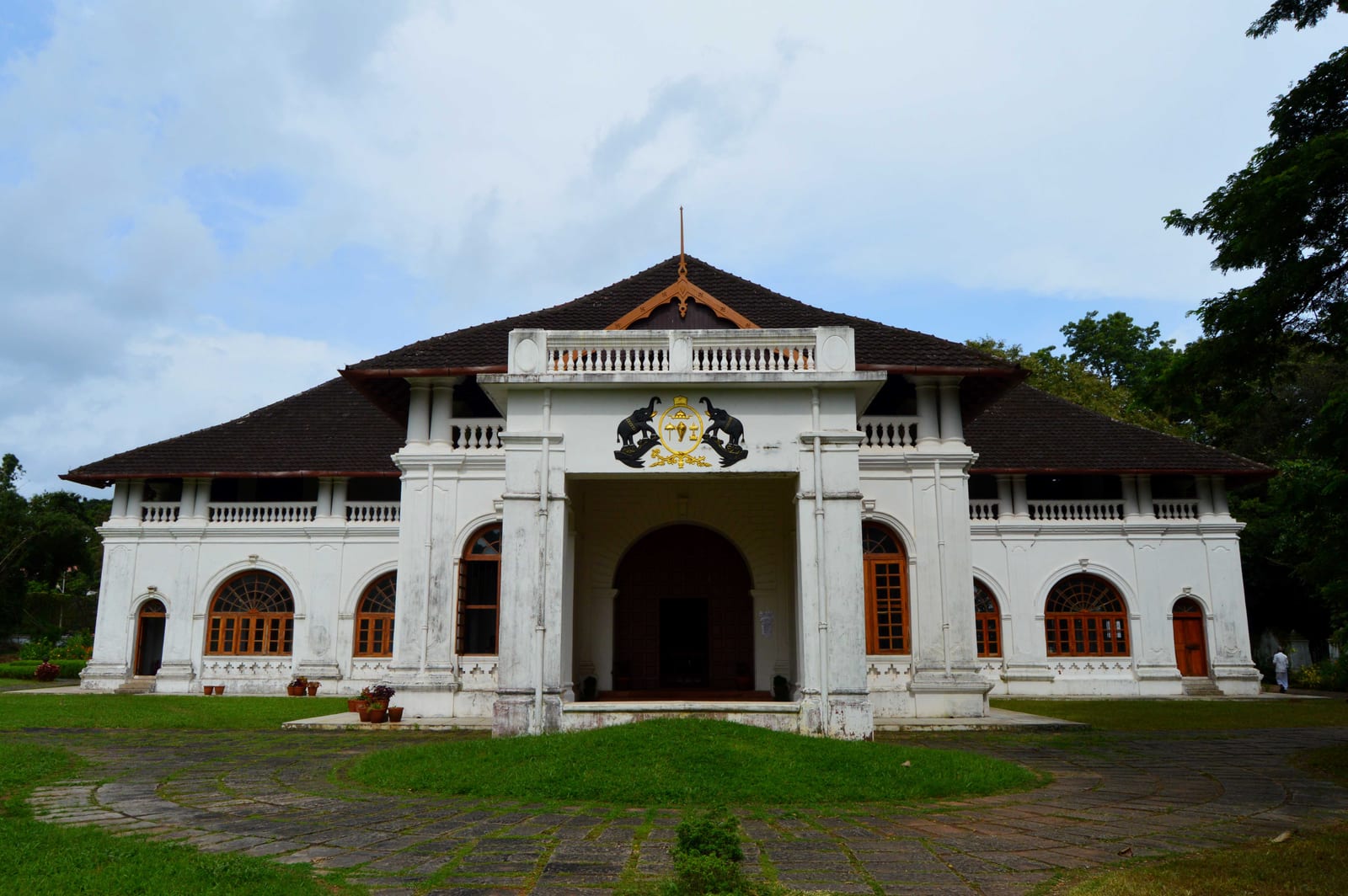
Thrissur talks about Sakthan Thampuran constantly — he cleared the teak, laid out the Round, moved the capital’s commerce here and broke the temple oligarchies — and the city’s own lore covers all of that. What gets far less attention is the building he lived in, which is a short walk from the ring road and is now the state archaeological museum.
A building in two halves
It is also called Vadakkekara palace, and it was rebuilt in 1795 by Rama Varma Thampuran. The striking thing is that it does not blend its two architectural sources so much as divide between them. The western half is a two-storeyed building in the European manner. The eastern half is traditional Kerala. Walk from one into the other and the ceiling heights, the window treatment and the whole logic of the rooms change.
The Dutch element is not decorative. It is thick walls, broad and high doors and windows, and seats built into the bottom of the window openings — practical building for heat, done the way the Dutch did it on this coast, on a palace that also carries a steep Kerala tiled roof to shed monsoon rain. Two climates’ worth of solutions to the same climate, in one house.
That is not an accident of taste. The Cochin state had been dealing with the Dutch at Kochi for well over a century by 1795, and a ruler who was reorganising his kingdom’s commerce was borrowing techniques from the people he was trading with. The building is a record of that relationship in a way no document quite is.
What is in it now
It became a museum in 2005 under the state archaeology department, and it is arranged as a proper regional museum rather than a palace with things in it. There are separate galleries for bronzes, for coins, for sculpture, for megalithic material and for epigraphy — inscriptions.
The megalithic and epigraphy rooms are the ones worth slowing down in, because they are the parts of Kerala’s past that are hardest to see anywhere else. Kerala’s prehistoric record is largely burial: dolmens, urns, rock-cut chambers, hat stones. Almost all of it is in fields and on hillsides, unlabelled and often unfenced. A room that gathers it and dates it is genuinely useful, and there are very few of them.
The grounds
- A sarpakavu — a serpent grove — of considerable age in the compound. These were once ordinary across Kerala and are now uncommon; an intact one on public ground is rare.
- A heritage garden on the southern side, planted with indigenous Kerala trees and plants and labelled.
- The eastern gateway, which is the surviving formal entrance and is worth walking round to.
The sarpakavu deserves the note it gets above. A kavu is a fragment of forest left deliberately uncut and dedicated, usually to serpent deities, and in aggregate these groves preserved a real amount of Kerala’s original vegetation on private land for centuries. Most have gone as households divided and built. One standing in the grounds of a state museum, next to a labelled heritage garden, is an accidental but rather good illustration of two different ways of conserving the same thing.
Fitting it into a day
It is close enough to the Swaraj Round to walk in ten or fifteen minutes, and it takes an hour or two properly. Check the opening day before going — state museums in Kerala commonly close on Mondays and on public holidays, and the timings are not the same as the temple’s or the basilica’s. Combined with the Round itself, the temple hill and the basilica, it makes the historic core of Thrissur a genuinely full and entirely walkable day.
