What to expect
Highlights
- Rajendra I’s royal temple
- Chola sculpture and tower profile
- A different setting from urban Thanjavur
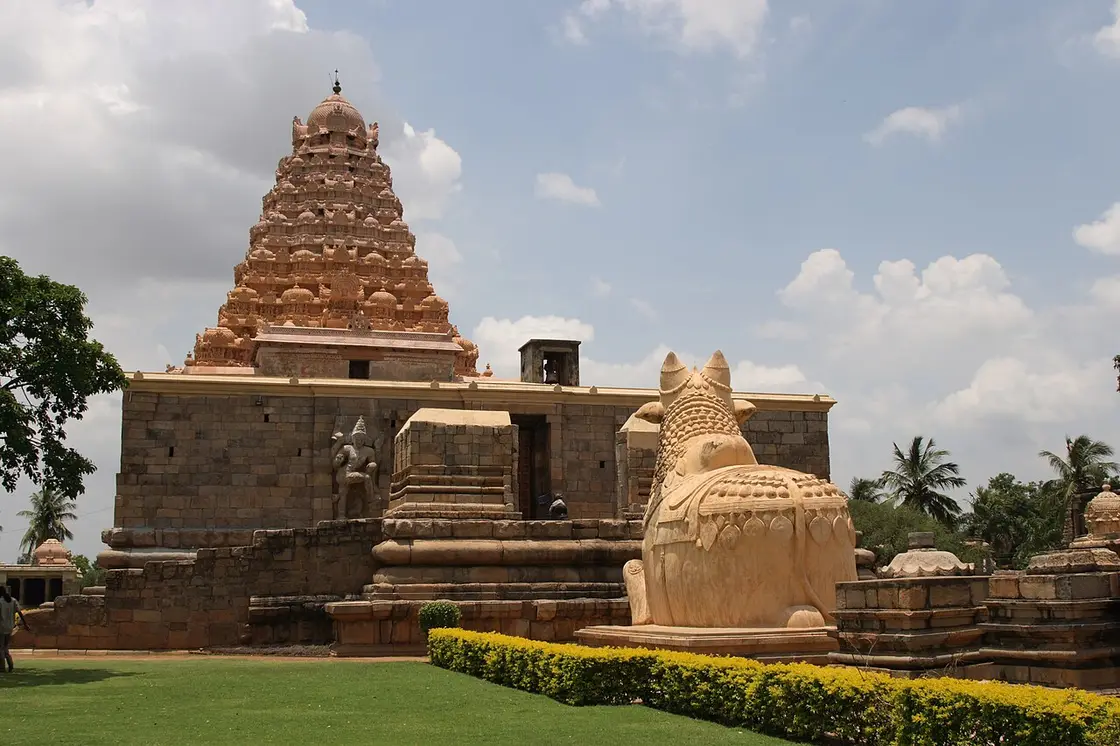
The Brihadisvara temple at Gangaikondacholapuram is the principal surviving monument of Rajendra Chola I’s capital, in Ariyalur district.
Check entry arrangements. Ask temple staff about visitor entry, dress requirements and access to the inner shrine before you travel, especially if you are visiting as a non-Hindu.
Dress respectfully and follow the institution’s admission and photography rules.
The Brihadisvara temple at Gangaikondacholapuram is the principal surviving monument of Rajendra Chola I’s capital, in Ariyalur district. This is a separate Chola destination, not another name for the Big Temple in Thanjavur. Build travel time into the day rather than treating the two as neighbouring city sights.
Rajendra I established his capital here, and the surviving Shiva temple makes the ambitions of that royal centre visible. It belongs to the UNESCO Great Living Chola Temples.
Compare the tower’s profile and the sculptural treatment with Thanjavur if you are visiting both. The comparison is more rewarding than asking which temple is the larger or more impressive.
The temple is the focus of a rural excursion. Finish meals and arrange your onward journey with the day’s travel in mind; leave time for the visit rather than arriving just before a long return drive.
For the visit itself, allow one to two hours at the temple, plus road travel. The best time is cooler daylight, within the temple’s open worship sessions. Confirm your driver is taking you to Gangaikondacholapuram in Ariyalur district. Plan it as a road excursion with an agreed return pickup. Follow worship access and avoid exposed midday heat.
Cooler daylight, within the temple’s open worship sessions.
Live forecast loads in your browser.
Sun and moon are calculated for this location and shown in IST. Photography windows are the hour around sunrise and sunset; the sunset bearing is degrees clockwise from true north. Moon phase is accurate to about half a day.
Verified hotels, homestays, restaurants, experiences, sights, shops and rentals around Gangaikonda Cholapuram — commission-free, with direct contact. Filter by what you need.
JKS Deluxe Lodge is an accommodation option in Gangaikondacholapuram. Contact the property directly to confirm room availability, current tariff, check-in time, accessibility and parking, then use Directions for the listed location.
Book with the place itself. India’s cyber-crime coordination centre warned in April 2025 that convincing copies of hotel and pilgrimage booking sites are being pushed through sponsored search and social ads, taking payment for rooms the property never hears about. Every listing here links to the business’s own contact details and its own Google or Bing profile — we take no commission and sit in nobody’s payment path. If a booking page reached you through an ad, check the address bar against the property’s own site before you pay. Fraud can be reported on cybercrime.gov.in or on 1930.
2 more places around Gangaikondacholapuram. Open a guide to plan the visit and onward journey.
3.3 km · ~8 min by auto
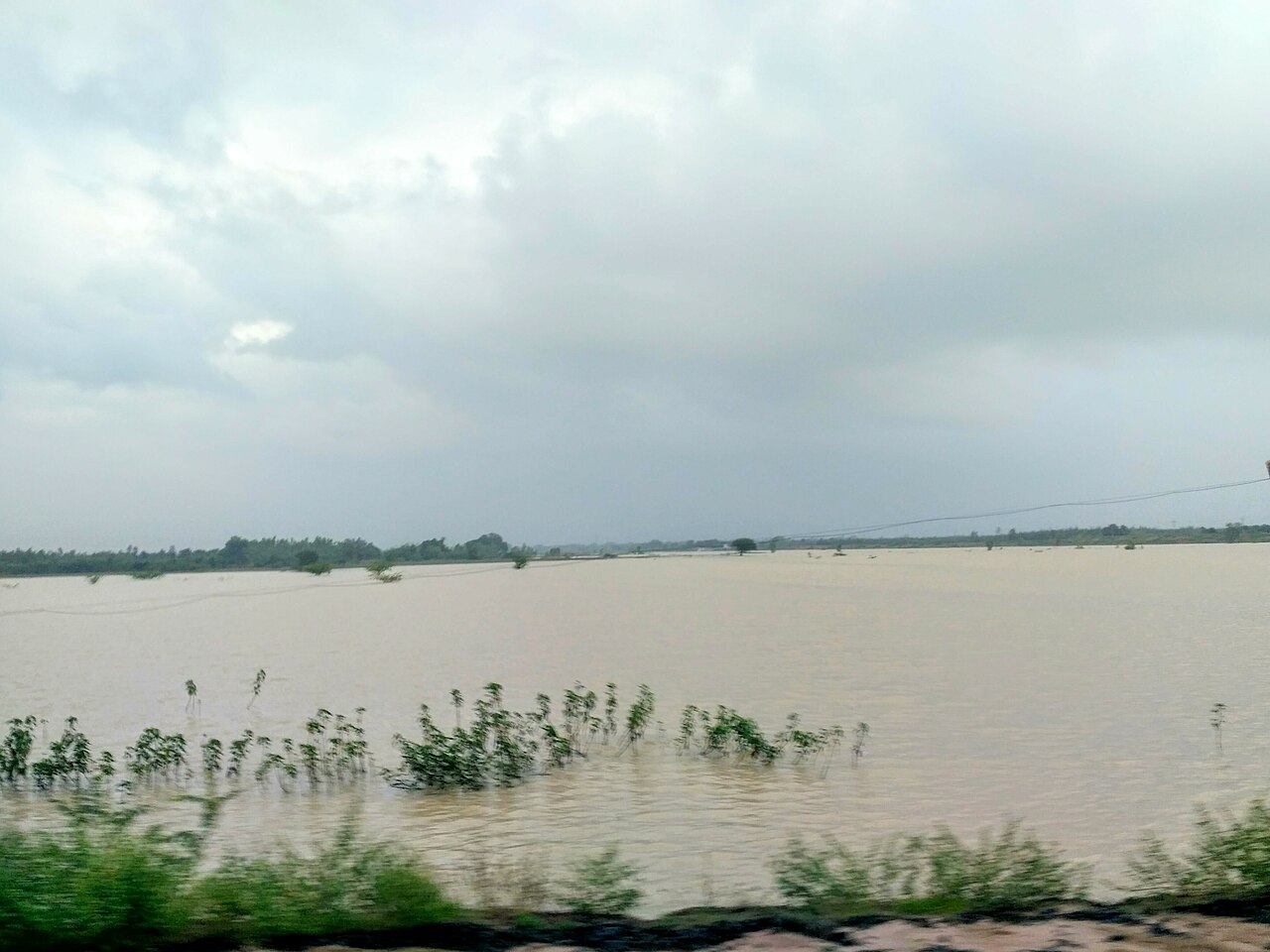
A large irrigation tank excavated by Rajendra Chola I beside his new capital and fed from the Kaveri and Kollidam, hailed in inscriptions as a liquid pillar of victory commemorating his northern campaigns. It lies close to the Gangaikonda Cholapuram temple.
410 m · 5 min walk
An excavated mound about 3 km from the Gangaikonda Cholapuram temple where the Tamil Nadu State Department of Archaeology unearthed the remains of the imperial Chola royal palace, built in burnt brick with flat-tiled roofing. It served as the administrative seat from which Rajendra I and later kings such as Virarajendra and Kulottunga I issued royal edicts, corroborated by inscriptions dated between 1031 and 1119 CE. Excavations from 1980 onward recovered iron nails, ivory objects, Chinese ceramics, coloured bangles, gold foil and copper coins.
Roampedia is commission-free — own or know a stay, eatery, guide or shop near Gangaikonda Cholapuram? List it and it appears here once verified.
Add a nearby businessIf you need step-free access, contact the site before travelling. Ask about a level entrance, steps along the route, the nearest drop-off point, seating and accessible toilets.
Emergency numbers are verified against official government and state tourism sources. 112 works anywhere in India.
An excavated mound about 3 km from the Gangaikonda Cholapuram temple where the Tamil Nadu State Department of Archaeology unearthed the remains of the imperial Chola royal palace, built in burnt brick with flat-tiled roofing. It served as the administrative seat from which Rajendra I and later kings such as Virarajendra and Kulottunga I issued royal edicts, corroborated by inscriptions dated between 1031 and 1119 CE. Excavations from 1980 onward recovered iron nails, ivory objects, Chinese ceramics, coloured bangles, gold foil and copper coins.
410 m · 5 min walk · straight lineA large irrigation tank excavated by Rajendra Chola I beside his new capital and fed from the Kaveri and Kollidam, hailed in inscriptions as a liquid pillar of victory commemorating his northern campaigns. It lies close to the Gangaikonda Cholapuram temple.
3.3 km · ~8 min by auto · straight line
The main town and gateway to Gangaikonda Cholapuram, named in the Chola tradition (Jayamkonda) and serving as the commercial hub for the northern part of Ariyalur district.
9.1 km · ~15 min by cab · straight lineA Chola-era Vishnu temple whose presiding deity Veeranarayana Perumal, also called Vedanarayana, is enshrined with his consort Maragadhavalli Thayar. Built in Chola architectural style and attributed to the Chola dynasty, the temple gives the village of Kuruvalapparkovil its name. It is a notable Vaishnavite pilgrimage stop in the northern part of the district.
12.8 km · ~21 min by cab · straight lineA Shiva temple at Andimadam where the deity Agastheeswarar is enshrined with the goddess Dharmasamvardhini. It is one of the principal ancient temples of the Andimadam area, in the northern reaches of Ariyalur district near the Kollidam. The temple is a local Shaivite pilgrimage centre with Chola-period roots.
16.0 km · ~27 min by cab · straight line
A historic palayam (zamindari) town, once the seat of the Udayarpalayam Palayakarars whose fort and estate made it a regional power centre. Today it is a taluk headquarters in northern Ariyalur district; the old palace survives as its landmark.
17.1 km · ~28 min by cab · straight lineAn earthen irrigation dam in Udayarpalayam taluk with a bund about 5 km long and a maximum height of roughly 7 metres, fed as part of the Marudaiyaru basin system. It supplies irrigation to surrounding farmland in a largely agricultural district. The reservoir and its long bund make for a quiet local waterscape.
21.4 km · ~36 min by cab · straight lineA Chola Shiva temple at Sendurai whose epigraphy places it in the reign of Rajaraja I (985-1014 CE), with about five stone inscriptions and two copper-plate grants attesting its antiquity. It is locally believed to predate the great Thanjavur Brihadeeswarar temple and preserves a Nataraja Sabha within its inner prakaram. The temple anchors Sendurai, one of the four taluk headquarters of Ariyalur district.
30.1 km · ~50 min by cab · straight lineA Chola Shiva temple at Sennivanam whose inscriptions place it in the reign of Rajendra Chola I (1012-1044 CE), with the presiding deity worshipped as Thirthapurishwarar. It forms part of the cluster of dated Chola shrines in the district alongside the temples at Sendurai and Sripurandan.
31.3 km · ~52 min by cab · straight lineAn early Chola Shiva temple at Periyathirukkonam, listed among the district's historically important temples of the Chola period, with its deity worshipped as Adimadyarjunar (Adhimoolanathar). It is a modest but old heritage shrine reflecting the dense Chola temple-building activity across Ariyalur.
34.4 km · ~57 min by cab · straight lineThe Kallamedu Formation is a Late Cretaceous (Maastrichtian) rock unit of the Ariyalur Group, laid down in a river (fluvial) setting of siltstones, clays and sandstones. It has yielded dinosaur remains and petrified wood, and the area near Kallamedu village is the reported find-spot of Bruhathkayosaurus, a titanosaur that may have been among the largest land animals ever. The formation is a key terrestrial-dinosaur locality that complements the district's better-known marine fossil beds.
34.6 km · ~58 min by cab · straight lineA Vishnu temple at Kallankurichi where the presiding deity Kaliyuga Varadaraja Perumal, popularly called Kaliyaperumal, is worshipped. Local tradition holds that the temple was built roughly five centuries ago by a cowherd at the spot of a post believed to hold miraculous powers, though the deity itself is considered far more ancient. It is one of the better-known Vaishnavite shrines of the district and lends its name to the limestone-rich locality around it.
36.4 km · ~61 min by cab · straight lineNo. This is the temple at Gangaikondacholapuram in Ariyalur district, associated with Rajendra Chola I.
Yes, but allow separate travel time; they are not on one walkable site.
Cooler daylight, within the temple’s open worship sessions.
Confirm your driver is taking you to Gangaikondacholapuram in Ariyalur district. Plan it as a road excursion with an agreed return pickup.
Allow one to two hours at the temple, plus road travel.
Nearby you can pair Maligaimedu Chola Palace Excavation Site (410 m), Chola Gangam (Cholagangam Lake) (3.3 km), Jayankondam (9.1 km), Veeranarayana Perumal Temple, Kuruvalapparkovil (12.8 km).
Follow worship access and avoid exposed midday heat.
Written about Gangaikonda Cholapuram itself — its history, its legends and the arguments about them.
These guides explore Gangaikondacholapuram and the surrounding area. Choose a visit that fits your interests, allowing separately for travel between stops.
Route-level itineraries and practical guides for the rest of Tamil Nadu.
Photographs: Ssriraman (CC BY-SA 3.0), Phadke09 (CC BY-SA 4.0), Rainer Halama (CC BY-SA 4.0), Nicholas.iyadurai (CC BY-SA 4.0). Wikimedia Commons.
