What to expect
Highlights
- Kaveri–Bhavani confluence
- Living Sangameswarar worship
- Kooduthurai river landscape
Bhavani Sangameswarar Temple stands by Kooduthurai, the visible meeting of the Kaveri and Bhavani rivers, with a third sacred river belonging to faith tradition.
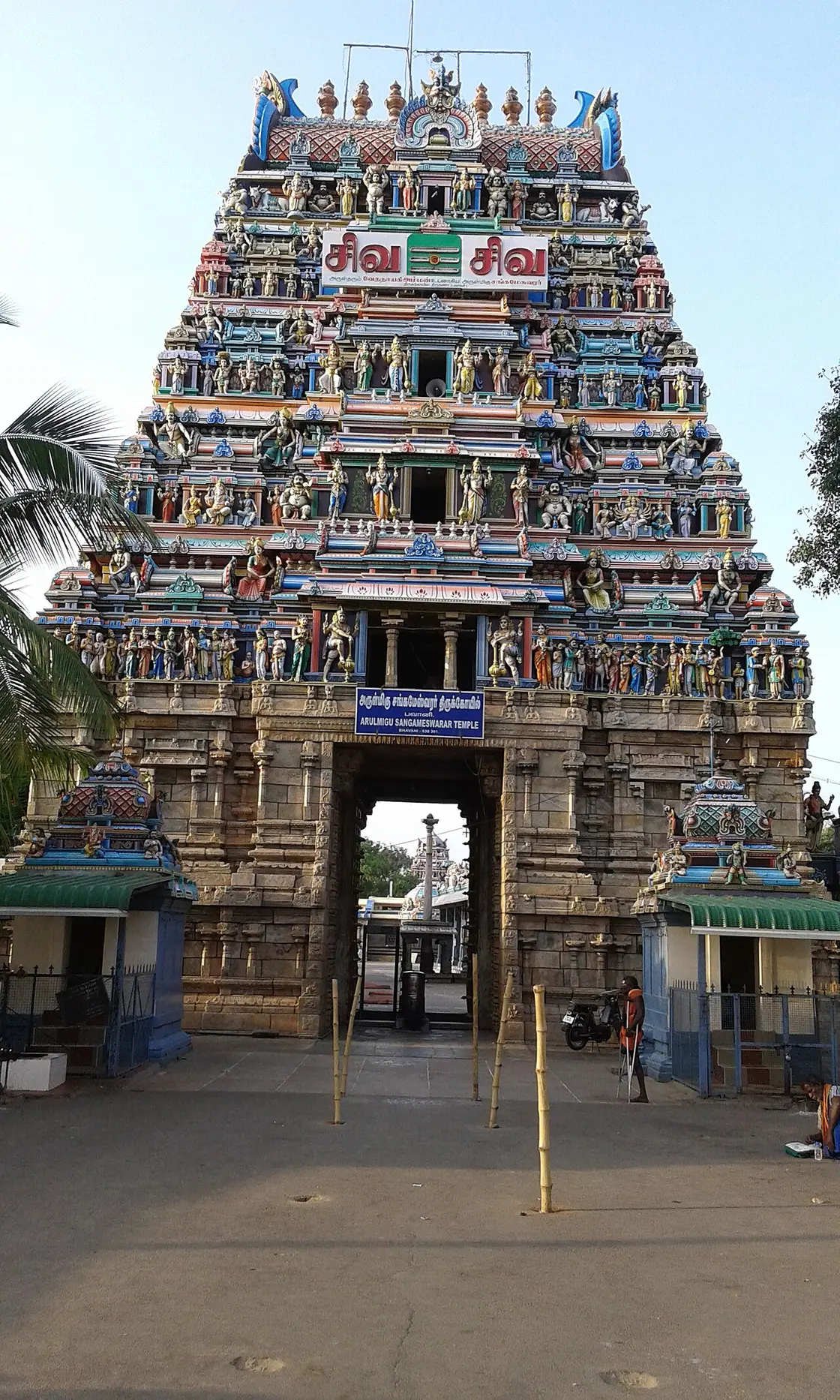
Check entry arrangements. Ask temple staff about visitor entry, dress requirements and access to the inner shrine before you travel, especially if you are visiting as a non-Hindu.
Dress respectfully and follow the institution’s admission and photography rules.
Bhavani Sangameswarar Temple stands by Kooduthurai, the visible meeting of the Kaveri and Bhavani rivers, with a third sacred river belonging to faith tradition. Plan temple worship and river-ghat access independently. The confluence is visible, but currents and water levels do not make it a guaranteed bathing place.
The temple’s setting beside two rivers gives Bhavani its pilgrimage importance. The unseen Amudha or Amirtha river is a sacred belief rather than a mapped surface channel.
Living worship, ancestral rites and private grief deserve space. Ask before photographing people at the ghats.
Use only the currently permitted steps, keep children close and stay out of the water when flow or local instructions make it unsafe.
For the visit itself, allow one to two hours. The best time is a quieter morning in safe river conditions. Check temple darshan and ghat conditions separately. Observe rituals without intrusion. River currents, slick steps and changing levels can be dangerous.
A quieter morning in safe river conditions.
Live forecast loads in your browser.
Sun and moon are calculated for this location and shown in IST. Photography windows are the hour around sunrise and sunset; the sunset bearing is degrees clockwise from true north. Moon phase is accurate to about half a day.
Verified hotels, homestays, restaurants, experiences, sights, shops and rentals around Bhavani Sangameswarar Temple — commission-free, with direct contact. Filter by what you need.
Verified places are being added. The category filters will fill in as approved stays, restaurants, experiences, sights, shops and nature listings go live.
List your place2 more places around Bhavani. Open a guide to plan the visit and onward journey.

160 m · 2 min walk
The riverside confluence and bathing ghat at Bhavani where the Kaveri, Bhavani and mythical Amudha rivers meet, adjoining the Sangameswarar Temple — a pilgrimage spot for ancestral rites, known as the Triveni Sangamam of the South.
6.1 km · ~15 min by auto
This Vishnu temple sits on the Vedagiri hill at Urachikottai, about 5 km from Bhavani on the western bank of the Cauvery, and is regarded as the first of five hills known as the Panchagiri. Dedicated to Varadaraja Perumal, the temple is believed to be more than 1,000 years old. The hill is dotted with Saiva and Vaishnava shrines and overlooks the river.
Roampedia is commission-free — own or know a stay, eatery, guide or shop near Bhavani Sangameswarar Temple? List it and it appears here once verified.
Add a nearby businessEntry: Ordinary darshan and paid rites are separate.
Navigate to Sangameswarar Temple/Kooduthurai in Bhavani.
If you need step-free access, contact the site before travelling. Ask about a level entrance, steps along the route, the nearest drop-off point, seating and accessible toilets.
Emergency numbers are verified against official government and state tourism sources. 112 works anywhere in India.
The riverside confluence and bathing ghat at Bhavani where the Kaveri, Bhavani and mythical Amudha rivers meet, adjoining the Sangameswarar Temple — a pilgrimage spot for ancestral rites, known as the Triveni Sangamam of the South.
160 m · 2 min walk · straight lineThis Vishnu temple sits on the Vedagiri hill at Urachikottai, about 5 km from Bhavani on the western bank of the Cauvery, and is regarded as the first of five hills known as the Panchagiri. Dedicated to Varadaraja Perumal, the temple is believed to be more than 1,000 years old. The hill is dotted with Saiva and Vaishnava shrines and overlooks the river.
6.1 km · ~15 min by auto · straight lineThis Vishnu temple in Erode city is dedicated to Kasthuri Aranganathar (Ranganatha) and goddess Kamalavalli, and is attributed to the Chola king Parantaka I, making it about 1,080 years old. Its name derives from a legend in which a pregnant woman offered kasthuri (herbal medicine) to the deity for a safe delivery. It is counted among the historic Kongu-region temples and lies within walking distance of the Periya Mariamman Temple.
10.9 km · ~18 min by cab · straight line
The Periya Mariamman Temple stands in the heart of Erode city, opposite the Corporation building near Panneer Selvam Park, and is dedicated to the goddess Mariamman. It is traditionally held to have been built by the Kongu Cholas around 1,200 years ago. The temple is a prominent local pilgrimage centre known for its Mariamman festival.
11.0 km · ~18 min by cab · straight line
A multipurpose government museum on Brough Road, established 1987, holding collections of art, archaeology, anthropology, numismatics and natural history, including Kongu Chola inscriptions and Thanjavur paintings.
11.5 km · ~19 min by cab · straight line
The childhood home of social reformer Erode Venkatappa Ramasamy, widely known as Periyar. Born in Erode in 1879, he is remembered here through personal belongings, photographs and writings.
11.5 km · ~19 min by cab · straight line
A CSI church consecrated in 1933, built by missionary Rev. Antony Watson Brough in Indo-Saracenic style within the CSI institutions campus at Erode Fort.
11.6 km · ~19 min by cab · straight line
A hilltop temple to Lord Murugan (Arulmigu Velayuthaswamy) on the Thindalmalai hillock about 7 km from Erode city, known for its golden temple chariot that circles the hill during festivals.
12.8 km · ~21 min by cab · straight line
An ancient hilltop Murugan shrine reached by a stairway of about 1,320 steps or a road with nine hairpin bends, roughly 28 km from Erode, linked to the Kanda Sashti Kavasam line "Siragiri Velavan".
19.9 km · ~33 min by cab · straight line
A bird sanctuary built around the Periyakulam tank near Vadamugam Vellode, about 12 km from Erode, drawing thousands of migratory birds — pelicans, spoonbills, storks and ducks — between November and March.
20.4 km · ~34 min by cab · straight lineLocated at Pudupalayam near Anthiyur, this temple enshrines Gurunathaswami, worshipped through three sacred stones representing Kamakshi, Vishnu, and Shiva combined with Murugan. Legend holds the stones were once worshipped near Chidambaram, hidden in a river, and rediscovered at Pudupalayam, where a temple was built with Pandya patronage about 600 years ago. Its annual festival falls in the Tamil month of Aadi.
20.8 km · ~35 min by cab · straight lineThe Amarapaneeswarar Temple at Pariyur is a Shiva temple dating to about the 10th century CE, with its consort worshipped as Soundaranayaki Amman. Originally built during the Chola period, it received later additions from the Pandya, Hoysala and Mysore rulers, and today is rebuilt almost entirely in white marble. Maha Shivaratri and Pradosham are celebrated here with particular grandeur.
25.0 km · ~42 min by cab · straight lineThe Kaveri and Bhavani are visible; the third river belongs to sacred tradition.
No. Follow current local restrictions and water conditions.
A quieter morning in safe river conditions.
Entry: Ordinary darshan and paid rites are separate. Timings: Confirm current darshan sessions; ghats depend on river conditions.
Check temple darshan and ghat conditions separately. Observe rituals without intrusion.
Allow one to two hours.
Nearby you can pair Kooduthurai Triveni Sangamam (160 m), Urachikottai Varadaraja Perumal Temple (6.1 km), Kasthuri Aranganathar Temple (10.9 km), Periya Mariamman Temple, Erode (11.0 km).
River currents, slick steps and changing levels can be dangerous.
Written about Bhavani Sangameswarar Temple itself — its history, its legends and the arguments about them.


These guides explore Bhavani and the surrounding area. Choose a visit that fits your interests, allowing separately for travel between stops.
Route-level itineraries and practical guides for the rest of Tamil Nadu.
Photographs: Ssriram mt (CC BY-SA 4.0), Shanze1 (CC BY-SA 4.0). Wikimedia Commons.