
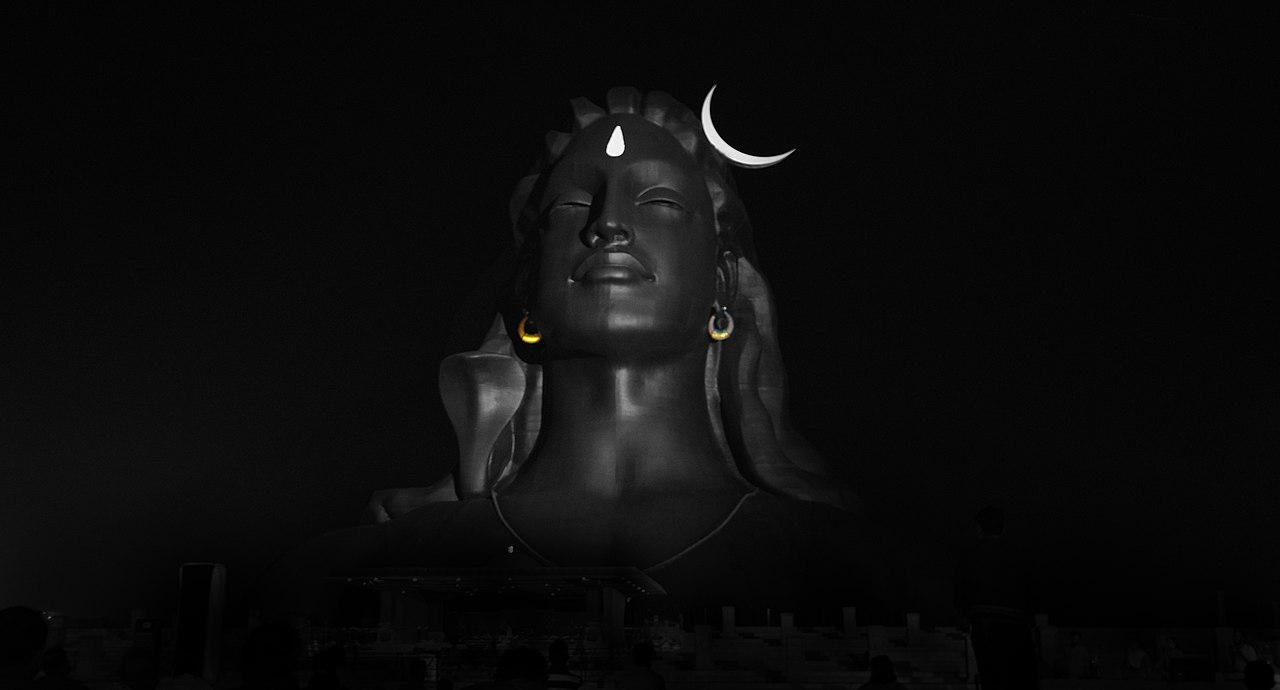
At the foot of the Velliangiri hills west of Coimbatore, a vast black face rises from the plain — eyes closed, hair falling in coils, a crescent moon at the brow. This is Adiyogi, a 112-foot steel bust of Shiva conceived as the “first yogi”, the mythic figure that yogic tradition credits with giving the science of yoga to humanity. Unveiled in 2017, it has quickly become one of Tamil Nadu’s most photographed modern landmarks and, by one measure, a record-holder: the largest bust sculpture in the world.
- Where: the Isha Yoga Center, in the foothills of the Velliangiri hills, about 30 km west of Coimbatore.
- What: a 112-foot (34 m) steel bust of Shiva as Adiyogi, unveiled on Maha Shivaratri, 24 February 2017.
- Record: recognised by Guinness World Records as the largest bust sculpture in the world.
- Cost: free to visit — the grounds and the evening light-and-sound offering are open to the public.
The first yogi, cast in steel
The bust was designed under Sadhguru, founder of the Isha Foundation, and built in about eight months by volunteers and rural blacksmiths. It stands roughly 112 feet (34 metres) high, some 147 feet long and 82 feet wide, and is assembled from steel plates and pipes weighing around 500 tonnes. Prime Minister Narendra Modi unveiled the Adiyogi statue on Maha Shivaratri, 24 February 2017. Guinness World Records went on to certify it as the largest bust sculpture in the world — a bust being a sculpture of the head, shoulders and chest rather than a full figure. It sits on open ground at the foot of the Velliangiri hills, the range the foundation holds sacred, so that the great face seems to gaze out from the mountains.
The meaning of 112
The height is not arbitrary. According to the foundation’s teaching, the figure 112 stands for the 112 ways in which a human being can attain to wellbeing — the 112 methods, or paths towards liberation, that yogic culture is said to describe, corresponding to 112 chakras or energy centres in the human system. In this reading Adiyogi is presented less as a deity to be worshipped than as a symbol of possibility: the claim, as Isha frames it, is that anyone willing to work on themselves has many doors open to them. Whether or not one accepts the metaphysics, the number gives the sculpture both its scale and its billing as “the source of yoga”.
The Yogeshwara Linga, the Yaksha and the light offering
Directly in front of the face, the foundation has consecrated the Yogeshwara Linga, a black stone linga it describes as an energy form set aside for meditation. The space before the bust also stages Yaksha, Isha’s annual festival of Indian classical music and dance, held in the run-up to Maha Shivaratri when performers appear beneath the illuminated face. On most evenings the statue becomes the backdrop for the Adiyogi Divya Darshanam, a short 3D light-and-sound presentation projected onto the bust that narrates, in the foundation’s telling, how the first yogi came to share yoga with the world. The offering is free and draws large crowds after dark.
The Isha Foundation and the mountain behind it
Adiyogi stands within the Isha Yoga Center, the headquarters of the Isha Foundation — a spiritual organisation founded by Sadhguru that runs yoga programmes and social projects across India. The same campus holds the Dhyanalinga, a domed meditation shrine consecrated in 1999 and open to visitors of any faith or none, and it sits directly below the Velliangiri hills, whose hilltop Shiva shrine is reached by a steep pilgrim climb. The foundation presents the site as a place for stillness rather than ritual, and it rewards being approached on those terms, as much for descriptive interest as for devotion. Entry to the grounds and to the Adiyogi is free.
Visiting
The Isha Yoga Center lies about 30 km west of Coimbatore, roughly 45 minutes by road, at the foot of the Velliangiri hills; the nearest airport and railway station are both in the city. The grounds are free to enter and are busiest around Maha Shivaratri in February or March, when an all-night celebration fills the campus. Dress modestly, carry water for the open plaza, and — if you can — time an evening visit for the light offering. For getting there and what else to see around the city, our companion guides go further: the Coimbatore city guide at /india/tamil-nadu/guides/coimbatore-city-guide, and the two-day hill run at /india/tamil-nadu/guides/coimbatore-to-ooty-in-2-days.
Frequently asked questions
How tall is the Adiyogi Shiva statue?
It stands about 112 feet (34 metres) high, roughly 147 feet long and 82 feet wide, and is built from steel weighing around 500 tonnes. The 112-foot height is deliberate, echoing the number that gives the sculpture its symbolism.
Is the Adiyogi statue really a world record?
Yes. Guinness World Records recognises the Adiyogi bust as the largest bust sculpture in the world — a bust being a sculpture of the head, shoulders and chest rather than a full standing figure.
What does the number 112 mean?
According to the Isha Foundation’s teaching, 112 refers to the 112 ways a person can attain to wellbeing, and to 112 chakras or energy centres in the human system. It is presented as the foundation’s symbolism rather than an established fact.
Who built the Adiyogi statue and when was it unveiled?
It was designed under Sadhguru of the Isha Foundation and built in about eight months by volunteers and rural blacksmiths. Prime Minister Narendra Modi unveiled it on Maha Shivaratri, 24 February 2017.
Is it free to visit the Adiyogi and the Isha Yoga Center?
Yes. Entry to the grounds and to the Adiyogi is free, as is the evening light-and-sound offering, the Adiyogi Divya Darshanam, projected onto the bust after dark.
What else is there to see at the site?
Beyond the bust, the campus holds the Dhyanalinga meditation shrine and the consecrated Yogeshwara Linga in front of Adiyogi, and it sits below the Velliangiri hills, whose hilltop Shiva shrine draws pilgrims on a steep climb.