
In almost every Shiva temple in the Tamil country, the sanctum holds a lingam. At Avudaiyarkoil, near Aranthangi in Pudukkottai district, it holds nothing at all. The Athmanathaswamy Temple — the temple of Tirupperunturai — worships Shiva with no lingam and no image, only the avudaiyar, the pedestal on which a lingam would ordinarily stand, with the space above it left empty. What is enshrined here is that emptiness itself, held up as a sign of the formless Absolute. Add to that some of the most astonishing stone carving in South India, and a deep bond with the saint Manikkavacakar, and Avudaiyarkoil becomes one of Tamil Nadu’s most quietly extraordinary temples.
- Where: Avudaiyarkoil village, near Aranthangi, Pudukkottai district, Tamil Nadu
- What: A Shiva temple (Tirupperunturai) where the deity is worshipped in formless fashion — no lingam or image, only the avudaiyar pedestal
- Famous for: The Tiruvasagam of Manikkavacakar, by tradition composed here, and its extraordinarily fine granite carving
- Don’t miss: The stone rafters and eaves cut to imitate a timber roof, and the filigree pillar-work of the mandapams
A temple to the formless
Most Shaiva sanctums are built around a lingam. Here the Athmanathaswamy Temple breaks that rule entirely. In the innermost shrine there is only the avudaiyar — the base that normally cradles a lingam — with the place above it empty. An upturned measuring vessel, the padi, is set on the pedestal to mark where a lingam would otherwise be. The presiding deity, Athmanathaswamy, is understood as formless, the nirguna Brahman without shape or attribute, and the bare pedestal is his sign. The idea is often explained this way: images help the beginner, but as devotion matures the worshipper is led towards the truth that the divine has no form. The goddess too is worshipped without an idol, represented by a yoga peetham, a meditation seat; some accounts describe a carved footprint upon it. Unusually for a Shiva temple, older descriptions also note the absence of a conventional Nandi before the shrine. The temple stands in the village of Avudaiyarkoil, and its formless worship has long invited comparison with the “space” shrine of Chidambaram.
Manikkavacakar and the Tiruvasagam
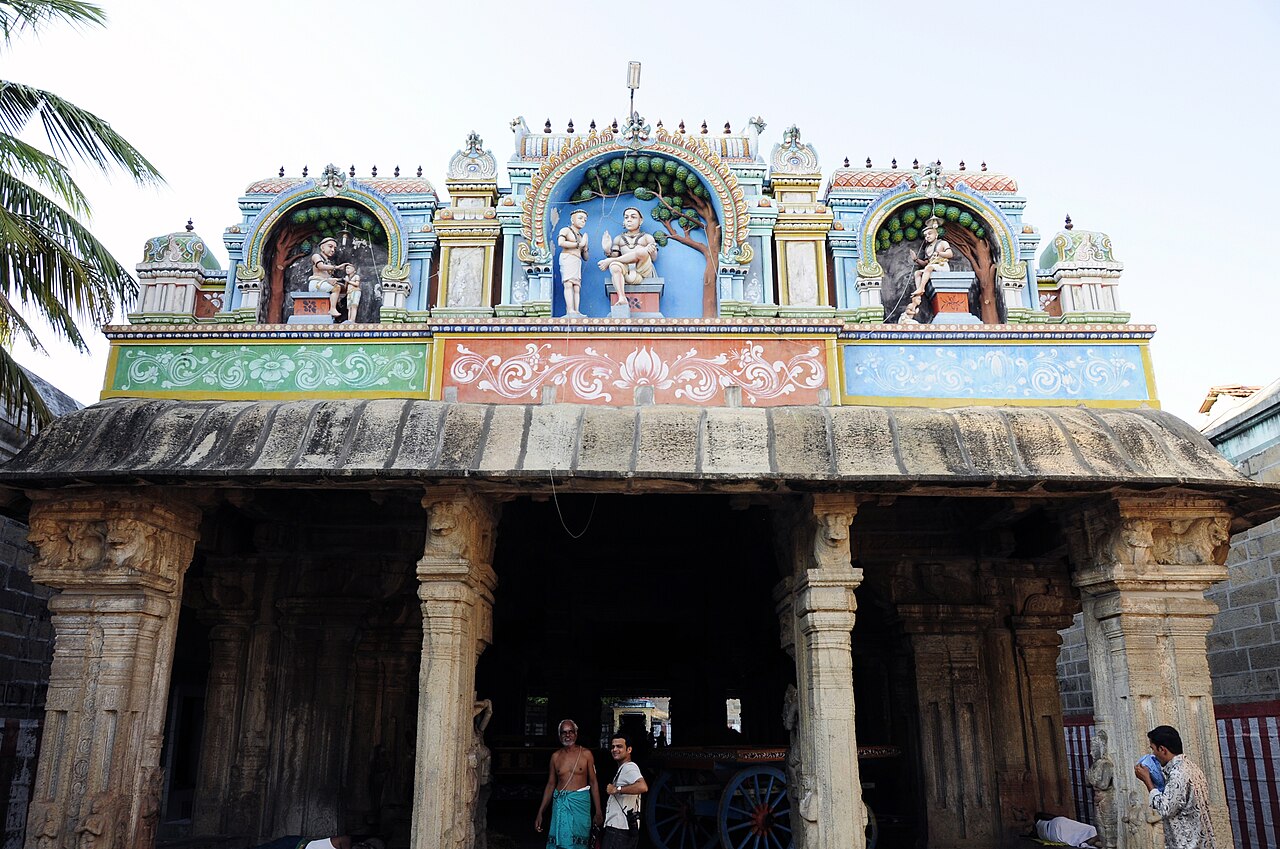
Avudaiyarkoil’s fame rests as much on a saint as on its stone. By tradition this is Tirupperunturai, the place where Manikkavacakar — one of the four great saints of Tamil Shaivism — found his guru and composed the Tiruvasagam, the “sacred utterance” whose verses are among the most loved in all Tamil devotional literature. The best-known legend frames him as a minister of a Pandya king who was sent with royal treasure to buy war-horses. At Tirupperunturai he met a teacher he took to be Shiva himself, and spent the money instead on building and adorning the temple. The tale of the missing horses, the king’s anger and the miracles that followed is told with many variations and is best read as sacred legend rather than history; what is not in doubt is the temple’s enduring identification with the saint and his hymns. A shrine to Manikkavacakar stands within the complex, and the Tiruvasagam is recited here still.
A poem in stone
If the sanctum is famous for its emptiness, the halls around it are famous for being impossibly full of carving. Avudaiyarkoil is celebrated for granite worked as though it were timber: the kodungai — the sloping eaves and rafters of the mandapams — are cut from stone yet imitate wooden beams, purlins and even the nails and lashings that would bind a real roof together. Look up in the great halls and you find ribs and cross-beams of granite where a carpenter’s work should be. The pillars carry a dense programme of relief — dancers, deities and mythological scenes — worked with a delicacy that has earned the temple its reputation as a “poem in stone”. Guides often point to chains and other filigree said to be cut from single blocks of granite; such claims are common at South Indian temples and are best enjoyed with a little caution, but the sheer refinement of the work here is beyond dispute. Much of it is usually attributed to the temple’s later expansion, with the mandapams counted among the finest achievements of Nayaka-era stone-craft.

Fire, steam and other customs
Several of Avudaiyarkoil’s ritual customs are as unusual as its sanctum, though accounts of them vary and are worth treating with care. The most often repeated concerns the food offering: because the deity is formless, it is said that the naivedyam is presented not as a dish but as the steam rising from hot rice — sometimes described as rice mixed with bitter gourd — spread on a stone slab, so that the vapour itself is offered to the formless Lord. Some accounts extend the idea to say the temple sets aside the usual fire and lamp rituals, while others instead stress its lamp symbolism, with lamps read as the divisions of time and the twenty-seven nakshatras of the lunar month. The temple is also described as following Vedic rather than Agamic forms of worship. Because these traditions are reported so differently from source to source, it is wise to ask the temple staff about current practice rather than rely on any single description.
Visiting Avudaiyarkoil
Avudaiyarkoil lies in Pudukkottai district, close to Aranthangi and within reach of Pudukkottai town and Tiruchirappalli (Trichy). Like most living temples it keeps a morning and an evening darshan session and closes through the middle of the day, so plan around those hours; photography inside the sanctums is usually restricted, and modest dress is expected. The carving rewards a slow, upward-looking visit, so allow time and, if you can, a knowledgeable guide. The temple pairs naturally with other Pudukkottai heritage — the hilltop Thirumayam Fort is an easy drive away, as is the rock-cut Jain cave at Sittanavasal. To set Avudaiyarkoil in the wider story of Tamil temple building, read /india/tamil-nadu/guides/great-living-chola-temples and /india/tamil-nadu/guides/sittanavasal-frescoes-story .
Frequently asked questions
Why is there no lingam at Avudaiyarkoil?
The temple worships Shiva as formless, the nirguna Absolute without shape or image. So the sanctum holds only the avudaiyar — the pedestal on which a lingam would normally sit — with the space above it empty, and an upturned measuring vessel placed on it to mark the spot. The empty pedestal is itself the object of worship.
Where is Avudaiyarkoil and how do I reach it?
Avudaiyarkoil is a village in Pudukkottai district, near Aranthangi in southern Tamil Nadu. It is most easily reached by road from Pudukkottai town or Aranthangi; the nearest larger transport hubs are Pudukkottai and Tiruchirappalli (Trichy).
What is the temple’s connection with Manikkavacakar?
By tradition this is Tirupperunturai, where the saint Manikkavacakar met his guru and composed the Tiruvasagam, one of the great works of Tamil Shaiva devotion. The popular legend that he was a Pandya minister who spent the king’s horse-money on the temple is sacred legend rather than documented history, but the temple’s bond with the saint is central to its identity.
What makes the carving at Avudaiyarkoil special?
Its granite is worked to imitate woodwork. The eaves and rafters of the mandapams, called kodungai, are carved from stone yet mimic timber beams, purlins and fixings, and the pillars are covered in fine relief. This craftsmanship has earned the temple its nickname as a “poem in stone”.
Is it true that rice is offered as steam here?
That is the tradition most often described: because the deity is formless, the offering is said to be the steam rising from hot rice spread on a stone slab, rather than a plated dish. Accounts of this and other customs differ between sources, so treat the details as reported tradition and check current practice with the temple.
When is the temple open, and can I take photographs?
Like most living Tamil temples it opens for morning and evening darshan and closes in the middle of the day, so plan around those windows. Photography inside the sanctums is usually restricted and modest dress is expected — ask on arrival and follow the temple staff’s guidance.