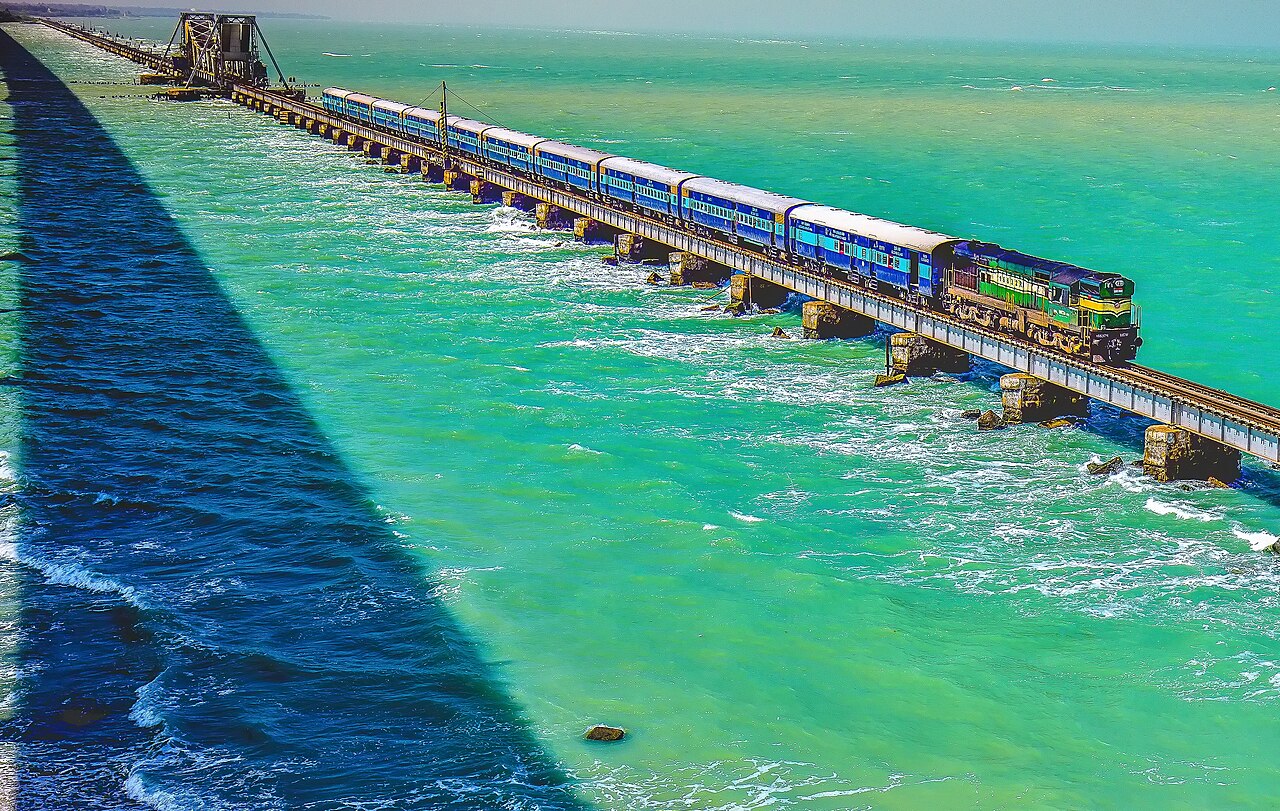
For most of a century, everything and everyone reaching the island of Rameswaram by land crossed a single slender ribbon of iron over the sea. The Pamban Bridge — a low rail viaduct striding across the shallow, turquoise Palk Strait — was India’s first bridge built over open sea, and for pilgrims heading to the great Ramanathaswamy Temple it was as much a rite of passage as a railway line. Watching a train inch across the water, with the strait glittering on both sides, remains one of the most photographed sights in Tamil Nadu.
- The historic 1914 rail bridge was decommissioned in December 2022 and trains no longer use it — the striking bridge you see trains crossing today is the new lift bridge that opened alongside it in 2025.
- The best free viewpoints are from the road bridge (the Annai Indira Gandhi Road Bridge) that runs parallel, and from the Rameswaram-bound train itself.
- It is windy and exposed over the strait — hold on to hats, phones and loose items.
- Pair the crossing with Rameswaram’s temple and the ghost town of Dhanushkodi for a full day.
India’s first bridge over the sea
The idea of bridging the strait was floated as far back as 1870, but work only began in 1911, and the bridge opened to traffic on 24 February 1914. It ran a little over two kilometres — about 2,065 metres — carried on 143 piers, with the rails set some 12.5 metres above the water. That length made it not just India’s first sea bridge but its longest, a record it held for almost a century until the Bandra–Worli Sea Link opened in Mumbai in 2010. Building it in the corrosive salt air of the strait, over a channel that funnels cyclones, was a genuine feat of Edwardian engineering.
How the leaves lifted for ships
The bridge’s signature feature sat right in the middle: a double-leaf bascule span of the Scherzer rolling-lift type, which let the central section split and tilt upward like a drawbridge so that boats and small ships could pass between the strait’s two halves. Each of the two lifting leaves weighed around 415 tonnes, and the whole operation was done by hand — bridge staff heaving on levers to raise and lower the span, a job that took roughly three quarters of an hour. For generations of railway workers, standing on the water and cranking open a bridge for a passing dhow was simply part of the day’s work.
The night the sea took a train
The strait’s danger was not theoretical. On the night of 22–23 December 1964 a ferocious cyclone slammed into the tip of the island, wiping out the town of Dhanushkodi — which has been a ghost town ever since — and sweeping the Pamban–Dhanushkodi passenger train off the tracks into the sea, killing everyone aboard; estimates of the toll on that train range from around 115 to 200 people. The bridge itself was wrecked, losing most of its spans. The task of rebuilding it fell to a young engineer named E. Sreedharan — later famous as the “Metro Man” behind the Konkan Railway and Delhi Metro — who is widely credited with restoring the shattered bridge in just 46 days, far ahead of schedule.
The new bridge that rises
By the 2020s a century of salt had taken its toll, and the old bascule span was corroded beyond safe use; rail traffic across it stopped in December 2022. Its replacement, the New Pamban Bridge, was opened for traffic on 6 April 2025 and stands as India’s first vertical-lift sea railway bridge. Built parallel to the old line and running about 2.07 kilometres on 99 spans, it swaps the tilting leaves for a modern trick: a central section some 72 metres long that rises straight up between two towers to let ships pass beneath, lifting clear in a few minutes. Constructed by Rail Vikas Nigam Limited at a cost of roughly ₹5 billion and designed to carry electrified, higher-speed trains, it is built to outlast its remarkable predecessor. (A parallel road link, the Annai Indira Gandhi Road Bridge, has carried vehicles across the strait since 1988.)

Seeing the bridges
The most memorable way to experience Pamban is simply to arrive by train, watching the strait open out on either side as you cross. For photographs, the parallel road bridge gives sweeping views of both structures side by side — the low, historic line and the taller new lift bridge with its towers — and dawn and dusk are the golden hours here. Give the crossing its due and then roll on into Rameswaram itself. To fit it into a wider trip, see our two-day plan at /india/tamil-nadu/guides/rameswaram-and-dhanushkodi-in-2-days and the temple story at /india/tamil-nadu/guides/rameswaram-ramanathaswamy-story.
Frequently asked questions
When did the original Pamban Bridge open, and why is it famous?
It opened on 24 February 1914 as India’s first sea bridge, connecting Rameswaram (Pamban Island) to the mainland across the Palk Strait. At around 2,065 metres it was also India’s longest sea bridge until the Bandra–Worli Sea Link opened in 2010.
How did the old bridge let ships pass?
A central double-leaf bascule span of the Scherzer rolling-lift type split and tilted upward like a drawbridge. Each leaf weighed about 415 tonnes and was raised and lowered manually with levers, a process that took roughly 45 minutes.
What happened in the 1964 cyclone?
On the night of 22–23 December 1964 a cyclone destroyed the town of Dhanushkodi and swept the Pamban–Dhanushkodi passenger train into the sea, killing everyone on board — estimates range from about 115 to 200 people. The bridge lost most of its spans and was famously rebuilt in around 46 days under engineer E. Sreedharan.
Can trains still cross the old 1914 bridge?
No. The historic bridge was decommissioned in December 2022 because the corroded bascule span was no longer safe. Trains now use the new bridge that opened beside it in 2025.
What is the New Pamban Bridge?
Opened for traffic on 6 April 2025, it is India’s first vertical-lift sea railway bridge. Its roughly 72-metre central span rises straight up between two towers to let ships pass, and the bridge is built for electrified, faster trains — replacing the century-old line running alongside it.
How do I get the best view of the bridge?
Cross by train for the classic over-the-water experience, or walk and drive the parallel Annai Indira Gandhi Road Bridge for wide views of both the old and new bridges together. Sunrise and sunset are the best times for photographs.