
Few Indian states carry as much World Heritage as Tamil Nadu, and fewer still spread it across such different worlds. Here the honour attaches to imperial Chola granite in the Kaveri delta, to Pallava sculpture carved straight out of seaside boulders, to some of the last rainforest ridgelines of the Western Ghats, and to a steam-and-diesel rack railway that still grinds up to Ooty. Four separate UNESCO listings touch the state — three of them anchored in Tamil Nadu, one shared across the mountains of the south. This guide sorts out what is actually inscribed, what is merely famous, and how to string the sites into a trip.
- Great Living Chola Temples — inscribed 1987, extended 2004 (Thanjavur, Ariyalur, Kumbakonam).
- Group of Monuments at Mahabalipuram — inscribed 1984 (Chengalpattu district, coast south of Chennai).
- Western Ghats — inscribed 2012, a serial site of 39 properties across four states; Tamil Nadu clusters include the Nilgiris and the Anamalai hills.
- Nilgiri Mountain Railway — part of the “Mountain Railways of India” World Heritage Site (the NMR was added in 2005).
What counts as World Heritage in Tamil Nadu
A “World Heritage Site” is a specific thing: a place formally inscribed on UNESCO’s list after nomination by the national government and assessment by expert bodies. That is different from a site that appears on India’s tentative list, and different again from a place that is simply old, sacred or beautiful. Tamil Nadu has plenty of the latter — grand temple towns and hill stations that draw millions — but only four inscribed strands. Getting this straight matters, because a good deal of tourism copy loosely calls almost any historic temple a “UNESCO site.” It is worth knowing which claims are true.
The Great Living Chola Temples
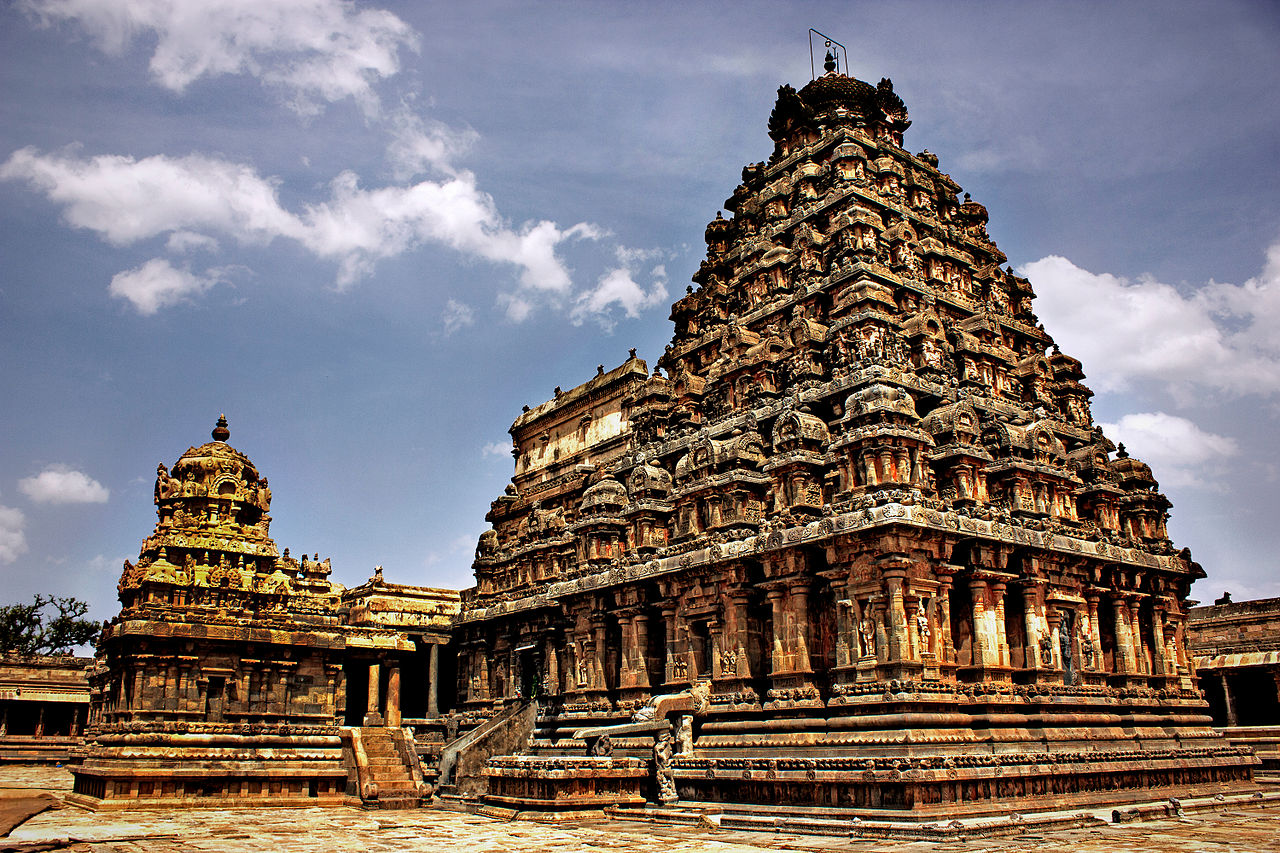
The oldest of the state’s listings began in 1987, when UNESCO inscribed the Brihadeeswarar Temple at Thanjavur — Rajaraja Chola I’s granite masterpiece, completed in 1010 CE, its vimana rising in a single tapering pyramid over the sanctum. In 2004 the listing was extended and renamed the “Great Living Chola Temples,” adding two more monuments raised by the same dynasty: the Brihadeeswarar Temple at Gangaikonda Cholapuram, built by Rajendra Chola I to mark his new capital, and the Airavatesvara Temple at Darasuram near Kumbakonam, a smaller but exquisitely carved 12th-century shrine.
The word “living” is the key. Unlike ruins that have passed out of use, all three are functioning Shiva temples where worship continues daily. They form a compact trail through the Chola heartland — Thanjavur, Ariyalur and Kumbakonam are within a couple of hours of one another — and together they show the dynasty’s temple architecture at three moments of its confidence.
The Group of Monuments at Mahabalipuram
On the coast south of Chennai, in Chengalpattu district, a different genius is at work. The Group of Monuments at Mahabalipuram was inscribed in 1984 and gathers a scatter of Pallava-era carvings from the 7th and 8th centuries — an age when sculptors worked not by assembling blocks but by cutting form directly out of the living rock. The seafront Shore Temple is the exception, a structural temple of dressed stone; almost everything else is monolithic or rock-cut.
The set-pieces are extraordinary. The Pancha Rathas are five “chariots,” each a whole shrine carved from a single boulder and each in a different architectural style. Nearby, Arjuna’s Penance — also read as the Descent of the Ganges — is one of the largest open-air rock reliefs in the world, its cliff face crowded with gods, sages, and a family of life-size elephants. Behind them, cave temples such as the Mahishasuramardini cave and the Varaha cave temple hold panels that are among the finest narrative sculpture of early medieval India. All of it sits within an easy walk, making Mahabalipuram the most concentrated of the state’s heritage sites.
The Western Ghats and the Nilgiri Mountain Railway
The fourth strand is not a monument at all but a mountain range. In 2012 UNESCO inscribed the Western Ghats as a serial natural site — 39 separate properties spread across Kerala, Tamil Nadu, Karnataka and Maharashtra, recognised as one of the world’s eight “hottest” biodiversity hotspots and an engine of the Indian monsoon. Tamil Nadu’s share lies in two clusters. In the Nilgiris, Mudumalai National Park and the higher, misty grasslands of Mukurthi National Park protect elephant, tiger and endemic Nilgiri tahr. Further south, in the Anamalai hills above Valparai, the Anamalai Tiger Reserve shelters lion-tailed macaque and shola-grassland forest. These are inscribed for what lives in them, not for anything built by people.
There is, however, one built thing in the same mountains that carries its own listing. The Nilgiri Mountain Railway, the metre-gauge rack line that climbs from Mettupalayam through Coonoor to Udhagamandalam (Ooty), is part of the “Mountain Railways of India” World Heritage Site — a group listing to which the NMR was added in 2005, alongside the Darjeeling and Kalka–Shimla lines. Opened in 1908 and still using its original Swiss-designed rack-and-pinion system on the steepest sections, it is a piece of working heritage: you do not just look at it, you ride it.

Visiting: how to plan around the sites
Because the four listings sit in very different corners of the state, no single loop takes in all of them comfortably. The practical split is by region. The Chola temples form a delta cluster best reached from Thanjavur or Kumbakonam, ideally over two unhurried days. Mahabalipuram is a half-day-to-a-day trip from Chennai and pairs naturally with the city. The Western Ghats sites belong to a hill-country itinerary — base yourself in Ooty or Coonoor for the Nilgiris and the railway, or Valparai for the Anamalais — and reward slow travel and early mornings. Carry modest, covered clothing for the living temples, where worship continues, and book NMR seats well ahead in season, as the little train fills quickly.
For the deeper stories behind these places, our companion guides go further: read about the Chola trail in the guide to the Great Living Chola Temples at /india/tamil-nadu/guides/great-living-chola-temples, and about the sculptors of the coast in the guide to the Pallava monuments at /india/tamil-nadu/guides/mahabalipuram-pallava-monuments-story.
Frequently asked questions
How many UNESCO World Heritage Sites are there in Tamil Nadu?
Three World Heritage listings are anchored in the state — the Great Living Chola Temples, the Group of Monuments at Mahabalipuram, and the Nilgiri Mountain Railway (part of the Mountain Railways of India) — plus the Tamil Nadu clusters of the Western Ghats, which is a serial site shared across four states.
What are the Great Living Chola Temples?
They are three functioning Shiva temples built by the Chola dynasty: the Brihadeeswarar Temple at Thanjavur (inscribed 1987), and the Gangaikonda Cholapuram temple near Jayankondam and the Airavatesvara Temple at Darasuram, both added when the listing was extended in 2004.
When was Mahabalipuram made a World Heritage Site?
The Group of Monuments at Mahabalipuram was inscribed in 1984. It includes Pallava-era works of the 7th and 8th centuries — the Shore Temple, the monolithic Pancha Rathas, the open-air relief known as Arjuna’s Penance, and several rock-cut cave temples.
Is the Western Ghats a UNESCO site, and is it in Tamil Nadu?
Yes. The Western Ghats were inscribed in 2012 as a serial natural site of 39 properties spread across Kerala, Tamil Nadu, Karnataka and Maharashtra. Tamil Nadu’s clusters include the Nilgiris (Mudumalai and Mukurthi) and the Anamalai hills.
Why is the Nilgiri Mountain Railway a World Heritage Site?
It is recognised as an outstanding example of hill railway engineering and is part of the group listing “Mountain Railways of India.” The Nilgiri line was added to that site in 2005, joining the Darjeeling Himalayan Railway and the Kalka–Shimla Railway.
Can I see all of Tamil Nadu’s World Heritage sites in one trip?
Not comfortably — they lie in different regions. Most travellers group them: the Chola temples around Thanjavur and Kumbakonam, Mahabalipuram from Chennai, and the Western Ghats and railway in the Nilgiri and Anamalai hills.