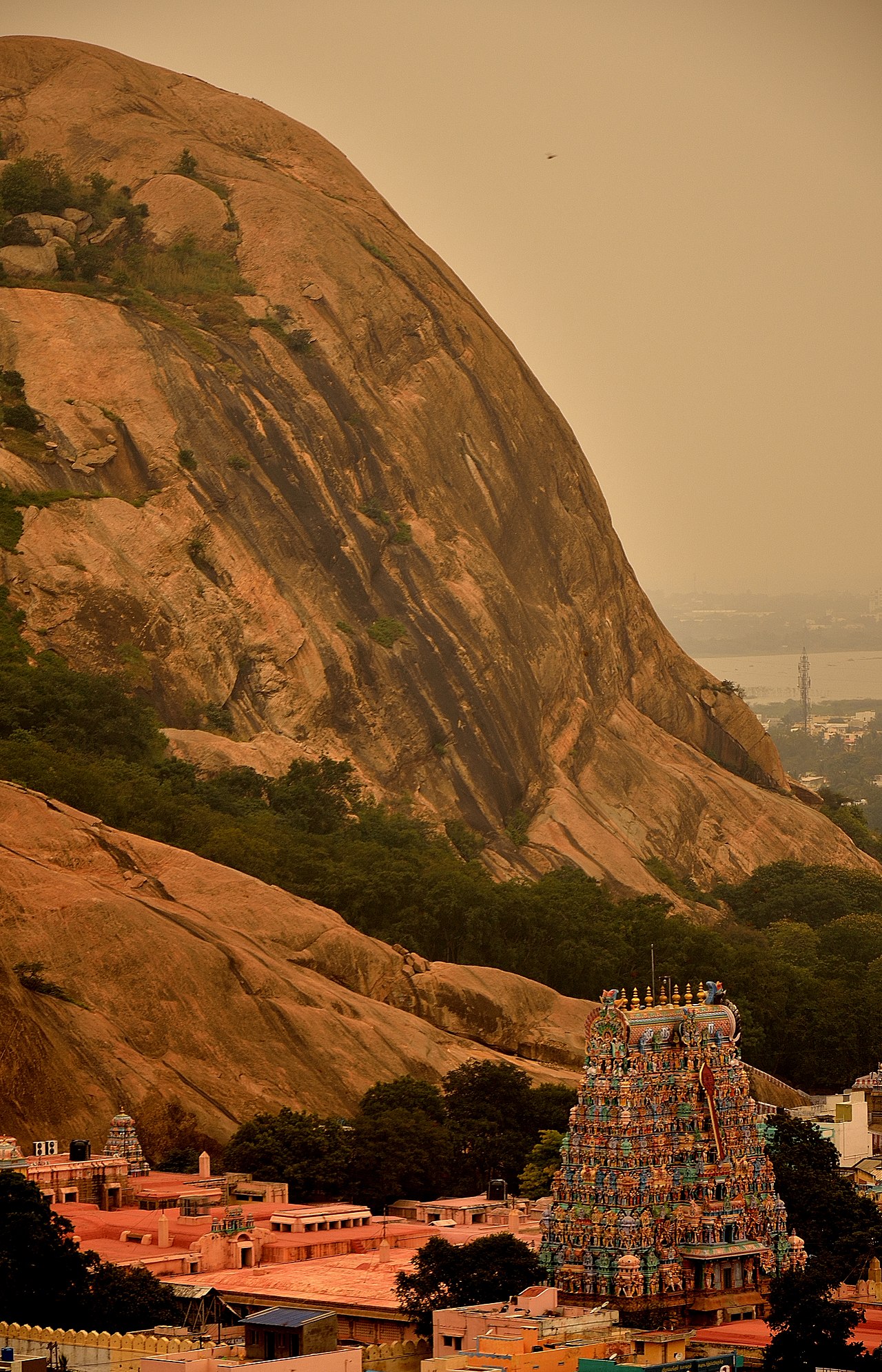
About eight kilometres south-west of Madurai, a granite hill rises abruptly from the plain, and into its base is carved one of the oldest and most revered shrines in the Tamil country. This is Thiruparankundram, held to be the first of the Arupadai Veedu — the six sacred abodes of Murugan strung across Tamil Nadu. Where later temples pile up gopurams and pillared halls, the heart of this one is a rock-cut cave, its deities cut directly from the living stone of the hillside. Pilgrims have begun the six-abode circuit here for well over a thousand years, and for many the visit is bound up with a single story: this, by tradition, is where Murugan married.
- Thiruparankundram is the first of the six Arupadai Veedu, the sacred abodes of Murugan, about 8 km south-west of Madurai
- The core of the temple is a Pandya-era rock-cut cave; the inner sanctum is generally open to Hindus, while the outer halls and gopuram are open to all
- The great annual festival is the Panguni Brahmotsavam, which marks the wedding of Murugan and Deivanai
- The cave enshrines Murugan alongside Shiva, Vishnu, Durga and Vinayaka — an unusual gathering of deities in one shrine
The first of the six abodes
The Thiruparankundram Murugan temple opens the Arupadai Veedu, the trail of six shrines that together tell the life of Murugan — from Palani and Swamimalai to the seashore temple at Tiruchendur. Thiruparankundram is traditionally counted first, the place where the god settled into married life after his battles were won. Its closeness to Madurai ties it firmly into the great temple city: during the Panguni festival, images of Murugan and Vishnu are carried in procession to Madurai for the celebrated wedding of the goddess Meenakshi at the Meenakshi Amman temple. For pilgrims, the two temples belong to a single sacred landscape, and many pair a visit to the first abode with the city’s towering shrine a short drive away.

The wedding of Murugan and Deivanai
The legend that draws so many here is told, not recorded as history. According to the Skanda Purana, Murugan led the armies of the gods against the demon Surapadman and, after a long war, defeated him. In gratitude, Indra, king of the gods, is said to have given his daughter Deivanai — also called Deivayanai or Devasena — to Murugan in marriage, and that wedding, by tradition, took place at Thiruparankundram. It is why the temple is so closely associated with marriage and family, and why couples still come to seek blessings here. The story is best understood as sacred tradition rather than fact, but it has shaped the temple’s festivals, its rituals and its place in Tamil devotion for centuries, and the Panguni Brahmotsavam each spring re-enacts the divine marriage before large crowds.
A Pandya rock-cut cave
The oldest part of the temple is a rock-cut cave shrine attributed to the Pandya dynasty, its earliest work generally dated to around the sixth to eighth centuries CE — among the early rock-cut monuments of the south. Rather than being built up in stone, the sanctums and their images were cut directly into the face of the hill, so that the gods appear to emerge from the rock itself. What makes the cave unusual is its company of deities: alongside Murugan, the walls hold Shiva, Vishnu, Durga and Vinayaka together in one shrine, a rare pairing of the region’s major traditions. The hillside also carries older marks of Jain presence — rock beds and carvings from a time when Jain monks used these slopes — a reminder that the site changed hands and faiths across the long Pandya centuries before settling into its present form.

The hill above the shrine
The temple takes its name from the hill — Parankundram — that towers more than a thousand feet above the cave. The lower shrine is the destination for most visitors, but the slopes above hold their own layers of worship. Near the summit stands a Kasi Viswanatha shrine dedicated to Shiva, reached by a long climb that rewards the effort with wide views over Madurai and the plain. The hilltop is also home to the Sikandar Dargah, a Muslim shrine that draws its own pilgrims, so that Hindu and Islamic devotion share the same rock — a quiet mirror of the mixed history written into the hillside below. Together the cave, the summit shrines and the Jain traces make Parankundram a single hill layered with many centuries of faith.
Visiting
Thiruparankundram is an easy trip from Madurai, close enough to fold into a day that also takes in the Meenakshi temple. Mornings are calmest; the temple grows busy on festival days and especially during the Panguni Brahmotsavam, when the wedding is celebrated with processions and large crowds. As at many Tamil Nadu temples, the inner cave sanctum is generally reserved for Hindus, while the outer halls, the great gopuram and the hill paths are open to all. Dress modestly, remove footwear before entering, and if you plan to climb to the summit shrines, set off early to beat the midday heat and carry water. To place this first abode in its wider setting, read our guide to the six shrines at /india/tamil-nadu/guides/arupadai-veedu-six-abodes-of-murugan, and plan the surrounding city with /india/tamil-nadu/guides/madurai-city-guide.
Frequently asked questions
Why is Thiruparankundram important among Murugan temples?
It is traditionally counted as the first of the Arupadai Veedu, the six sacred abodes of Murugan in Tamil Nadu, and by tradition the place where he married Deivanai after defeating the demon Surapadman.
What is the wedding legend of Thiruparankundram?
According to the Skanda Purana, Murugan defeated the demon Surapadman, and Indra gave his daughter Deivanai (Deivayanai or Devasena) to him in marriage at this site. It is sacred tradition rather than recorded history, but it shapes the temple’s festivals and its association with marriage blessings.
How old is the rock-cut cave temple?
The cave shrine is attributed to the Pandya dynasty, with its earliest work generally dated to around the sixth to eighth centuries CE, making it one of the early rock-cut monuments of southern India. The sanctums and images were carved directly into the hillside.
Can non-Hindus enter the temple?
The outer halls, the gopuram and the hill paths are open to everyone, but the inner cave sanctum is generally reserved for Hindus, as at many Tamil Nadu temples. Dress modestly and remove footwear before entering the complex.
Is there anything on top of the hill?
Yes. Near the summit is a Kasi Viswanatha shrine dedicated to Shiva, reached by a long climb, and the hilltop also holds the Sikandar Dargah, a Muslim shrine with its own pilgrims. The slopes carry older Jain rock beds and carvings as well.
How far is Thiruparankundram from Madurai?
About 8 km south-west of the city, an easy trip by taxi, auto or bus. It pairs naturally with the Meenakshi Amman temple in Madurai, and during the Panguni festival the two temples are linked by processions between them.