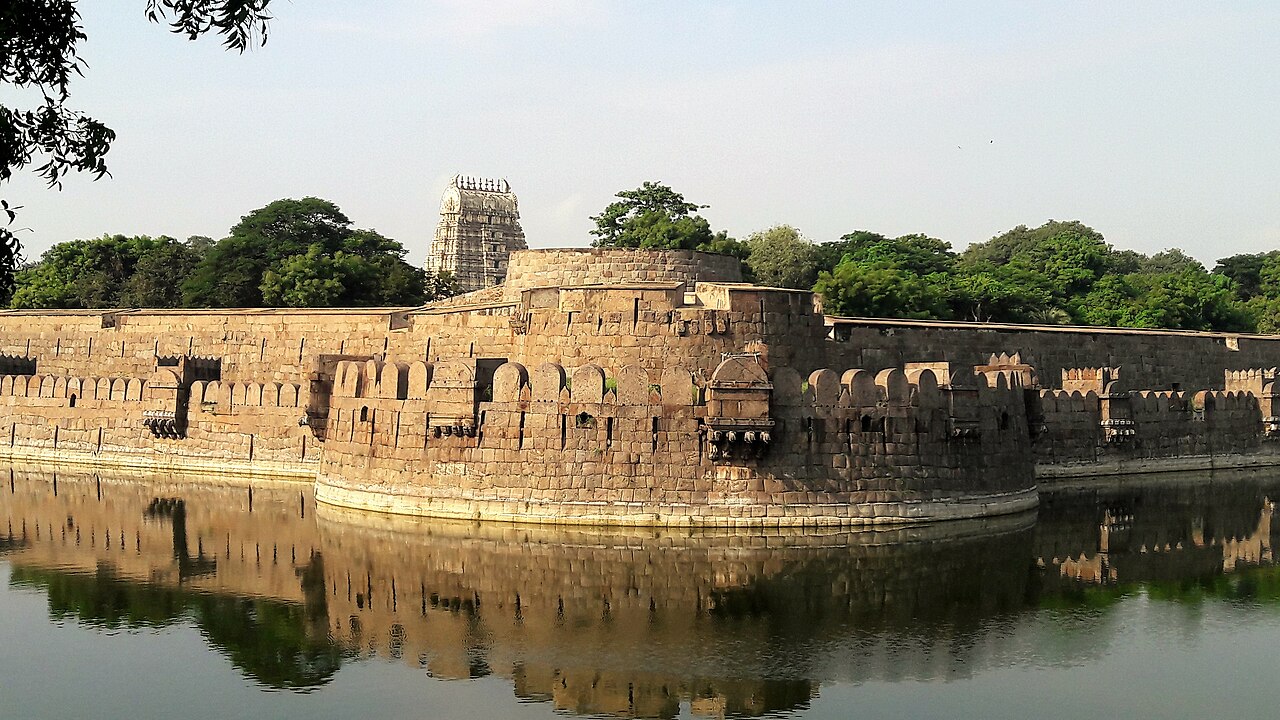
Northern Tamil Nadu holds two very different kinds of landmark within an easy drive of each other. Vellore keeps a sixteenth-century granite fort inside a broad water moat and, a short hop away, a modern temple sheathed in gold. Kanchipuram, the old Pallava capital, is called the city of a thousand temples and still weaves the silk saris that carry its name. This two-day loop pairs the two, and it slots neatly between Chennai and Bengaluru, so you can begin from either city.
- Day 1: Vellore — the moated Vellore Fort and Jalakandeswarar temple, then the Sripuram Golden Temple, about 8 km out of town.
- Day 2: Kanchipuram — the great Shiva and Vishnu temples and a stop at a silk-weaving workshop.
- Getting there: Vellore is about 135 km west of Chennai (2.5–3 hrs) and roughly 210 km east of Bengaluru (about 4 hrs); Vellore to Kanchipuram is about 70 km (1.5 hrs).
- Best time: November to February, when the plains are dry and comparatively cool.
Getting there and how the days fit together
Vellore sits on the Chennai–Bengaluru corridor, so both cities feed it well. From Chennai it is about 135 km and 2.5 to 3 hours by road, with frequent trains to Katpadi junction just outside town. From Bengaluru it is roughly 210 km and around four hours. The logic of the route is simple: base yourself in Vellore for the first night, spend day one on the fort and the Golden Temple, then drive the 70-odd kilometres east to Kanchipuram on the morning of day two. Kanchipuram is only about 75 km from Chennai, so if you started in Chennai you can close the loop and be back in the city by evening. Both towns have plenty of mid-range hotels; Vellore also draws a steady medical-tourism crowd, so rooms are easy to find.
Day 1: Vellore Fort and its water moat
Start early at the Vellore Fort, built around 1566 under the Vijayanagara rulers. Its low granite walls are unusual for being wrapped in a wide, still moat, once stocked (so local accounts say) with crocodiles to deter attackers. The fort later passed through Bijapur, Maratha, Mughal and finally British hands, and in 1806 it was the scene of the Vellore Mutiny, an early revolt of Indian sepoys against the East India Company that predates the better-known 1857 uprising. Inside the walls stands the Jalakandeswarar temple, a fine piece of Vijayanagara architecture whose name means roughly the lord residing in water — its lingam was once ringed by water. Look for the carved pillared hall and the monolithic sculptures. The same compound holds the Government Museum, with regional bronzes and coins, and the colonial-era St John’s Church, so you can cover several centuries without leaving the ramparts.
Day 1 continued: the Sripuram Golden Temple
In the afternoon head about 8 km south of the city to Thirumalaikodi, where the Sri Lakshmi Narayani Golden Temple sits at the foot of green hills. Opened in 2007, it is a modern shrine famous for being clad in gold foil worked over copper, glinting hard in the afternoon sun. Pilgrims walk a long star-shaped path that spirals inward to the sanctum, and the route is lined with panels carrying spiritual inscriptions. It is a deliberate contrast to the weathered stone of the morning — one place all age and siege, the other all shine and calm gardens. Note a strict dress code and a ban on cameras and phones inside; there are lockers at the entrance. Allow a couple of unhurried hours, then return to Vellore for the night.

Day 2: Kanchipuram’s temples and silk looms
Drive east to Kanchipuram, one of the seven sacred cities of Hinduism and a town packed with temples spanning the Pallava, Chola and Vijayanagara eras. Begin at the Kailasanathar temple, the oldest of them, raised by the Pallava king Rajasimha in the early eighth century. Built of soft sandstone rather than granite, it is quieter and more intimate than the giants nearby, its outer wall lined with small cells and traces of old fresco. From there move to the Ekambareswarar temple, a vast complex dedicated to Shiva as the earth element among the five Pancha Bhoota Sthalams, crowned by a towering gopuram and sheltering a mango tree the priests will tell you is centuries old. Round out the temple circuit at the Kamakshi Amman temple, the town’s great goddess shrine, and the Varadharaja Perumal temple, a Vishnu Divya Desam known for its finely carved stone chain and hundred-pillared hall. Bear in mind that the inner sanctums of many working temples are open to Hindus only, though the halls and towers are yours to wander.

Save the last hour for the looms. Kanchipuram silk, the heavy Kanjivaram sari woven with pure mulberry silk and real gold or silver zari, is one of India’s most prized textiles, and a visit to a silk-weaving workshop or cooperative shows the pit looms and the interlocked-border technique in action. Prices climb fast, but even browsing is a lesson in why a single sari can take days to weave. From here Chennai is an easy run back for the evening.
When to go
The comfortable window is November to February, when the plains are dry and temperatures are manageable for a day of walking stone courtyards. March through June turns fiercely hot, with the interior regularly pushing into the high thirties Celsius, so if you must travel then, do the fort and temples early and rest through midday. The northeast monsoon brings rain from about October, which can green the hills behind Sripuram but also flood the odd temple street. Whichever season you pick, carry water, wear clothes that cover shoulders and knees for the temples, and expect to leave your shoes (and often your camera) at the gate.
Want more before you set off? Read the companion story on Vellore’s fort and golden temple at /india/tamil-nadu/guides/vellore-golden-temple-and-fort-story, and dig into the weaving town in the guide at /india/tamil-nadu/guides/kanchipuram-silk-and-temples-story.
Frequently asked questions
How many days do you need for Vellore and Kanchipuram?
Two days is enough for the highlights — one for Vellore Fort and the Sripuram Golden Temple, and one for the Kanchipuram temples and silk. Add a third day only if you want an unhurried pace or extra temples.
How far is Vellore from Kanchipuram?
About 70 km, or roughly 1.5 hours by road. Both towns lie on well-served routes, so a taxi or bus between them is straightforward.
Can non-Hindus enter the temples?
You can freely explore the courtyards, halls and towers of the Kanchipuram temples and the Jalakandeswarar temple in Vellore Fort. The innermost sanctums of many active temples, however, are open to Hindus only.
Are cameras allowed at the Sripuram Golden Temple?
No. Cameras and phones are banned inside, and there is a dress code. Lockers are provided at the entrance for your belongings.
Is Vellore Fort worth visiting?
Yes. It is one of the best-preserved forts in Tamil Nadu, ringed by a wide water moat, and it holds the Vijayanagara-era Jalakandeswarar temple, a museum and a colonial church all within its walls.
When is the best time to visit?
November to February, when the weather is dry and cool. Avoid April to June, when the plains grow very hot.