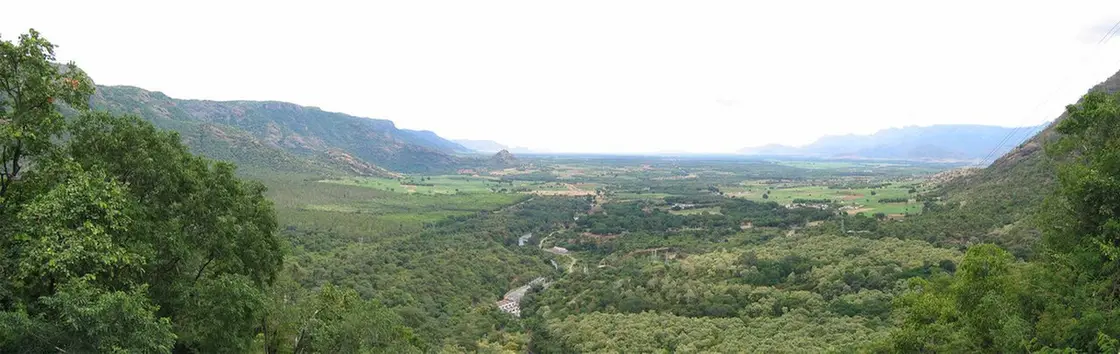
Kamayagoundanpatti is a Cumbum Valley village beneath the Western Ghats, worth visiting for a local Murugan shrine, vineyard country and the scale of an agricultural settlement—not as a substitute label for Cumbum’s monuments.
Kamayagoundanpatti village is the dependable navigation anchor. Earlier attraction coordinates merely repeated the village centre, so this guide does not present them as a surveyed temple entrance.
Kamayagoundanpatti lies in Uthamapalayam taluk near Cumbum, on the cultivated floor of a valley held between high Western Ghats slopes. The enclosing mountains affect rain, wind, crops and every road view.
The village is associated with Shanmuganathar worship and a Thaipusam gathering. It is a living local shrine, not a staffed heritage attraction with published tourist hours.
No dependable named OSM object for the temple appeared in the audit. Navigate to the exact village, show the Tamil name காமயகவுண்டன்பட்டி, and ask for the current public approach instead of following the former copied pin.
Thaipusam centres Murugan and the carrying of vows. A festival visit requires humility: streets become procession space, traffic changes, photography needs consent and a visitor should never obstruct kavadi bearers or worship.
The valley is well known for grapes and other irrigated cultivation. Vineyards are farms, not public tasting rooms. Enter only by invitation, agree whether photographs are welcome and purchase directly when a grower offers produce.
Cumbum Ardhanareeswarar Temple has been removed from this town’s own compact selection because it belongs to Cumbum. It remains a possible separate outing, but should not be used to make Kamayagoundanpatti appear to contain two monuments.
That correction matters. A small village page becomes useful by explaining arrival, worship, agriculture and return transport, not by borrowing the nearest famous name.
The Cumbum Valley carries old routes towards the Kerala high ranges. Modern traffic includes farm vehicles, buses and tourism transfers; roadside shoulders can be narrow and are not automatically pleasant walking routes.
Early morning is best for village streets and field-edge views. Midday heat can be intense even with mountains nearby, while monsoon rain can obscure slopes and change minor-road surfaces.
The northeast and southwest monsoons affect different parts of the valley and ghats. A green photograph cannot guarantee today’s crop stage, waterfall flow or road condition.
Cumbum and Uthamapalayam offer more dependable food, cash, fuel and onward transport. Listings shown for the village must be checked on the map; do not assume an app will supply a late return car.
Agree an auto or driver’s total fare and waiting time before a farm-edge or temple visit. Ask about the last bus while still in the morning service window.
Accessibility cannot be inferred from flat valley ground. Temple thresholds, crowded festival streets, broken verges and toilets all require specific local questions.
For a traveller with limited stamina, a short vehicle-based village circuit, a permitted exterior shrine view and an arranged vineyard conversation can be more meaningful than chasing a checklist.
There is no securely sourced supernatural foundation myth in the reviewed official and map records. The page preserves the documented Thaipusam tradition without manufacturing an origin tale.
Kamayagoundanpatti’s story is the relationship between hill wall, irrigated field, Murugan devotion and an ordinary village’s working day. That is specific enough when described honestly.
Legend & myth
Thaipusam devotional practice is documented locally, but no reliable village-foundation myth was found.
Murugan stories belong to a broad Tamil sacred tradition; the page does not claim a universal story happened at this precise shrine without a local source.
Ask worshippers how the festival is understood today and obtain consent before recording an account.