What to expect
Highlights
- The hilltop Renuka-Yellamma shrine.
- The sweeping views over the Malaprabha country.
- The vast full-moon jatre gatherings.
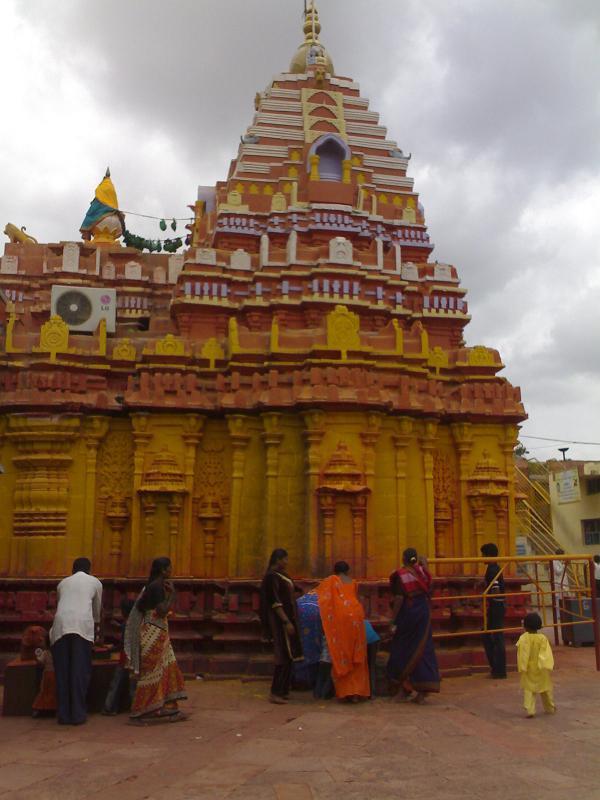
The Saundatti Yellamma temple crowns Yellammana Gudda hill above Saundatti, rebuilt in 1514 in a Chalukya-Rashtrakuta style and dedicated to the goddess Renuka-Yellamma.
Check entry arrangements. Ask temple staff about visitor entry, dress requirements and access to the inner shrine before you travel, especially if you are visiting as a non-Hindu.
Dress respectfully and follow the institution’s admission and photography rules.
One of the most visited Shakta pilgrimage sites in Karnataka, it draws enormous crowds at its full-moon jatres, especially the Bharata Hunnime fair.
The Renuka–Yellamma shrine on Yellammana Gudda, five kilometres outside Saundatti: a hill temple dated by the Belagavi district administration to 1514 and a living pilgrimage centre drawing worshippers from Karnataka and neighbouring states.
Saundatti’s great shrine stands on a hill once called Siddhachal Parvat. The Belagavi district administration identifies the goddess as Renuka, worshipped here as Yellamma, and places the temple about 5 km from town and roughly 70 km from Belagavi.
The district account says Bomappa Naik of Raybag built the temple in 1514. It describes a blend of Chalukya and Rashtrakuta style and notes Jain influence in the carving, with subsidiary shrines to Ganesh, Mallikarjuna, Parashurama, Eknath and Siddeshwara in the precinct.
The architecture explains only part of the place. Pilgrims arrive from Maharashtra, Goa and Andhra Pradesh as well as Karnataka, and the jatres turn the hill into a dense temporary city. The temple has been under government management since 1975; the district says dharmashalas and health facilities were provided for pilgrims.
Yellamma worship also has a difficult social history tied to the outlawed dedication of devadasis. A visit should neither sensationalise women at the shrine nor romanticise exploitation. The living faith, reform history and present-day pilgrims all deserve the same basic respect.
In Hindu tradition Yellamma is Renuka, wife of the sage Jamadagni and mother of Parashurama. The cycle tells of her beheading and restoration, and worshippers read it through ideas of rupture, endurance and divine motherhood. This is sacred narrative, not documentary history.
The hill’s older name, Siddhachal, and the nearby Parashurama shrine keep that Renuka cycle visible in the landscape. Visitors encounter it through worship and festival practice rather than through a single authoritative version of the story.
1514 — the Belagavi district administration dates the present temple to construction by Bomappa Naik of Raybag.
1975 — management passed to the government, which the district account says developed dharmashalas, health centres and other pilgrim facilities.
The jatres remain major inter-state gatherings. Dates and crowd arrangements vary with the religious calendar and must be checked for the intended visit.
Visit for one of northern Karnataka’s most important living Shakta pilgrimage landscapes, where shrine, hill and fair ground form one religious complex.
An ordinary weekday gives the clearest architectural visit. A jatre gives the fullest living tradition but demands advance transport planning, patience and close attention to official crowd controls.
Road km to Belagavi; ghat roads and traffic vary — allow extra.
October to February; full-moon days are peak but extremely crowded.
Live forecast loads in your browser.
Sun and moon are calculated for this location and shown in IST. Photography windows are the hour around sunrise and sunset; the sunset bearing is degrees clockwise from true north. Moon phase is accurate to about half a day.
Verified hotels, homestays, restaurants, experiences, sights, shops and rentals around Saundatti Yellamma Temple — commission-free, with direct contact. Filter by what you need.
The mapped bus stand serving the Yellammana Gudda pilgrimage precinct, useful for checking current return transport before joining the temple queue.
Book with the place itself. India’s cyber-crime coordination centre warned in April 2025 that convincing copies of hotel and pilgrimage booking sites are being pushed through sponsored search and social ads, taking payment for rooms the property never hears about. Every listing here links to the business’s own contact details and its own Google or Bing profile — we take no commission and sit in nobody’s payment path. If a booking page reached you through an ad, check the address bar against the property’s own site before you pay. Fraud can be reported on cybercrime.gov.in or on 1930.
Find food, accommodation and activities across Saundatti. Browse the guides for places to eat, stay and explore along your route.
Walking routes start at Saundatti Yellamma Temple. Check the route and access before setting out, especially where a road, gate or waterway separates the stops.
5 more places around Saundatti. Open a guide to plan the visit and onward journey.

4.6 km · ~12 min by auto
The walled fort in Saundatti town, a compact historic stop close to the market streets. It is distinct from Parasgad Fort south of town.

6.6 km · 7 min drive
A hill fort south of Saundatti linked to the Desai chiefs and later the Marathas, its broken walls occupying an exposed ridge above the Malaprabha country.

8.2 km · 8 min drive
A cluster of 11th–12th-century Kalyani-Chalukya and Ratta temples at Huli (Hooli) in Saundatti taluk, the Panchalingeshwara temple among them — richly carved, protected shrines of the region’s temple-building golden age.

9.7 km · ~16 min by cab
The Malaprabha dam and Renuka Sagara reservoir at Navilutirtha, which the Belagavi district administration places 10 km from Saundatti in a valley between two hills.
11.6 km · ~19 min by cab
A small historic fort at Munavalli north of Saundatti, mapped around a surviving walled enclosure. Treat it as an unstaffed local heritage stop rather than a serviced monument.
Roampedia is commission-free — own or know a stay, eatery, guide or shop near Saundatti Yellamma Temple? List it and it appears here once verified.
Add a nearby businessEntry: No verified visitor fee
The hill precinct is walked once you leave the vehicle, with slopes, steps, queues and hot exposed paving. Keep companions together during a jatre and use only signed public approaches; retain the same vehicle for any wider Saundatti circuit.
Online taxis: Do not assume an instant app pickup at the hill temple. Pre-arrange a car or local auto for both directions, agree waiting time and the return pickup landmark, and retain the driver number.
If you are travelling by bus or ferry, check the return service with the operator before setting out. Leave time to reach the stop or jetty after your visit.
Ask at the jetty or stand for the time of the last service back, not the next one. If you miss it, an auto or app cab is the fallback — agree the fare before you get in.
Checked 4 September 2026 against source 1. Conditions change and surfaces vary with weather — if step-free access is essential, confirm with the site before you travel.
Emergency numbers are verified against official government and state tourism sources. 112 works anywhere in India.
The walled fort in Saundatti town, a compact historic stop close to the market streets. It is distinct from Parasgad Fort south of town.
4.6 km · ~12 min by auto · straight lineA hill fort south of Saundatti linked to the Desai chiefs and later the Marathas, its broken walls occupying an exposed ridge above the Malaprabha country.
6.6 km · 7 min driveA cluster of 11th–12th-century Kalyani-Chalukya and Ratta temples at Huli (Hooli) in Saundatti taluk, the Panchalingeshwara temple among them — richly carved, protected shrines of the region’s temple-building golden age.
8.2 km · 8 min driveThe Malaprabha dam and Renuka Sagara reservoir at Navilutirtha, which the Belagavi district administration places 10 km from Saundatti in a valley between two hills.
9.7 km · ~16 min by cab · straight lineA small historic fort at Munavalli north of Saundatti, mapped around a surviving walled enclosure. Treat it as an unstaffed local heritage stop rather than a serviced monument.
11.6 km · ~19 min by cab · straight lineA historic fortified enclosure at Torgal in Ramdurg taluk, a village associated with Vijayanagara and Adil Shahi layers and an old Bhutanatha temple complex.
22.2 km · ~37 min by cab · straight lineThe hill fort above Ramdurg town, with ruined walls and a broad view over the Malaprabha country. It is an unstaffed climb: go in daylight and do not assume maintained paths or barriers.
26.0 km · ~43 min by cab · straight line
A living Veerabhadra and Bhadrakali pilgrimage temple at Godachi in Ramdurg taluk, known for its annual jatre. Confirm the current festival dates, worship hours and traffic arrangements locally.
28.5 km · ~48 min by cab · straight lineA small fort at Mudakavi east of Ramdurg, surviving as a local, unstaffed heritage site. Combine it only with a daylight road circuit and expect no visitor facilities.
34.1 km · ~57 min by cab · straight line
The fort and palace ruins of the Desai chiefs of Kittur, where in 1824 Rani Chennamma led one of the earliest armed revolts against the British East India Company; the on-site museum holds arms, coins and sculptures from the fort.
42.4 km · ~71 min by cab · straight line
A two-tier waterfall where the Markandeya river drops through a forested valley near Gokak, also called Markandeya Falls; reached by a short trek and fullest after the monsoon.
61.7 km · ~103 min by cab · straight line
Karnataka's second, granite-and-dome legislature building, opened in 2012 on the edge of Belagavi so the assembly can hold a winter session in the north — a monumental modern landmark modelled on Bengaluru's Vidhana Soudha and floodlit at night.
62.7 km · ~104 min by cab · straight lineWalking and driving times are real routed distances, except the few marked “straight line”, which are direct-line estimates and will read short.Routing: © openrouteservice.org by HeiGIT | Map data © OpenStreetMap contributors
Yes. The district administration describes the goddess here as Renuka, popularly worshipped as Yellamma.
The Belagavi district administration places it about 5 km from Saundatti, on Yellammana Gudda.
The district administration dates it to 1514 and attributes it to Bomappa Naik of Raybag.
They follow the religious calendar. Confirm the current dates and transport controls through official temple or district notices before travel.
Do not assume complete step-free access. Road access reaches the hill precinct, but gradients, crowds, thresholds and queue barriers can still obstruct visitors; confirm current assistance locally.
October to February; full-moon days are peak but extremely crowded.
Entry: No verified visitor fee. Timings: No current official daily schedule found; confirm with the temple administration.
About 80 km east of Belagavi via Saundatti town; reached by bus or taxi, then the hill approach. Dress modestly, remove footwear, and expect very heavy crowds on jatre days.
2 to 3 hours with travel and the climb.
Nearby you can pair Savadatti Fort (4.6 km), Parasgad Fort (6.6 km), Hooli Panchalingeshwara Temples (8.2 km), Navilutirtha and Renuka Sagara Dam (9.7 km).
Written about Saundatti Yellamma Temple itself — its history, its legends and the arguments about them.


Route-level itineraries and practical guides for the rest of Karnataka.
Photographs: Manjunath Doddamani Gajendragad, Public domain, via Wikimedia Commons (Public domain). Wikimedia Commons.


