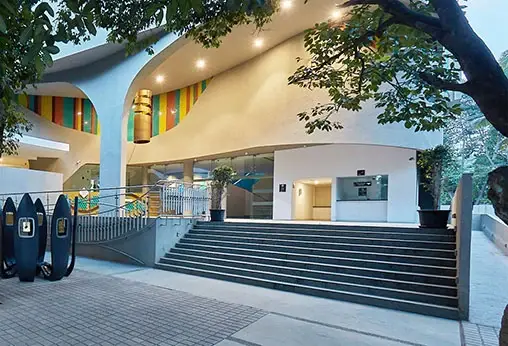
The Indian Music Experience Museum in JP Nagar is a non-profit interactive museum devoted to the diversity and history of Indian music. Its visit combines nine multimedia galleries, an outdoor Sound Garden, performance spaces and a learning centre.
The story of Indian Music Experience Museum
IME opened in 2019 with the aim of introducing younger audiences to Indian musical heritage while preserving and documenting it. This is not a corridor of instruments behind glass. Listening, touchscreens, recording histories and participatory installations ask visitors to compare how music is made, circulated and remembered.
The galleries cross categories that are often kept apart. Living Traditions introduces Carnatic and Hindustani concepts and performers; Songs of the People places folk and tribal music in community context; Contemporary Expressions follows Indian indie rock; and Stories through Song examines music connected with public movements and shared memory.
Reaching Out follows recording technology from wax cylinders and gramophones through radio, studios and mobile listening. The Stars gallery uses personal objects—including Bismillah Khan’s shehnai, M. S. Subbulakshmi’s tambura and Bhimsen Joshi’s concert attire—to connect a public voice with the working life of an artist.
Outside, the Sound Garden turns resonance, vibration and rhythm into physical experiment. A good visit alternates focused listening with breaks instead of trying every screen in quick succession. Check the official programme as concerts, workshops and temporary exhibitions can change what is available on a particular day.
Tradition and living practice
The museum presents classical, devotional, folk, film and contemporary forms through their artists and communities rather than treating “Indian music” as one uniform tradition.
Visitors participate by listening and making sound, but volume controls, headphones and staff instructions protect both equipment and other visitors.
History
IME is a non-profit initiative supported by Brigade Group and opened to the public in 2019.
The museum states that Gallagher & Associates designed the exhibits; its wider work covers exhibitions, conservation, education, audience development and community outreach.
Its 2020 Ravi Shankar@100 exhibition shows how temporary programmes extend the permanent galleries.
Why visit
Hear nine galleries tell connected stories across Indian musical traditions.
Trace recording technology from early mechanical media to phones.
See objects associated with major performers and understand their context.
Experiment with acoustic principles in the Sound Garden.