Hampi is one of the great open-air ruin fields of the world, and there is far more to do here than tick off temples. Spread across the boulder-strewn Tungabhadra valley in Karnataka's Vijayanagara district, this is the ruined capital of the Vijayanagara empire, founded in 1336 and, at its height under Krishnadevaraya in the early 1500s, one of the largest and richest cities on earth. In 1565 the allied Deccan sultanates broke the empire at the Battle of Talikota and sacked the city; what stands today is the vast, quiet aftermath — hundreds of temples, palaces, bazaars and waterworks that UNESCO inscribed as a World Heritage Site in 1986. This guide runs through the best things to do in Hampi and the places to visit across both halves of the site, with Roampedia's commission-free listings for each one — no booking markups, just links straight to the monuments.
- Two halves: the Sacred Centre around the Virupaksha temple and the river, and the Royal Centre of palaces and enclosures a few kilometres south.
- Don't miss: the Virupaksha temple, the Vittala stone chariot, a Matanga or Hemakuta sunset, and the royal enclosures.
- Best months: October to February, when the days are cool and dry; avoid the summer heat from March to May.
- Getting there: Hosapete (Hospet) is the railhead, about 13 km away, with trains from Bengaluru, Hubballi, Hyderabad and Goa.
- Getting around: cycles, mopeds, autos and a battery vehicle link the sites; coracles and a small boat cross the Tungabhadra.
Virupaksha Temple — the living heart of Hampi
The natural place to start is Virupaksha Temple, the only major temple in Hampi still in daily worship. Dedicated to Virupaksha, a form of Shiva, and his consort Pampa, it has roots in the 7th century and grew under the Vijayanagara kings into the complex you see now, its eastern gopuram rising about 50 m over the head of Hampi Bazaar and the river. Inside are pillared halls, a colonnaded courtyard, a temple elephant, and a small rear chamber where a pinhole throws an inverted image of the great tower onto the wall. Go early, leave your footwear at the gate, and allow about an hour.

Hampi Bazaar — the medieval market street
Running east from the temple is Hampi Bazaar, a colonnaded market street about a kilometre long. In Vijayanagara times traders dealt here in diamonds, pearls, horses and spices; today its rows of ruined stone pavilions frame the gopuram, with a large monolithic Nandi (Yeduru Basavanna) at the far eastern end. It is free to wander and best in the low light of early morning or late afternoon, when the stone warms up and the crowds thin.
Hemakuta Hill — early temples and an easy sunset
Just south of the temple, Hemakuta Hill is a low granite rise packed with an unusually dense cluster of pre-Vijayanagara and early Vijayanagara temples, arched gateways and stepped-pyramid towers from the 9th to 14th centuries. The climb is short and gentle, and the wide view west over Virupaksha and the boulder fields makes this Hampi's easiest and most popular sunset spot — arrive about an hour before sundown for a good perch.
The giant monoliths: Lakshmi Narasimha and Sasivekalu Ganesha
On the slopes below Hemakuta stand two of Hampi's giant monoliths. The Lakshmi Narasimha statue is the largest sculpture at the site, a 6.7 m image of Narasimha, the man-lion avatar of Vishnu, carved from a single boulder in 1528 and seated beneath a seven-hooded serpent; the figure of Lakshmi on his knee was damaged when the city fell in 1565, so it is often called Ugra (fierce) Narasimha. The huge Badavilinga Shiva linga stands right beside it. A short walk away, the Sasivekalu Ganesha is a 2.4 m Ganesha in an open pillared pavilion, named for its 'mustard-seed' belly, with the even larger Kadalekalu Ganesha uphill.
Vittala Temple and the stone chariot
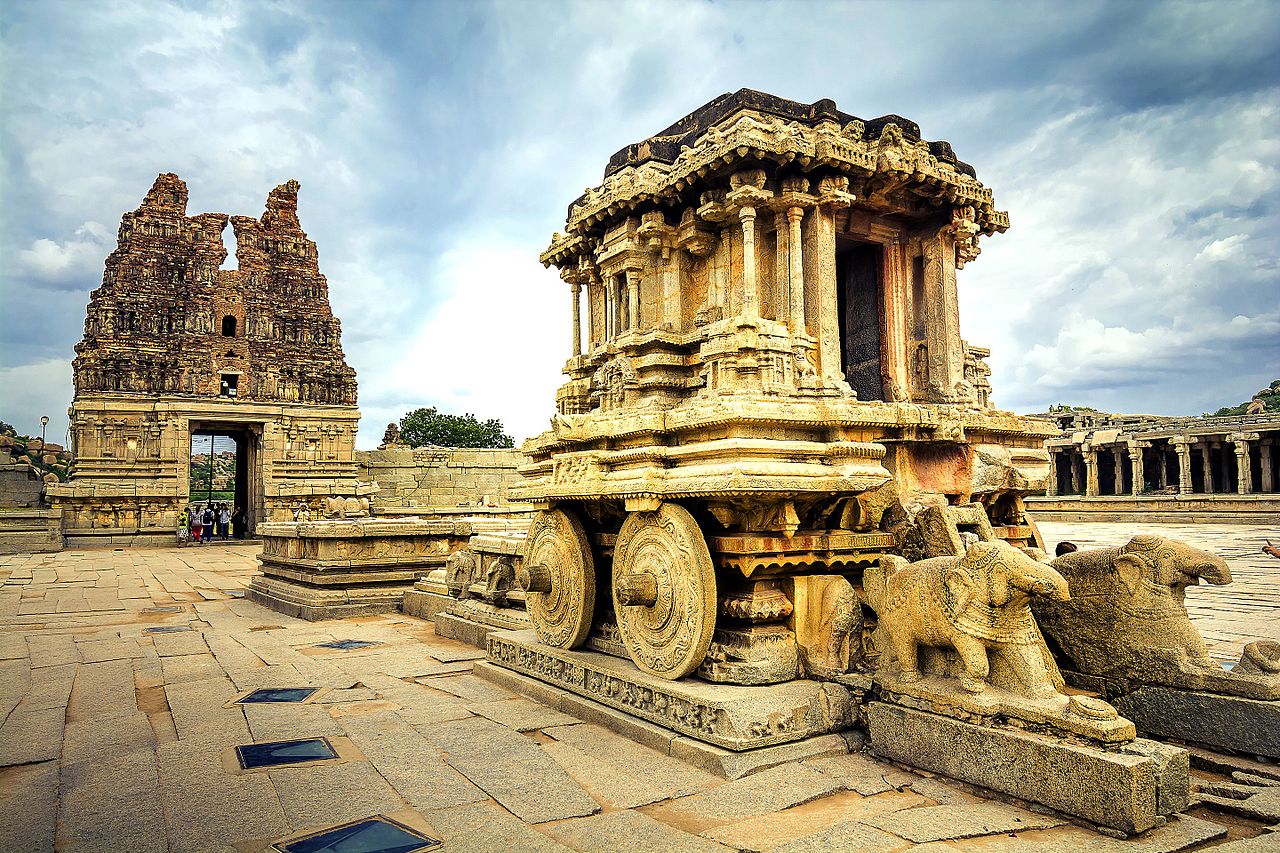
The single finest thing to do in Hampi is Vittala Temple, about 3 km east of the bazaar. Built in the 15th-16th centuries and dedicated to a form of Vishnu, its ranga mantapa is famous for slender 'musical' pillars that ring with different notes when tapped — now roped off to protect them. In the courtyard stands Hampi's signature monument, the ornate stone chariot: a shrine to Garuda carved to look like a temple car, whose stone wheels were once able to turn. It is an ASI-protected site, no longer in worship; keep your ticket, as it also covers the Lotus Mahal and Elephant Stables the same day.
Achyutaraya Temple and the Sule Bazaar
Between Vittala and the bazaar, in a natural amphitheatre of hills, the Achyutaraya Temple was one of the last great temples raised at Hampi, consecrated in 1534 and fronted by the long ruined Courtesans' (Sule) Bazaar. Large, austere and quieter than the headline sites, it is also the usual trailhead for the climb up Matanga Hill.
Matanga Hill — the sunrise viewpoint
For the definitive view, climb Matanga Hill, the highest point in central Hampi, crowned by the small Veerabhadra temple. From the top a 360-degree panorama takes in the whole ruin field, the Tungabhadra and the endless granite. The climb is short but steep and rocky; most people go up for sunrise, which brings the best light and the coolest hour — but not alone in the dark, so team up and check local safety advice first.

Hazara Rama Temple — the royal chapel
Cross into the Royal Centre a few kilometres south and start at the Hazara Rama Temple, the private chapel of the Vijayanagara kings. Its name — 'a thousand Ramas' — comes from the hundreds of relief panels covering its walls: outer friezes of royal processions, elephants, horses and dancers, and inner bands that narrate the Ramayana in sequence around four polished black-granite pillars. It is compact and easy to read as a story in stone.
Lotus Mahal and the Zenana enclosure
Nearby, inside the walled Zenana (women's) enclosure, the Lotus Mahal is one of Hampi's most graceful buildings — a two-storey pavilion whose arches, domes and recessed balconies blend Hindu and Islamic styles into a lotus-bud silhouette. Built to stay cool with airy arcades, it survived the sack of 1565 largely intact and sits on a neat lawn ringed by watchtowers.
Elephant Stables
Just outside the Zenana wall, the Elephant Stables are a grand symmetrical row of eleven large domed chambers that once housed the royal elephants, with a central pavilion and alternating fluted and ribbed domes. It is one of the most complete structures at Hampi and is entered on the same ASI ticket as the Vittala temple and Lotus Mahal.

Queen's Bath
At the southern edge of the Royal Centre, the Queen's Bath hides an ornate interior behind a plain square shell: arcaded corridors and projecting balconies wrap a large sunken tank that was once filled with scented water fed by aqueducts, with a moat around the building. It is a quick stop that shows the pleasure-garden side of Vijayanagara court life.
Tungabhadra Dam
If you have half a day to spare, the Tungabhadra Dam sits about 15 km away near Hosapete. Completed in 1953 across the Tungabhadra for irrigation and power, it has a landscaped garden, an evening musical fountain and viewpoints over a long reservoir; it is at its most dramatic in the monsoon and just after, from about July to October, when the crest gates are opened.
At a glance (the Vittala ASI ticket also covers the Lotus Mahal and Elephant Stables the same day)
| Sight | Best time | Time needed | Entry |
|---|---|---|---|
| Virupaksha Temple | Early morning | 45 min - 1 hr | Nominal + camera fee |
| Hampi Bazaar | Sunrise / sunset | 30-45 min | Free |
| Hemakuta Hill | Sunset | 45 min - 1 hr | Free |
| Lakshmi Narasimha | Morning | 20-30 min | Free |
| Sasivekalu Ganesha | Daytime | 15-20 min | Free |
| Vittala Temple | Early / late light | 1 - 1.5 hr | ASI ticket (~Rs 40 Indian) |
| Achyutaraya Temple | Late afternoon | 30-45 min | Free / nominal |
| Matanga Hill | Sunrise | 1.5 - 2 hr | Free |
| Hazara Rama Temple | Morning | 30-45 min | Free |
| Lotus Mahal | Morning | 30-45 min | ASI ticket (shared) |
| Elephant Stables | Morning | 30 min | ASI ticket |
| Queen's Bath | Daytime | 20-30 min | Free / nominal |
| Tungabhadra Dam | Jul - Oct | 1 - 1.5 hr | Small fee |
Two full days is enough to see everything above without rushing — one for the Sacred Centre and the river, one for the Royal Centre and the dam. If you are building a wider Karnataka route, Hampi pairs naturally with the palaces and gardens of Mysore; see guide:places-to-visit-in-mysore for that leg.
Frequently asked questions
What are the top things to do in Hampi?
The essentials are the living Virupaksha temple and Hampi Bazaar, the Vittala temple with its stone chariot and musical pillars, the giant Lakshmi Narasimha and Ganesha monoliths, a sunrise or sunset from Matanga or Hemakuta Hill, and the Royal Centre's Hazara Rama temple, Lotus Mahal, Elephant Stables and Queen's Bath. The Tungabhadra dam makes an easy add-on.
How many days do you need in Hampi?
Two full days covers the site comfortably: one for the Sacred Centre (Virupaksha, the bazaar, Hemakuta, the monoliths and Vittala) and one for the Royal Centre and the dam. A single day is possible but rushed; three days let you slow down, add extra viewpoints and cross the river.
What is the best time to visit Hampi?
October to February, when the days are cool and dry, is the best window; Hampi Utsav, the big cultural festival among the ruins, usually falls in November. March to May is very hot. The Tungabhadra dam is fullest from July to October, when its gates may open after the monsoon rains.
How do you get to Hampi?
The nearest railhead is Hosapete (Hospet) Junction, about 13 km away, with trains from Bengaluru, Hubballi, Hyderabad and Goa. The closest airports are Jindal Vidyanagar (about 40 km) and Hubballi (about 145 km), with Bengaluru around 340 km by road. From Hosapete, autos, buses and mopeds reach Hampi, and cycles, a battery vehicle and coracles get you around the ruins.
Is Hampi worth visiting?
Yes. Hampi is a UNESCO World Heritage Site and the ruined capital of the Vijayanagara empire, with hundreds of temples, palaces and monoliths spread across a striking boulder landscape on the Tungabhadra. Few places combine history, architecture and scenery on this scale, which is why it is one of Karnataka's defining destinations.