Walk along the canals in the middle of Alappuzha and you keep passing the same kind of building. It is long and wide, with a tiled roof and big doors facing the water. Some are painted and busy. Some have trees growing out of their walls. They look too large for the quiet town around them, and that is the clue to their story. They were built for a port.
When Raja Kesavadas set out to make Alappuzha a port town in the second half of the 1700s, he dug two parallel canals to carry goods towards the sea, as conservation architect Benny Kuriakose’s studio explains. Goods needed somewhere to wait between boat and ship, so warehouses rose along the water. Boats could pull up at the door, unload, and later carry the cargo on towards the pier on the beach.
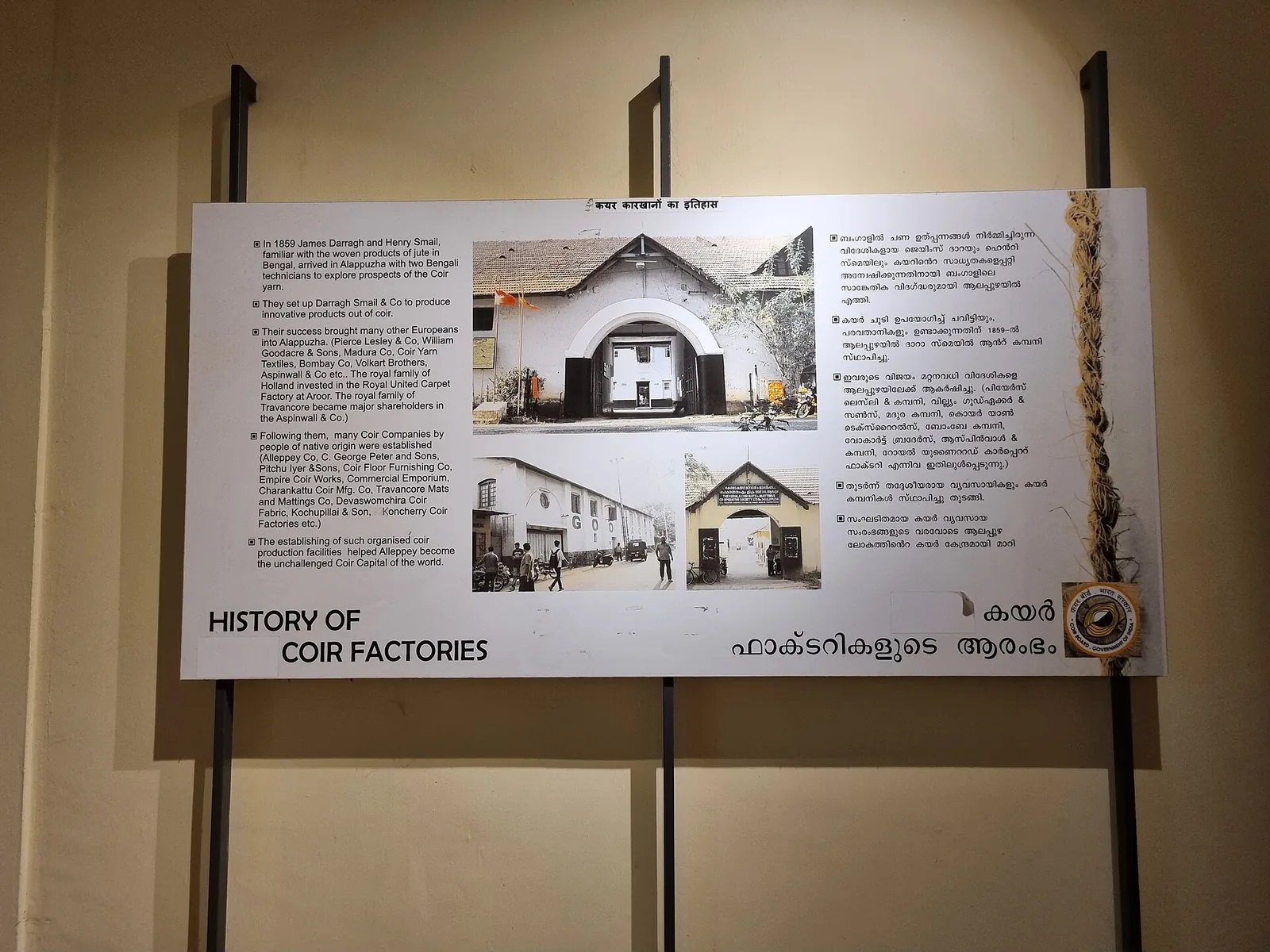
Then, in 1859, a newcomer changed what those buildings would be used for. Kerala Tourism records that an American trader, James Darragh, set up the firm Darragh Smail in Alappuzha that year and began sending coir mats and matting to markets abroad. The Benny Kuriakose studio adds that Darragh was of Irish descent and went into business with another foreign trader, Henry Smail. The district’s own history calls this the first modern factory for coir mats and matting in Alappuzha.
Coir suited Alappuzha perfectly. It is the tough fibre from the husk of the coconut, and the husks have to be soaked in water before the fibre can be worked. Kerala Tourism points out that the town’s waterways made that wetting easy. With coconuts all around, canals at the door and a port for export, the town had everything the trade needed.
Where Darragh Smail led, others followed. The Benny Kuriakose studio lists the big firms that came after it, including Pierce Leslie, William Goodacre and Sons, the Madura Company, the Bombay Company, Volkart Brothers and Aspinwall. Coir became the work of the town, and the town’s name became part of the product. "Alleppey Coir" is today a protected product name for coir from the region. That name alone does not prove a mat in a shop was made in the town, so check the maker when you buy. Yarn was spun, mats were woven, and the canal-side sheds filled with fibre and finished goods waiting to be shipped.
The port did not last, but the coir did, for a while. When the port at Kochi grew, Alappuzha lost its trade at sea, and many of the old warehouses and godowns were turned into coir and copra factories. Later, labour troubles led to the closing of most of those factories as well. Much of the work moved elsewhere, some of it to Tamil Nadu, and the great sheds along the canals went quiet.
That silence is now being broken in a new way. In 2017 a temporary coir exhibition was held in Alappuzha, and afterwards the Kerala government announced the Alappuzha Heritage Project. The Benny Kuriakose studio, which works on the project, says that old factories once owned by Volkart Brothers and Darragh Smail are to be conserved as heritage museums, as part of a plan for around 20 museums. Some of that work is finished and some is still under way, so whether a museum is open on the day you visit is a separate question, explained in what the heritage project has opened.
To see how coir is made and how the factories worked, the International Coir Museum is the best place to start. The coir factories were also at the heart of Alappuzha’s labour history, a bigger story with its own memorial at Punnapra–Vayalar. You do not need a museum to read this story, though. Walk the canal banks, look at the size of the doors facing the water, and you are looking at the buildings where Alappuzha’s coir was made and stored. Once you know what they were, the quiet canals of the town centre start to feel like a working port again.
Frequently asked questions
When did the coir industry start in Alappuzha?
In 1859, when the American trader James Darragh set up Darragh Smail and began exporting coir mats and matting (Kerala Tourism).
Why did coir grow in Alappuzha?
Coconut husks must be soaked before the fibre is worked, and the town had canals for wetting, coconuts all around and a port for export.
Which companies made coir in Alappuzha?
Darragh Smail was first; firms that followed included Pierce Leslie, William Goodacre and Sons, the Madura Company, the Bombay Company, Volkart Brothers and Aspinwall.
What is happening to the old warehouses?
Under the Alappuzha Heritage Project, old factories once owned by Volkart Brothers and Darragh Smail are to be conserved as museums.