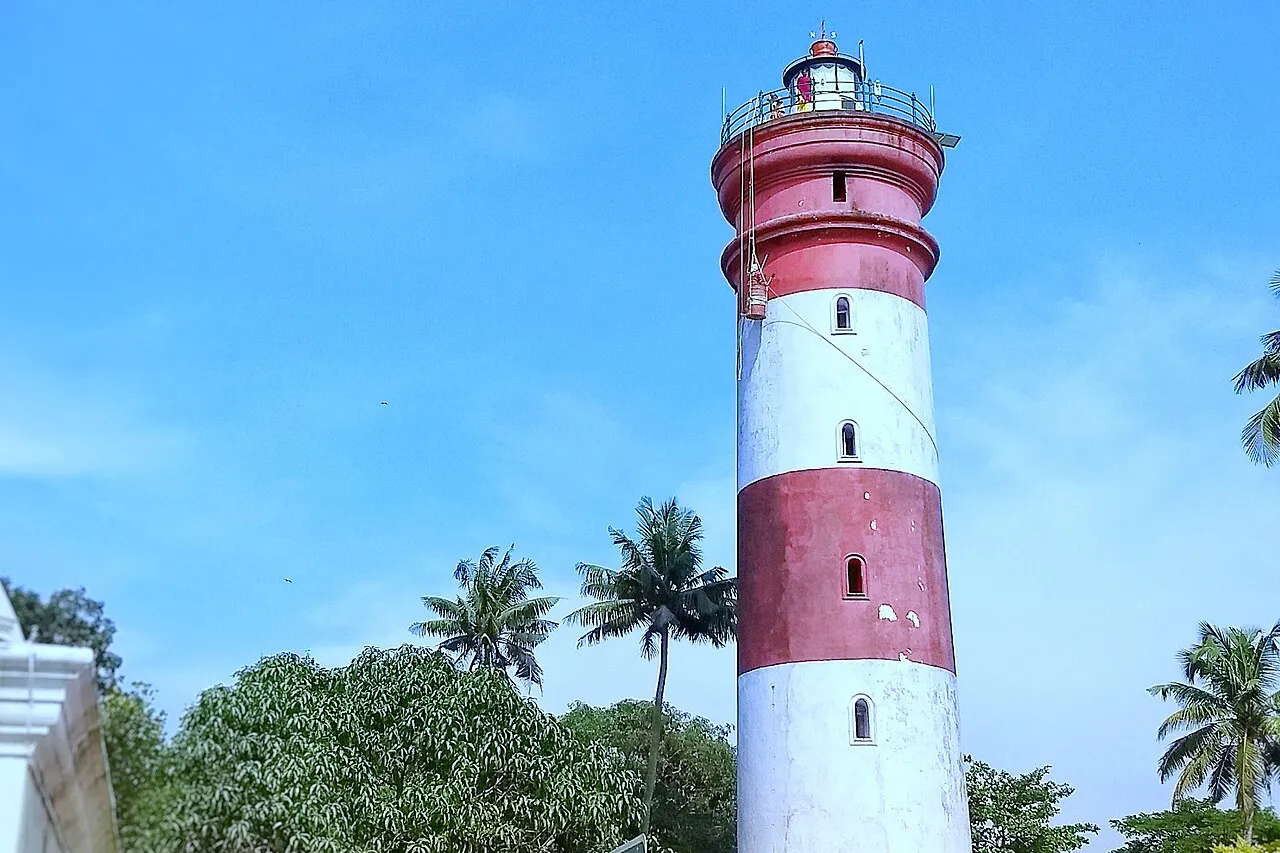
Long before there was a lighthouse in Alappuzha, there was a lamp on a pier. In the 18th century, as the Directorate General of Lighthouses records, ships coming to the young port were guided by "only a light, provided on the pier head". Later, according to the lighthouse authority’s heritage account published by IALA, a light was carried on the port’s flag mast in the 1830s. It was a small light for a growing port, and as more ships came to trade at the town Raja Kesavadas had built, it was no longer enough.
So Travancore built a proper tower. The same heritage account says a stone tower was proposed in 1860, and names Hugh Crawford, the port officer, as part of the building story. The lighthouse authority says the tower was completed in 1861, during the reign of Maharaja Rama Varma, and that its light was first switched on, if that is the word, on 28 March 1862. There was no electricity to switch. The first lamp was a double-wick lamp that burned coconut oil, set inside a large glass optic made by Chance Brothers of Birmingham, England. In a town surrounded by coconut palms, the light that guided ships to its shore came from the same trees.
That coconut flame kept watch over the coast for ninety years. Then, one change at a time, the lighthouse moved with the times. The lighthouse authority’s record reads like a short history of technology. In 1952 the oil lamp gave way to a gas-powered flashing light. On 4 August 1960 the tower went electric, with a revolving optic from Paris. A new drive and a separate emergency light were added in 1998, and on 28 February 1999 a 150-watt metal halide lamp was put in. The ships it guides today see a very different light from the one the first sailors saw, but it shines from the same tower. The lighthouse authority’s station ledger gives the tower a height of 28 metres, with the light 33 metres above sea level, and records its signal as a white flash every fifteen seconds. That flash is how a ship at sea still knows it is looking at Alappuzha.
The port that the lighthouse was built for did not last as long as the tower. When Kochi became the main harbour, the ships stopped coming, and the pier where the first lamp had stood slowly fell apart. Its story is told in the old pier at Alappuzha beach. The lighthouse, though, kept working, and it is still a working light today.
It has also become one of the town’s favourite places to visit. The tower stands near the beach, and visitors can go up it. From the top you look out over the sea on one side and the palm-covered town on the other, and you can see why sailors needed a light to find this flat green shore. At its foot, a small museum shows the lamps and equipment the tower has used, a story told in the Alappuzha lighthouse museum. Opening days and times change, and entry is charged, so check the current details at the gate or with the district tourism office before you plan your day around it. After the climb, walk down to the beach to see the remains of the pier where the story began.
Frequently asked questions
When was Alappuzha lighthouse built?
The tower was completed in 1861 and first lit on 28 March 1862 (Directorate General of Lighthouses).
What did the first Alappuzha lighthouse lamp burn?
Coconut oil, in a double-wick lamp. It was replaced by a gas light in 1952 and went electric on 4 August 1960.
How tall is Alappuzha lighthouse?
The tower is 28 metres high and its light stands 33 metres above sea level (lighthouse authority station ledger).
Can visitors climb Alappuzha lighthouse?
Yes, the tower is open to visitors. Check the current timings and ticket at the gate.
What was there before the lighthouse?
A light on the head of the old pier, which guided ships in the 18th century.