The coconut palms that frame Marari Beach are pretty, but for a long time they were mainly work. Their husks gave coir, the rough golden fibre spun into rope and woven into mats. In Mararikulam, coir was not one job among many. It was the main job.
A 2003 report in The Tribune puts a number on it. The coir industry had employed about 70 per cent of Mararikulam’s residents. The same report says that after the market opened up in the 1990s, the industry nearly collapsed. Families who had lived on fish, coir and coconuts suddenly found one of those three in deep trouble. That crisis is one reason the women of these villages started their own businesses, a story told in the Mararikulam Experiment.
Coir did not disappear, though. It changed shape. In 2018, the Kerala government’s Local Self Government Department reported that Kudumbashree and the Kerala State Coir Corporation were training women aged 18 to 50 to make coir mats. Sixty women in three batches were working in a cluster in the southern panchayats of Mararikulam village. The first batch began on 8 January 2018, when Thomas Isaac, then Kerala’s Minister for Finance and Coir, opened the programme. It is a neat link across the years. The same leader who inspired the soap units in 2002 opened mat-making training in the same villages sixteen years later.
So as you cycle the lanes inland from the beach, look out for the signs of the trade: husks, rope, a loom under a shed roof. Ask before you take photographs of people at work, and keep in mind that these are homes and workplaces, not show pieces.
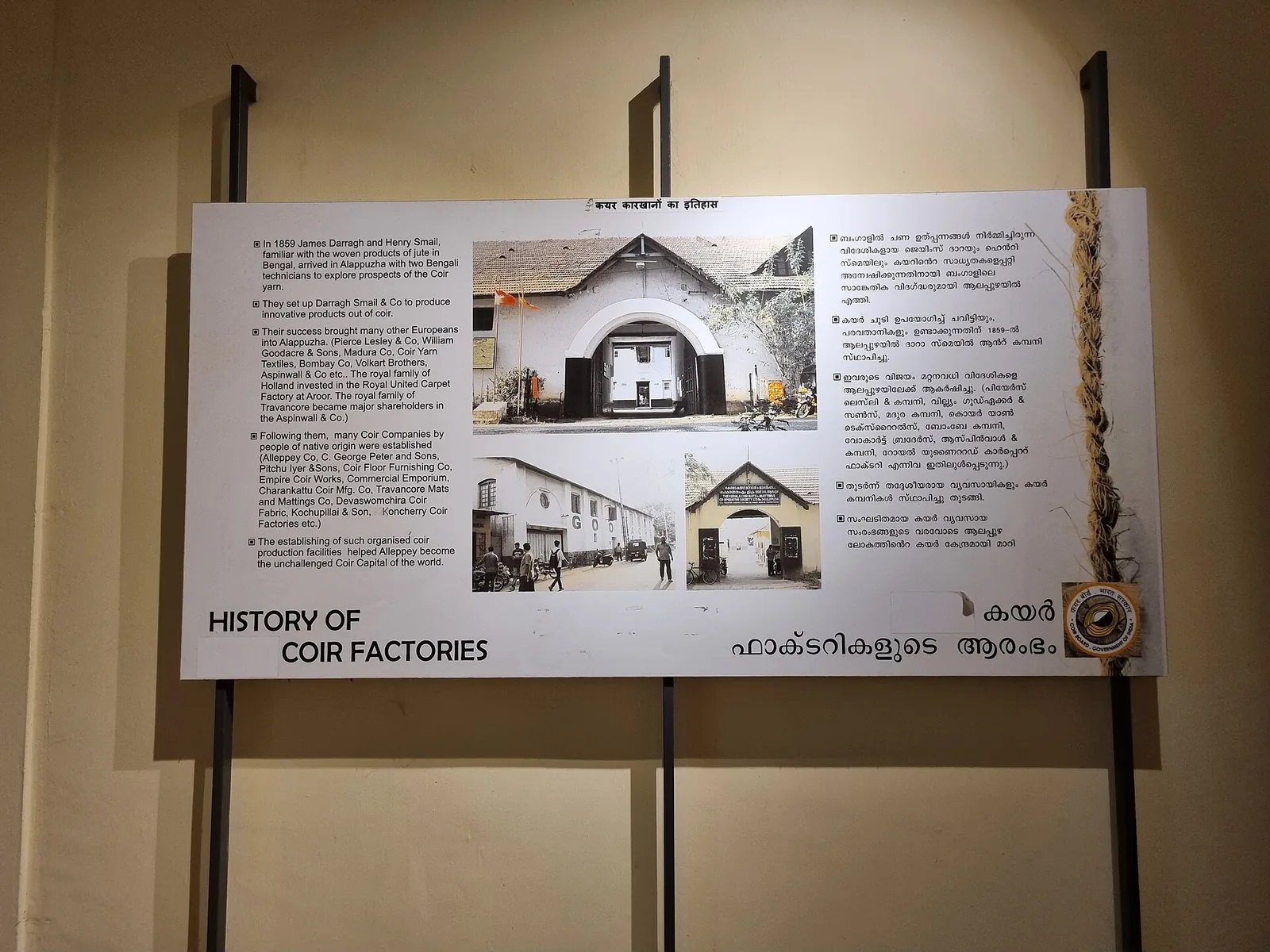
If you want to understand coir properly, the best stop is a short ride away. The International Coir Museum stands at Kalavoor, on the highway towards Alappuzha. DTPC Alappuzha says it is run by the Coir Board of India and opened in 2014. Inside, it traces coir from an everyday household material to modern uses, shows how fibre is taken from the husk, and explains the move to machines. There is a shop selling coir mats and small crafts. Kerala Tourism also lists the museum, as an initiative of the Coir Board. DTPC gives it as about 10 km from Alappuzha railway station, so it fits easily into a day that starts or ends at Marari.
A good plan is to see the museum first and the villages second. Once you know how many steps go into one coir mat, the sheds and lanes of Mararikulam make far more sense. Kerala Tourism itself suggests pairing Marari with the coir museum, as our Marari Beach guide notes.
Coir also explains a darker chapter. In 1946 the coir workers of this coast stood at the centre of a famous uprising, and Mararikulam was one of the places where shots were fired. Read Mararikulam and the 1946 Punnapra–Vayalar uprising.
Frequently asked questions
Was Mararikulam a coir village?
Yes. The coir industry once employed about 70 per cent of its residents (The Tribune, 2003).
Is coir still made in Mararikulam?
Yes, on a smaller scale. In 2018 a Kudumbashree and Kerala State Coir Corporation programme trained 60 women in coir mat making in Mararikulam’s southern panchayats (Kerala LSGD).
Where can I learn about coir near Marari Beach?
At the International Coir Museum, Kalavoor, run by the Coir Board of India (DTPC Alappuzha).
When did the International Coir Museum open?
In 2014 (DTPC Alappuzha).
How far is the coir museum from Alappuzha?
About 10 km from Alappuzha railway station (DTPC Alappuzha).