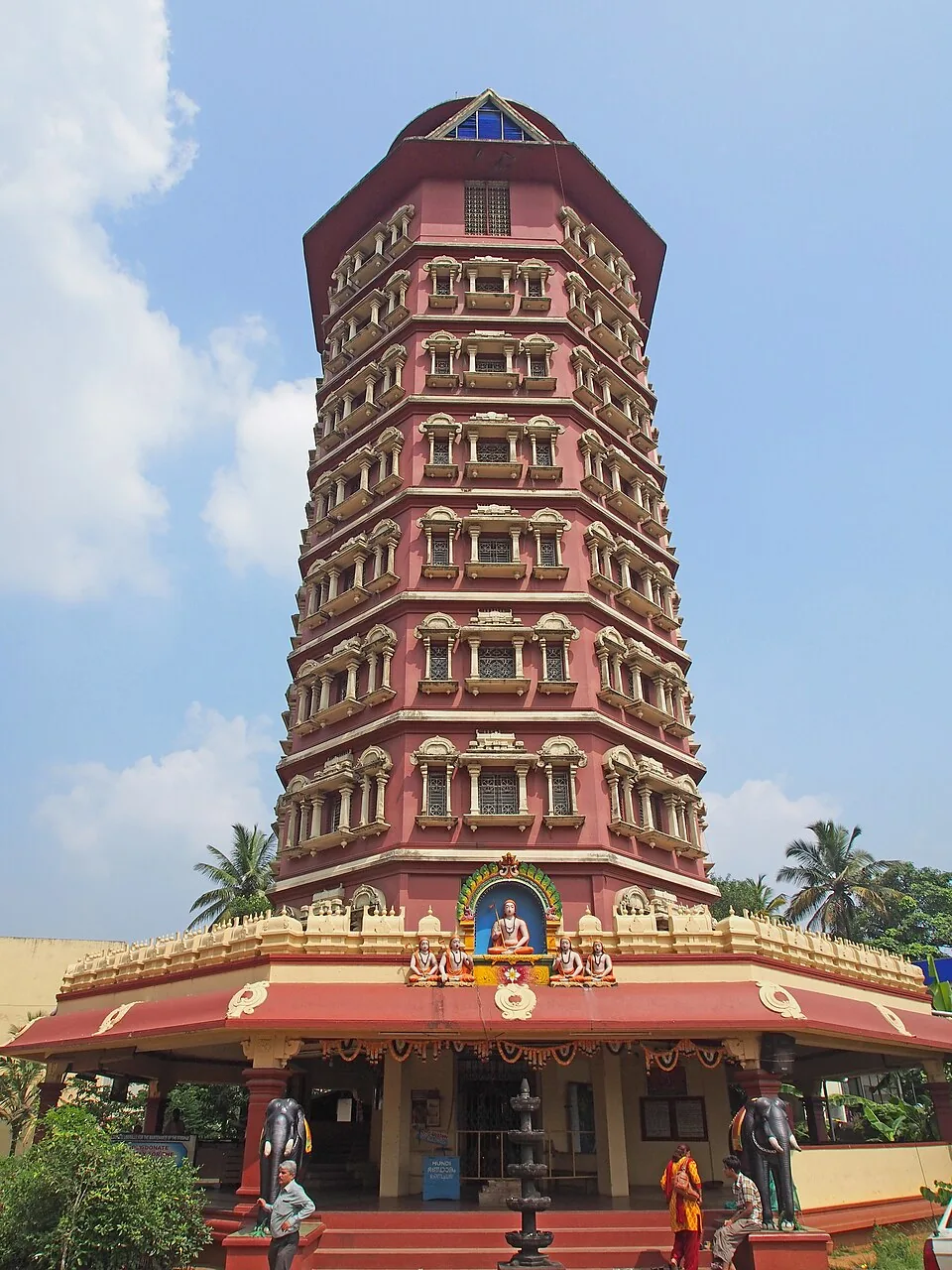
Kalady, on the bank of the Periyar about 10 km from Cochin airport, is venerated as the birthplace of Adi Shankara — the philosopher who systematised Advaita Vedanta and left behind an institutional network that still governs a large part of Hindu monastic life. It is one of the most visited pilgrim sites in Kerala.
It is also a site that had to be identified again after the trail went cold. That is not a slur on the place; it is the most interesting thing about it, and it is missing from almost every account you will read on the way there.
What Shankara actually did
Shankara’s achievement was double. Philosophically, he argued and systematised Advaita — non-dualism, the position that the individual self and ultimate reality are not two things — through commentaries on the Upanishads, the Bhagavad Gita and the Brahma Sutras, which remain the base texts of the school. Organisationally, he is credited with founding monastic centres at the compass points of the subcontinent and with reorganising Hindu renunciate orders, which is why a Kerala village matters to institutions in Karnataka, Odisha, Gujarat and the Himalaya.
He is traditionally held to have done all of this and died at thirty-two. Every version of the story, however they date him, agrees on the thirty-two years.
Nobody agrees when he lived
This is the part that surprises visitors, and it is not a fringe quibble — the monastic institutions founded in his own name do not agree with each other. The dates in circulation span roughly thirteen centuries.
Proposed dates for Adi Shankara
| Dating | Held by |
|---|---|
| 509–477 BCE | The Dwaraka, Puri and Kanchi traditions (Puri gives 507–475 BCE) |
| 44–12 BCE | A further traditional reckoning |
| 788–820 CE | Mainstream modern scholarship, and the Sringeri reckoning |
The 788–820 CE dating is the academic consensus and is the one you will see on signage. It rests largely on the records of the Sringeri Sharada Peetham, the matha with the most nearly unbroken list of its own heads, which places Shankara’s birth in the fourteenth year of the reign of a Vikramaditya — generally identified with Vikramaditya II of the Badami Chalukyas, who ruled in the 730s and 740s, putting Shankara in the middle of the eighth century.
We follow the mainstream dating on our pages. We also think you should know that the institutions closest to the man place him up to thirteen hundred years earlier, and that this is a live disagreement rather than a settled one.
The village that went quiet
Whatever the century, the site itself did not remain a continuously marked place of pilgrimage. Kalady entered the modern spiritual map of India only after it was identified again in the late nineteenth century by the then Shankaracharya of Sringeri, with a temple to Adi Shankara consecrated at the site in 1910.
Sit with what that means. Between Shankara’s lifetime and the late 1800s — on the mainstream dating, some eleven hundred years — the exact spot was not being maintained as a shrine. The identification rests on tradition, local memory and the judgement of the Sringeri matha, not on an inscription or an unbroken line of custody. It is entirely reasonable to accept it; it is also reasonable to know it is an attribution.
- It is not a debunking. Rediscovery is how a great many pilgrimage sites across the world were re-established.
- It explains the architecture: what you see is largely twentieth-century, because the commemoration is twentieth-century.
- And it is more interesting than the smooth version — a tradition reaching back for its own origin and having to decide where it was.
What stands there now
The Adi Shankara Keerthi Sthambha Mandapam is the landmark — an eight-storey tower raised by the KANCHI Kamakoti Peetham — not by Sringeri; the two mathas hold the two sites separately, and that separation is the whole point of the arrangement — with a pair of elephant figures at the entrance and, inside, a Paduka Mandapam where Shankara’s padukas are consecrated and worshipped. The storeys carry depictions from his life and teaching, and the climb gives you the Periyar and the surrounding country.
The Sree Krishna Temple is the other pole of the visit. Krishna was the family deity of Shankara’s household, and tradition holds that the image here was installed by Shankara himself. Nearby, the Karthyayani Devi Temple is the other temple tied to the family. One caution: searching for “Karthyayani Devi Temple” will mostly return the well-known temple at Cherthala in Alappuzha district, which is a different place entirely.
The river ghats matter as much as the buildings, because the two best-known Kalady stories both happen in the water rather than in a temple. We tell those separately in the legends of Kalady.
Frequently asked questions
Why is Kalady famous?
It is venerated as the birthplace of Adi Shankara, the philosopher who systematised Advaita Vedanta and reorganised Hindu monastic orders. It sits on the Periyar about 10 km from Cochin International Airport and is among the most visited pilgrim sites in Kerala.
When was Adi Shankara born?
There is no agreement, including among the monasteries founded in his name. Dates in circulation span about thirteen centuries: 509–477 BCE in the Dwaraka, Puri and Kanchi traditions, a further reckoning around 44–12 BCE, and 788–820 CE in mainstream scholarship and the Sringeri reckoning. All versions agree he lived thirty-two years.
How do we know Kalady is really Adi Shankara’s birthplace?
We do not know it in the documentary sense. Kalady re-entered the spiritual map only after it was identified again in the late nineteenth century by the Shankaracharya of Sringeri, with a temple consecrated at the site in 1910. The identification rests on tradition, local memory and the matha’s judgement rather than on an inscription or unbroken custody.
What is the Adi Shankara Keerthi Sthambha Mandapam?
An eight-storey memorial tower at Kalady raised by the Kanchi Kamakoti Peetham — begun under the Paramacharya, consecrated by Jayendra Saraswathi in 1978 and dedicated to the nation by President Neelam Sanjiva Reddy on 12 May 1978. There are elephant figures at the entrance and a Paduka Mandapam inside where Shankara’s padukas are consecrated and worshipped. The storeys carry scenes from his life, and the upper levels give views over the Periyar.
Why is there a Krishna temple at Kalady?
Krishna was the family deity of Shankara’s household, and tradition holds that the image at the Kalady Sree Krishna Temple was installed by Shankara himself. It is reported as tradition rather than as record.
Is the Karthyayani Devi Temple at Kalady the famous one?
No — and this trips people up. The widely known Karthyayani Devi Temple is at Cherthala in Alappuzha district. The Kalady temple of that name is a different, smaller temple connected with Shankara’s family.
How do I get to Kalady from Kochi?
It is about 10 km from Cochin International Airport at Nedumbassery and roughly 45 km from central Ernakulam, so it is an easy road trip and a common first or last stop for anyone flying in or out. Angamaly is the nearest railway station.