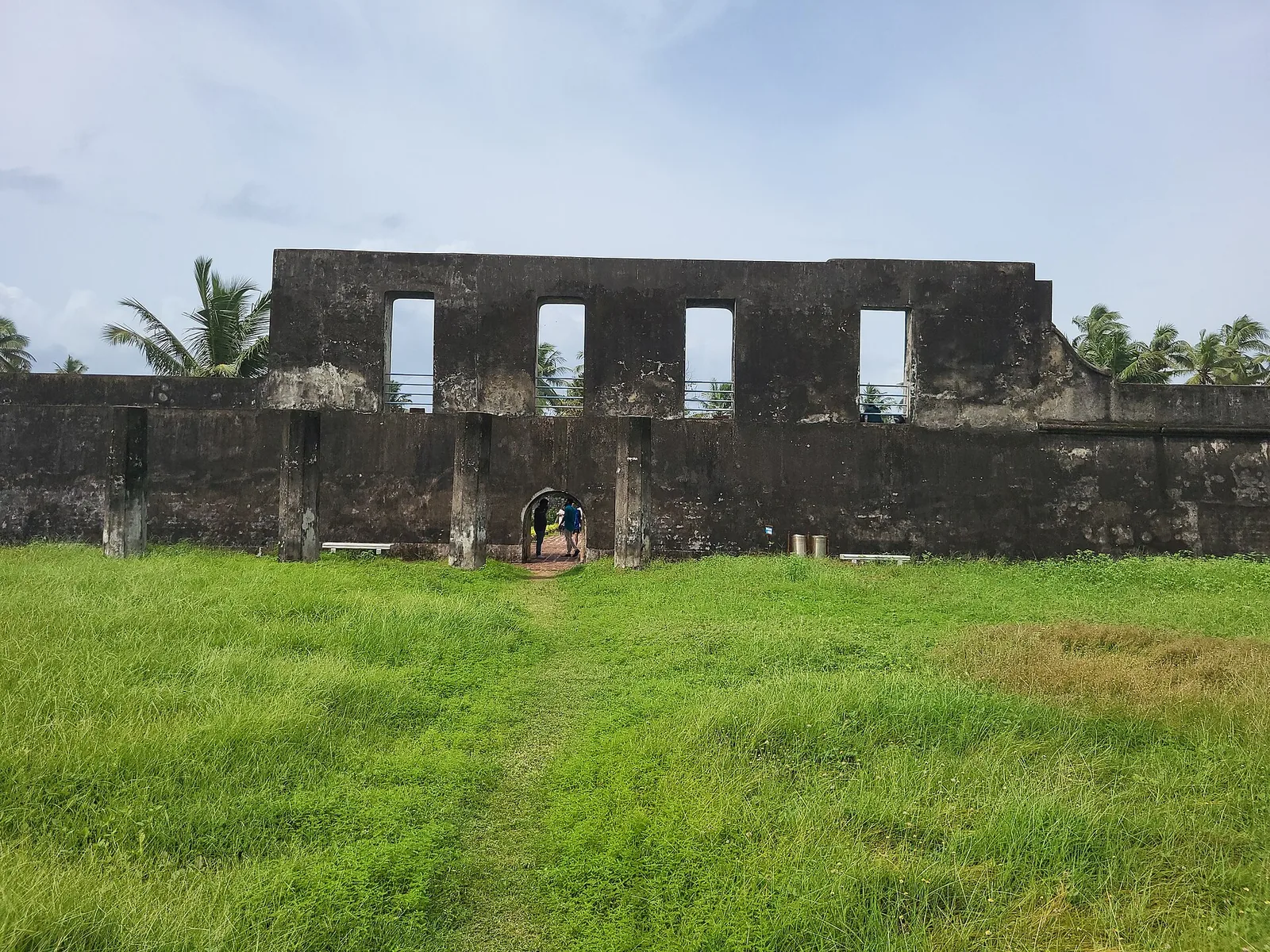
On the coast near Varkala, behind a fishing village and a long grey beach, stands a modest square of laterite walls most travellers have never heard of: Anchuthengu Fort. It looks like nothing much. But this was the English East India Company’s first settlement in Kerala, and one of its earliest anywhere in India. It was not, despite what is repeated almost everywhere including on the signage, the Company’s first territorial possession in the country — Fort St George at Madras was begun in 1639 and Bombay passed to the Company in 1668, both well before the 1694 grant here. The real distinction is regional, and large enough: this is where the English began on the Malabar and Travancore coast, among the Portuguese and the Dutch who had worked it for generations.
The first English foothold in Kerala
The name comes from the local Anchuthengu — “five coconut palms.” In 1694 the Rani of Attingal, the queen who ruled this stretch of coast, granted the English East India Company the right to build a factory and fort here, and by the mid-1690s the laterite stronghold stood guarding the little port. It was a prize: a foothold on the pepper coast, a place to gather the black gold that Europe craved. And it was, remarkably, the Company’s first true territorial possession in India — the small seed of what would one day become an empire.
Pepper, greed and a broken custom
The trouble grew, as it so often did, out of money and disrespect. The Company men manipulated the price of pepper and lined their own pockets, and resentment simmered among the local chieftains, the Pillamar, and the merchants. There was also a matter of protocol: by custom, the gifts the Company owed the Rani of Attingal were to be presented through her local lords. In 1721 the chief at Anchuthengu, a man named Gyfford, decided to bypass them and carry the gifts to the queen directly — a calculated snub to the very chieftains whose goodwill kept the peace.
The march that became a massacre
In April 1721, around a hundred and forty armed Company men set out from the fort towards the palace at Attingal, gifts in hand — a deliberate show of force meant to overawe. It did the opposite. As the party moved up the river, the local people rose: Nair soldiers and Muslim merchants together fell upon them, and near Attingal, at Kollampuzha, the entire force was destroyed on the water, hardly a man surviving. The show of strength had ended in annihilation.
The six-month siege
The rebels then turned on the fort itself and laid siege to it. For roughly six months the defenders held out, the defence led — the story goes — by the fort’s gunner, Samuel Ince, until Company troops finally arrived by sea from Tellicherry in the north to relieve them. In the end the Company and the Rani of Attingal came to terms and the Company was compensated for its losses. But the memory stuck: the Attingal Outbreak is remembered as one of the first organised uprisings against English authority on Indian soil — Kerala striking back, decades before the rest of India.
Visiting Anchuthengu
The fort sits on the coast a short drive from Varkala, its walls, cemetery and old cannon looking out over the sea, with a quiet beach alongside. It rewards anyone who likes their history unpolished and off the tourist trail. Details are on the Anchuthengu place page; more of the district is on the Thiruvananthapuram hub.
Frequently asked questions
Why is Anchuthengu (Anjengo) Fort historically important?
Built between about 1694 and 1698 after the Rani of Attingal granted the English East India Company land, it was the Company’s first settlement in Kerala and among the earliest English footholds in India — though not the first: Fort St George at Madras dates from 1639–44 and Bombay passed to the Company in 1668. It was also the scene of the 1721 Attingal Outbreak, one of the earliest organised revolts against English authority in India.
What was the Attingal Outbreak of 1721?
A revolt in April 1721 in which a party of around 140 East India Company men, travelling from Anchuthengu to the Attingal palace with the annual presents, was destroyed by local Nair soldiers and Muslim merchants. The rebels then besieged the fort for about six months until reinforcements arrived from Tellicherry. The casualty figure is not firm — published accounts give 140, 141 and 151, and the dead probably included a substantial number of Indian troops in Company service.
Where is Anchuthengu Fort?
It is on the coast near Varkala in Thiruvananthapuram district, beside a fishing village and beach, an easy trip from Varkala town.