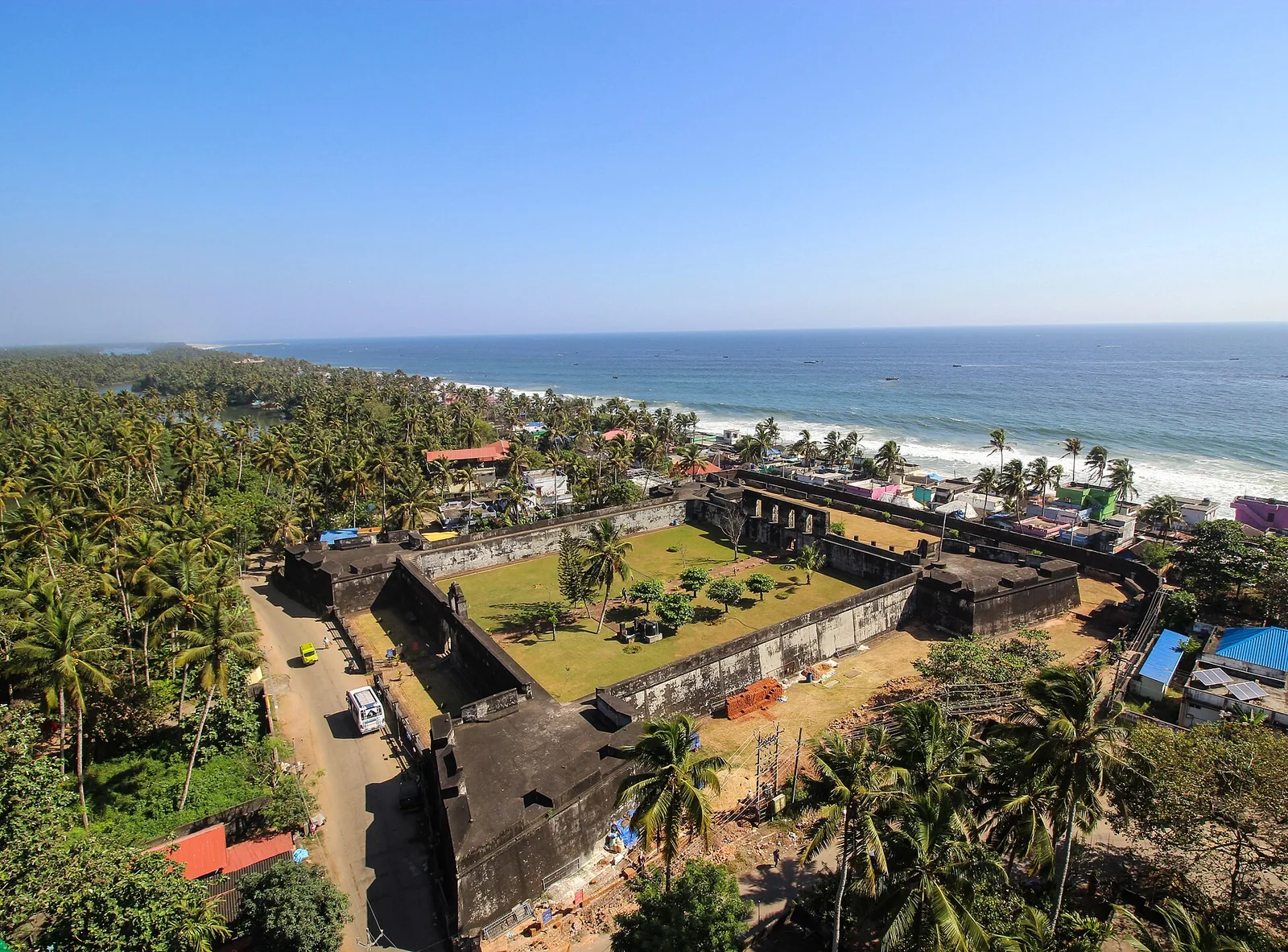
Read anything about Anchuthengu Fort — signage, tourism copy, a good many books — and you will be told the same thing. This was the East India Company’s first territorial possession in India. The beginning of everything.
It is not true, and the correction is worth making carefully, because what is actually true about this place is more interesting than the claim it has been dressed in.
The calendar
The Company began building Fort St George at Madras in 1639, and it was largely complete by 1644. Bombay passed to the Company in 1668, having come to the English Crown as part of Catherine of Braganza’s dowry six years earlier. The factory at Surat dates from 1613.
The grant at Anchuthengu is dated 1694 — some accounts trace English permission to settle here back to 1684 — and the fort was built between roughly 1694 and 1698. That is half a century after Madras. There is no arithmetic under which it comes first.
What the sources actually say
The careful formulations describe Anjengo as the Company’s first trade settlement in Kerala, and as one of the earliest English settlements in India. Both are accurate. Somewhere in the chain of copying, “first in Kerala” lost its qualifier and became “first in India”, and the inflated version travels better because it is a bigger claim.
This is a specific and very common failure mode, and it is worth recognising because it recurs across Indian heritage signage: a true regional superlative loses its region and becomes a false national one. The same shape produced “Kerala’s second-highest peak” for a mountain that ranks around thirty-third, and “one of only eight basilicas in India” for a country that passed thirty long ago.
Why the real claim is better
Being first in Kerala is not a consolation prize. This coast was the most contested commercial ground in the Indian Ocean. The Portuguese had been here since Vasco da Gama made landfall in 1498; the Dutch had displaced them through the seventeenth century. Pepper was the reason, and pepper was the most valuable agricultural commodity moving between Asia and Europe.
Arriving in the 1690s, the English were late to a crowded and dangerous market, and what they secured was not a conquest but a grant: permission from the Queen of Attingal to build a factory and a fort on a strip of sand. They were tenants on somebody else’s coast, negotiating with a polity that had its own long experience of managing Europeans.
That is a far better description of what the beginning of British India actually looked like than a foundation myth about the first stone of an empire. Empires begin as small commercial concessions granted by people who expect to remain in charge.
And then it went wrong
Which is precisely what the Attingal Outbreak of 1721 demonstrated. Twenty-seven years after the grant, a Company party carrying the annual presents to the Queen was destroyed, and the survivors were besieged in this fort for six months. The tenants had misread the arrangement.
They also, in the end, profited from misreading it: the settlement after the siege gave the Company a pepper monopoly, compensation and the right to build factories where it chose. But that is a different story, and it is not the story of a first foothold. It is the story of what happens when a commercial concession is tested and turns out to be the stronger position after all.
Frequently asked questions
Was Anchuthengu the East India Company’s first possession in India?
No. Fort St George at Madras was begun in 1639 and largely complete by 1644; Bombay passed to the Company in 1668; the Surat factory dates from 1613. The grant at Anchuthengu is dated 1694 and the fort was built between about 1694 and 1698.
What was Anchuthengu actually first at?
It was the Company’s first trade settlement in Kerala, and among the earliest English settlements anywhere in India. That is what the careful sources say; the “first in India” version is the same claim with its qualifier lost.
When was the fort built?
Between roughly 1694 and 1698, following a grant from the Queen of Attingal usually dated 1694, though some accounts trace English permission to settle here to 1684.
Why did the English come so late to this coast?
They were competing with established powers. The Portuguese had been on the Malabar coast since 1498 and the Dutch had displaced them through the seventeenth century. Pepper was the prize, and the English arrived as latecomers negotiating for a foothold rather than seizing one.
What happened to the fort in the end?
It played a part in the Anglo-Mysore Wars later in the eighteenth century, then declined as the Company’s centre of gravity moved elsewhere. In 1813 the Company abandoned it as an unnecessary expense.
Is the signage at the site wrong?
On this point the widely repeated “first in India” claim is not supportable, and the accurate version — first in Kerala, among the earliest in India — is what we publish. It remains a genuinely significant site.