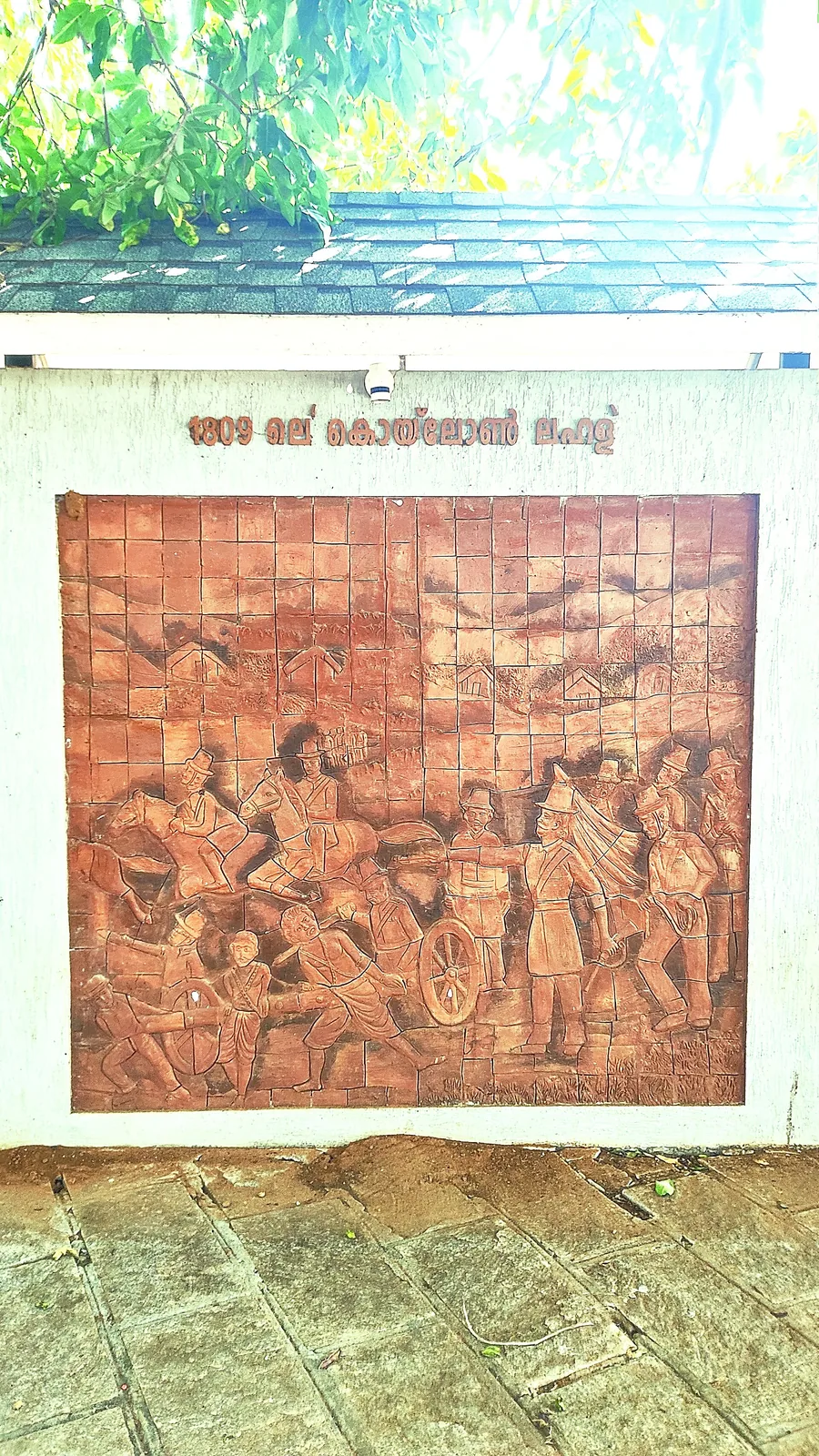
Walk the heritage path at Asramam and you come to a terracotta panel set into a white wall: horsemen, sepoys with muskets, a field gun being hauled forward by men on foot, houses on a hillside behind. The Malayalam caption above it names the event without ceremony — the Quilon revolt of 1809.
Walk a different path in the same grounds, towards the lake, and you arrive at a two-storey colonial house with a colonnade and a red-balustraded verandah under a Kerala tiled roof.
The second is a consequence of the first, and nothing in the park says so.
What happened in 1809
Travancore was a princely state under a subsidiary alliance with the East India Company: it kept its ruler and its administration, and the Company kept a Resident at the court. In 1808 and 1809 that arrangement broke down into open rebellion under Velu Thampi Dalawa, the Travancore Dalawa, and there was fighting — including at Quilon, which is what the panel shows.
The rising failed. And in its aftermath, in 1810, Colonel John Munro arrived as British Resident of Travancore and Cochin.
What followed is the part that makes the house at the other end of the park worth walking to. Munro did not remain merely the Company’s observer at the court. Within a year or two he was also Diwan — chief minister — of Travancore, and of Cochin. For a stretch of years in the 1810s, the head of the state’s administration and the foreign power’s representative to that administration were the same man.
The British Residency at the lake end of these grounds was built for him. It is still in official use, as the Government Guest House, and it has its own page on this site — including a correction to the construction date that almost every source prints, which turns out to be Munro’s tenure rather than a building period.
Why the panel is a good object
Public history in terracotta is usually decorative — a frieze of boats, a stylised elephant, something that gestures at heritage without committing to a claim.
This panel commits. It names a year and an event, and it depicts a specific kind of fighting: not a heroic single combat but a gun crew, cavalry, ranks of sepoys, the machinery of an early nineteenth-century colonial engagement. Whatever one makes of its politics, it is about something.
It also sits in a series that is unusually local. The other panels along the Paithruka Veedhi take the port of Kollam, the cashew processing that employed this city for a century, the Punalur suspension bridge upriver, the Seethakali festival. This is a district explaining itself to itself, panel by panel, on the way to a boat jetty.
A note on how we read the panel
A small methodological point, because it matters more often than it sounds like it should. The photograph of this panel circulates under a filename calling it the Battle of Quilon. Filenames are not evidence — we have been caught by that repeatedly, including on other pages in this district, where a file called a wharf turned out to be a breakwater.
Here, though, the object carries its own caption, in Malayalam, moulded into the wall above it: 1809 ലെ കൊയ്ലോൺ ലഹള. The panel says what it is. That is a corroboration from the object rather than from the uploader, and it is the only reason we describe it as confidently as we do.
Walk it in the right order
If you have half an hour spare in these grounds, do the panel first and the Residency second. The war, then the house the war produced.
It is an accident of municipal planning that both are here, and the park makes no attempt to link them. But the two objects are about four hundred metres apart, and taken in that order they explain each other better than either does alone — which is more than most heritage trails manage on purpose.
Frequently asked questions
What does the relief panel at Asramam show?
The Quilon revolt of 1809 — cavalry, sepoys with muskets and a field gun being hauled forward. Its Malayalam caption names the event directly, which is how we can describe it confidently rather than relying on the photograph’s filename.
What was the 1809 rising?
The rebellion under Velu Thampi Dalawa against the East India Company’s position in Travancore, in 1808–09, which included fighting at Quilon. It failed, and in its aftermath Colonel John Munro arrived as British Resident in 1810.
How is that connected to the British Residency in the park?
Directly. The Residency at the lake end of these grounds was built for Munro, the Resident whom the 1809 rising brought to Travancore — and who went on to hold the Diwanship of Travancore and Cochin at the same time. The park contains both the war and its consequence, and links neither.
What else is on the heritage walkway?
Captioned terracotta panels on the port of Kollam, traditional cashew processing, the Punalur suspension bridge and the Seethakali festival, among others — a district explaining itself to itself on the way to the boat jetty.
Can I go inside the Residency?
No. It is an occupied Government Guest House with no published visiting arrangement. It is visible from the public grounds, and we cover the building on its own page.
