The subsidiary alliance was a simple enough arrangement on paper. A princely state kept its ruler and its administration; the East India Company kept a Resident at the court, who represented the Company’s interests and reported home. Two governments, two officials, an arm’s length between them.

At Kollam, in the 1810s, the arm’s length disappeared entirely.

What actually happened

Colonel John Munro arrived as Resident of Travancore and Cochin in 1810, in the aftermath of the rebellion led by Velu Thampi Dalawa. Within a year or two he was also Diwan — chief minister — of Travancore. And of Cochin.

Consider what that means procedurally. The Diwan of Travancore ran the state’s administration and answered to the Maharani. The Resident watched the state’s administration and answered to Madras. When those are the same person, the machinery of oversight is reporting to itself. Munro was, in effect, writing letters about his own government’s conduct, in a house he had had built for the purpose.

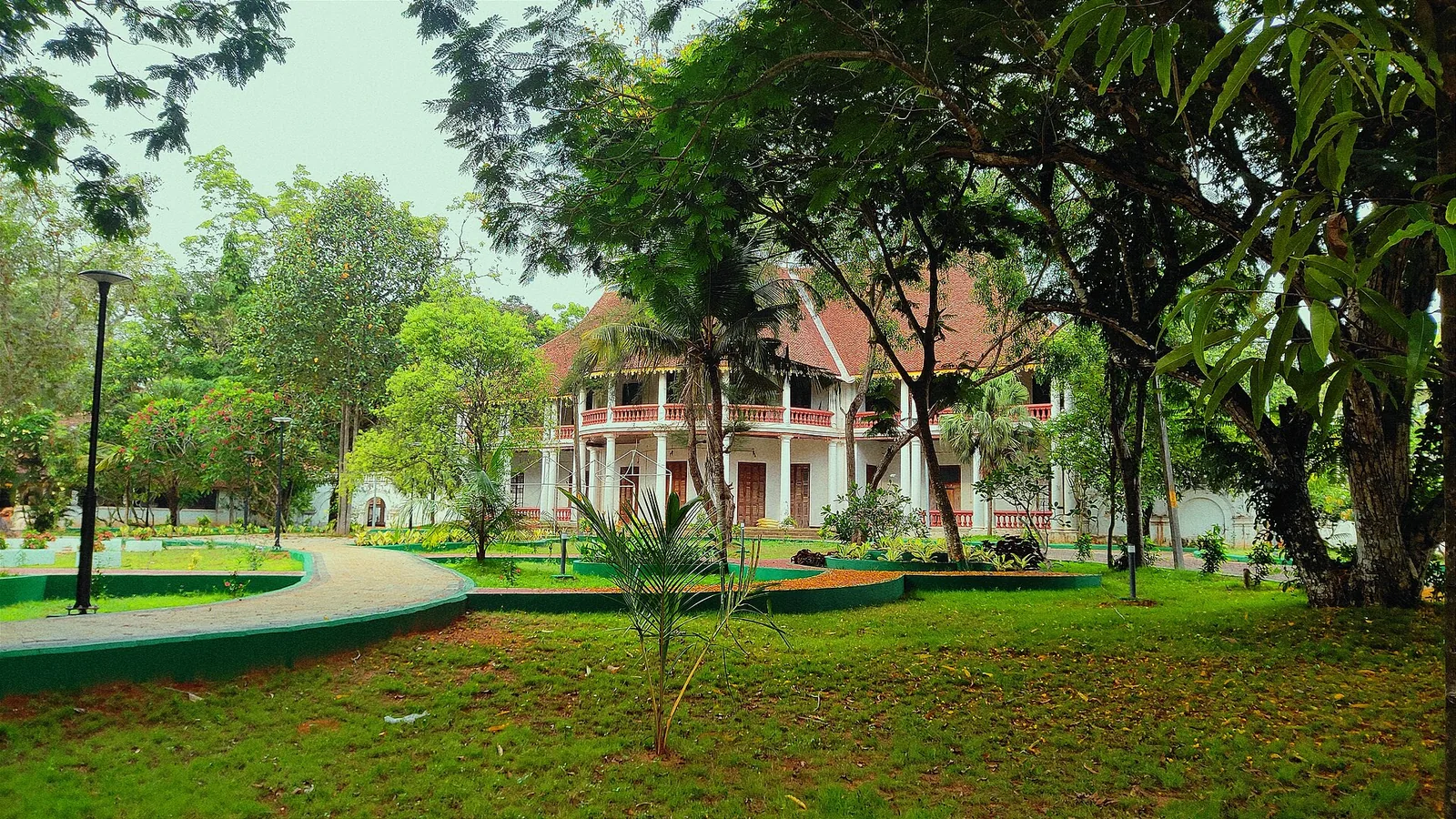
That house is the reason this page exists. It stands at Asramam, on rising ground above Ashtamudi, about three kilometres from the middle of Kollam. It is not a ruin, not a museum and not a ticketed monument. It is the Government Guest House, and it has been accommodating official visitors in one form or another for roughly two centuries.

We are not going to write his biography here

Munro has a page on this site already, in a manner of speaking. Munroe Island — Munroe Thuruthu, the cluster of low islets where the Kallada meets the Ashtamudi backwater — is named after him, and our page for it carries his dates, his offices and a careful argument about how much of the island’s canal system can genuinely be credited to him. The short version is that the trunk channel was cut in the 1820s, and credit is a more complicated word than the tourist copy allows.

What belongs here instead is what the concentration of offices produced, because the period is not an empty one.

Munro reformed the judicial system of Travancore. He introduced the practice of seating a Christian judge on the bench beside a Brahmin — in early nineteenth-century Travancore, a structural change to who was permitted to administer justice, not a courtesy. He is associated with measures of tax relief, and with the pressures that moved the state toward the abolition of slavery. He petitioned for the establishment of the Orthodox seminary at Kottayam. In 1816 the missionary Benjamin Bailey arrived, and the work that followed became CMS College.

None of that settles what one thinks about a foreign power’s representative holding the chief ministership of the state he was posted to observe. It does mean the question is more interesting than a verdict.

Read the building

The Residency is worth ten minutes of actual looking, because what it does architecturally is unusual and nobody describes it accurately.

The front is a colonnade: white columns carrying an upper verandah with red balustrades, the plain classical vocabulary the Company built in everywhere from Madras to Penang. Then look up. The roofs are Kerala — tiled, hipped, with deep overhanging eaves and carved timber gable-ends, the idiom of the region’s own large houses. Round the back, a long single-storey wing runs out under another tiled roof with ornamented gables, its verandah carried on the same white columns.

So the building is a classical order wearing a Malabar roof. Neither element has been made to give way to the other, and the join is not disguised. That is a more interesting object than the phrase the sources use — a blend of European, Indian and Tuscan architecture — which is a formula with no survey behind it, and which we discuss with the other unsourced claims on the place page.

Why it faces the water

The last thing to notice is the orientation, and it is the detail that turns the house back into a working building.

The Residency is composed to be seen from the lake. A Resident arriving at Kollam in the 1810s did not come up a road; he came across Ashtamudi by boat, and the elevation that mattered was the one above the water. Captain Heber Drury, writing in the 1830s, put it exactly: the residency here, built by Colonel Munro, charmingly situated on a slightly rising ground overlooking the back-water, with grounds of a park-like appearance.

The grounds are still park-like — they are now a public park — and the rising ground is still there. Walk round to the lake side and you are standing where the building was designed to be looked at from.

Frequently asked questions

Was the British Resident really also the Diwan?

Yes. Colonel John Munro was Resident of Travancore and Cochin from 1810 and, for part of the same period, Diwan of both states — the representative of the paramount power and the head of the native administration in one person. Sources differ on the precise years of the Diwanship, so we give the span rather than a hard bracket.

Can you go inside?

Treat it as no. It is an occupied Government Guest House in active official use, with no published visiting arrangement, fee or tour. The Asramam grounds are open public space and the house is visible from them.

Is this the same as Thevally Palace?

No. Thevally is the Travancore royal residence, about a kilometre away across the same lagoon. The two are constantly confused — the same impossible construction date has been printed for both — but one is the king’s house and one is the Resident’s.

What is Munroe Island’s connection?

It is named after the same man. Our page for the island carries his dates and offices in full, along with the argument about how much of its canal system he can actually be credited with — the trunk channel was cut in the 1820s.

What style is the building?

Described in sources as a blend of European, Indian and Tuscan, and in a nineteenth-century account as Palladian; no architectural survey supports either. What is visibly there is a classical colonnade carrying an upper verandah beneath Kerala tiled hipped roofs with carved timber gable-ends.