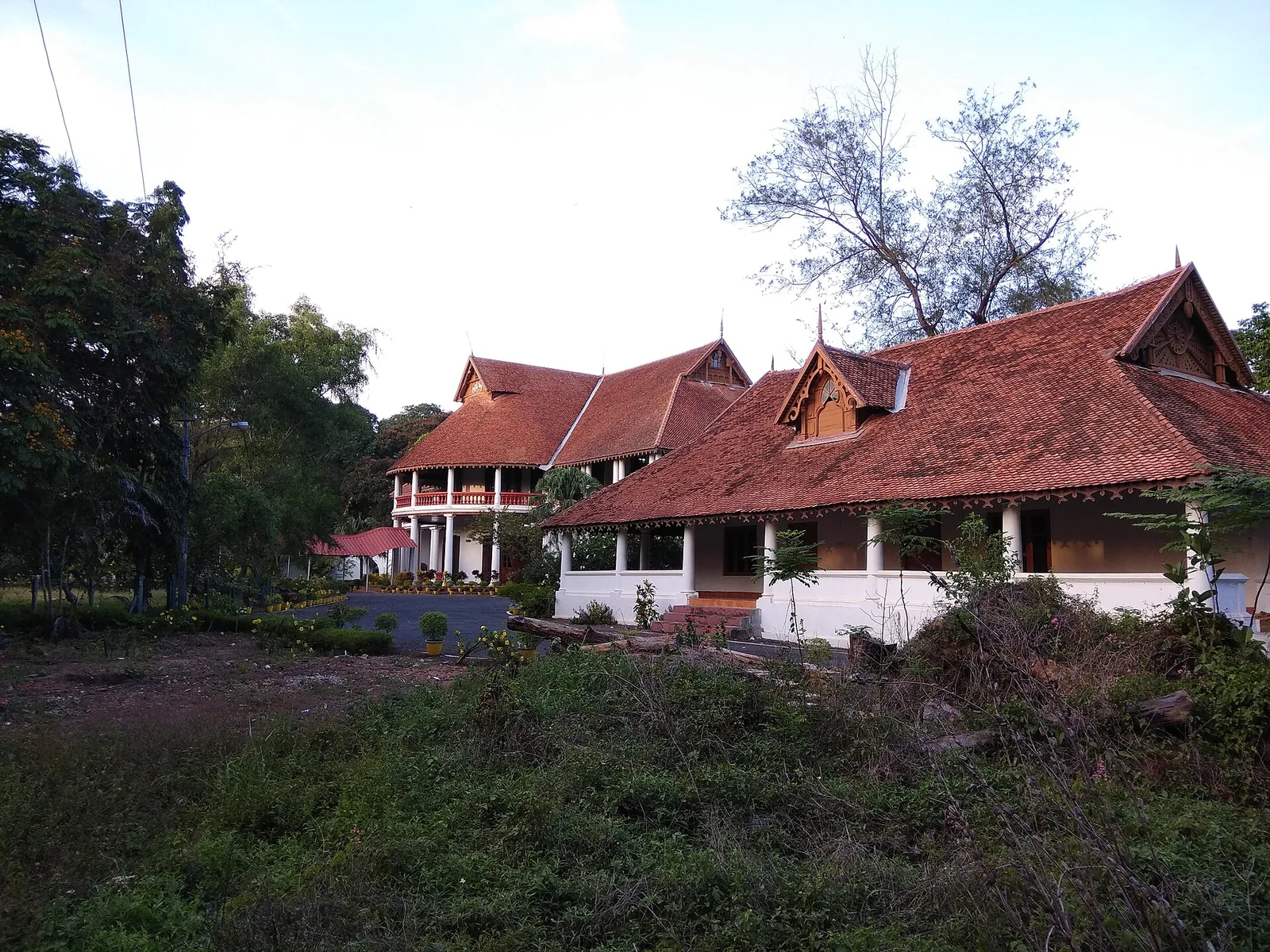
Look up the British Residency at Kollam and you will be told it was built between 1811 and 1819, during the reign of Maharani Gowri Parvati Bayi, when Colonel John Munro was British Resident.

Look up Thevally Palace, a kilometre away across the same lagoon, and you will be told it was built between 1811 and 1819, during the reign of Maharani Gowri Parvati Bayi.

That is not two records that happen to agree. That is one sentence.

And the sentence cannot be true

Gowri Parvati Bayi was not reigning in 1811. Her elder sister Gowri Lakshmi Bayi was Maharani from November 1810, and Regent from 1813. Gowri Parvati Bayi became Regent only in 1815, at the age of thirteen, and held the regency until 1829.

So four of the nine years in the famous bracket belong to a different queen, and the remainder belong to a child regent. This is not a date that needs hedging. It is a sentence that does not survive its own chronology, and it has been printed for two centuries about two different buildings.

Where the numbers actually come from

Here is the part that makes the whole thing click. Colonel John Munro took charge as Resident in October 1810. He resigned and went home on leave in 1819.

Eighteen-eleven to eighteen-nineteen is not a construction period. It is a man’s tenure — the beginning and the end of the most powerful British career in Travancore’s history — and at some point it stopped being read as a career and started being read as a building.

Our page on Thevally Palace worked this out from the other direction: the dates belong to the Residency and migrated onto Thevally by proximity, helped along by the sentence both buildings carry, that the Maharaja came to Kollam to meet the British Resident. What this page adds is that the migration took the queen with it. The same impossible attribution is now printed for both houses, which tells you it travelled as a unit.

So when was it built?

Honestly: during Munro’s residency, which ran from 1810 to 1819, and no more precisely than that.

The best attribution available is not from a database but from a man who saw the building when it was young. Captain Heber Drury, writing in the 1830s, records that the residency here was built by Colonel Munro. That is close to living memory, it is specific about who, and it is the kind of source that a construction claim ought to rest on.

A tenure is a reasonable outer bound for a house raised inside it. It is not a construction record, and the difference matters — because a bracket that looks like a measurement gets copied as one.

The second thing everyone gets wrong

There is a companion claim that travels with the first, and it is the one most likely to end up in a school essay: that the Residency mattered until 1829, when the capital shifted from Quilon to Thiruvananthapuram.

Travancore’s capital did not shift from Quilon in 1829. It moved to Thiruvananthapuram in 1795, from Padmanabhapuram. That is precisely why a royal visit to Kollam was an event rather than a homecoming, and it is why two large European-style houses ended up facing each other across this lagoon at all.

Kollam was a capital, but of medieval Venad, centuries earlier — a different polity in a different millennium. Compressing that into "the capital moved from Quilon in 1829" collapses about nine hundred years.

What plausibly moved around 1829 is the Residency itself: the seat of the British Resident, from Kollam to Thiruvananthapuram. That reading fits the date, fits the building’s short period of central importance, and explains how a sentence about a residency became a sentence about a capital. We give it as the likely reading rather than as a fact, because we could not put a primary source under the 1829 move either.

What is left when you take the wrong things out

A house built for Colonel John Munro during his residency between 1810 and 1819, attested as his by a writer of the 1830s. A building composed to be approached across Ashtamudi by boat. A classical colonnade under a Kerala tiled roof. Residents recorded in occupation — a Colonel Newall in 1824, a Colonel Morison in 1837. Roughly two decades as the centre of British influence in Travancore, and then two centuries as a government rest house.

That is a smaller claim than a nine-year construction bracket under a named queen. It is also the part that is true, and it has the advantage of being about the building rather than about a copied sentence.

Frequently asked questions

Was the Residency built between 1811 and 1819?

Those dates are Colonel John Munro’s tenure — he took charge in October 1810 and resigned in 1819 — not a documented construction period. The house was built for him during his residency; no source we found supports a precise bracket. The strongest attribution is Captain Heber Drury’s in the 1830s, that it was built by Colonel Munro.

Why do Thevally Palace and the Residency have the same date?

Because it is one copied sentence attached to two buildings a kilometre apart, and the copy carried an impossible queen with it. Gowri Parvati Bayi became Regent only in 1815, aged thirteen, so she cannot have reigned over an 1811 construction at either house.

Was Quilon the capital of Travancore until 1829?

No. Travancore’s capital moved to Thiruvananthapuram in 1795, from Padmanabhapuram. Kollam was the seat of medieval Venad, centuries earlier. What plausibly moved around 1829 is the seat of the British Residency, and that appears to have been garbled into a claim about the capital.

Who lived here after Munro?

Residents recorded in occupation include a Colonel Newall in 1824 and a Colonel Morison in 1837, so the house was still in use as the Residency after the seat is said to have moved. A Major Balmain is recorded as Resident in 1809, before the building existed — the post predates the house.

What can actually be verified about the building?

That it was built for Munro during his residency; that Drury described it in the 1830s as standing on rising ground above the backwater in park-like grounds; that Residents occupied it into at least the 1830s; and that it is today the Government Guest House. Everything tighter than that is copied rather than recorded.