Asramam Adventure Park is named after its ziplines, which is a shame, because the ziplines are the least interesting thing in it.
In 2012 a festival called Monsoon Sculptures brought ten sculptors to these forty-eight acres of municipal ground on the Ashtamudi shore. The festival ran, and ended, and the work stayed where it was. It has been standing in the grass ever since.
The titles are half the pleasure
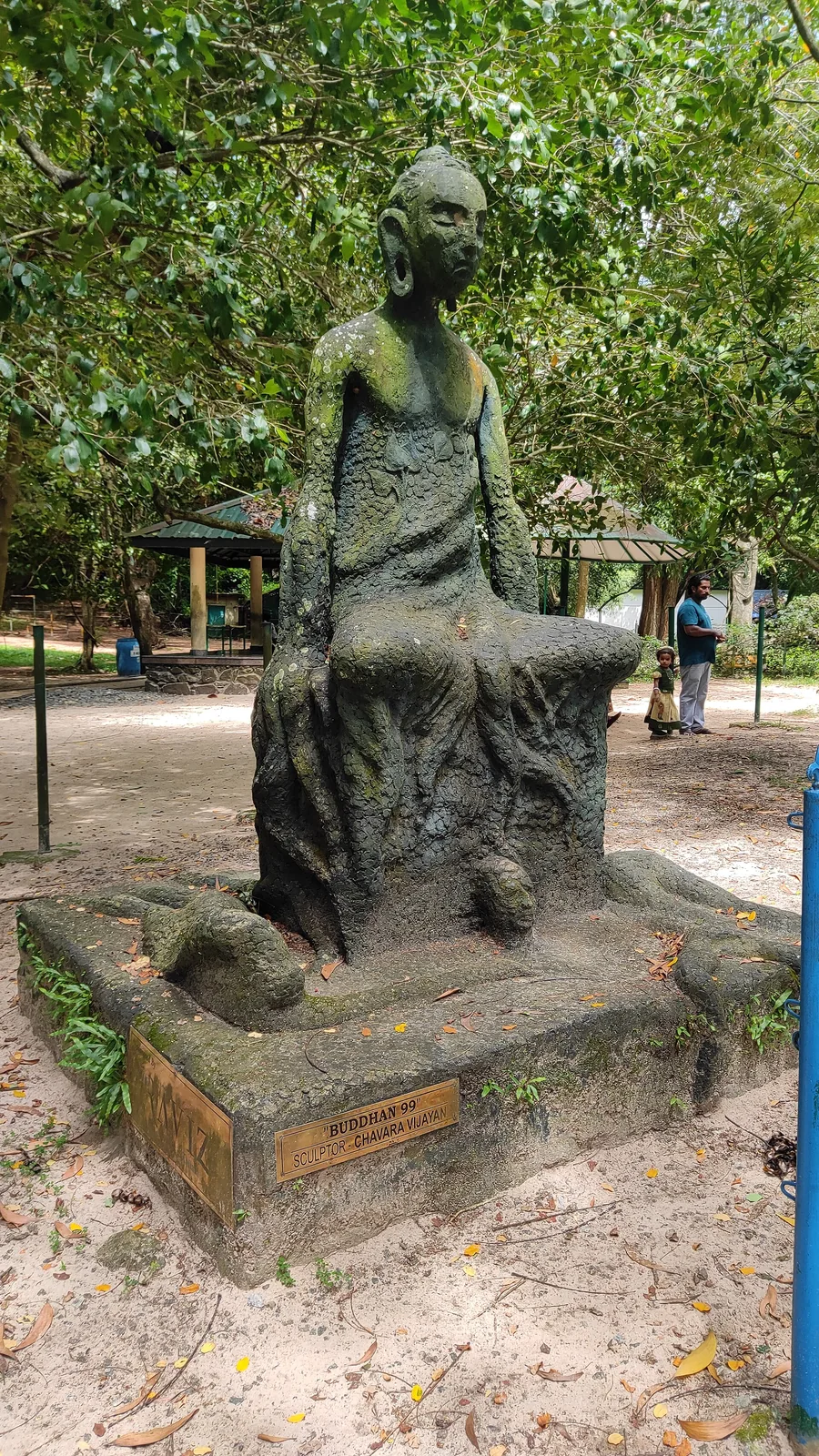
Meditation. Story Teller. Do not disturb. She. Love without heart and brain. Buddha 99. Victim. Descent. Winter Morning. Imagining Humanness. From the Margins. Adimakuthirakal. Nature of My Mother. Kuravanum Kurathiyum.
That is not a list you expect to find in a municipal recreation ground between a children’s play area and an open gym. Some are abstract, some figurative, some are jokes with a straight face. Love without heart and brain is doing something that a wall label would only spoil.
One caution about that list, because a printed list acquires authority it has not earned. The titles are not consistent across sources — one account gives Bundle of slogans where the photographic record gives Bundle of Thoughts. We name works that can be tied to a photograph or a source and we are not presenting a canonical set. If you find one we have missed, that is the correct outcome.
How you actually encounter them
Unannounced. There is no sculpture trail, no numbered map, no interpretation boards worth the name. You are walking between the boat jetty and the open theatre and there is a figure standing in the grass under a tree.
Whether that is a failure of civic communication or the best possible way to meet a sculpture is genuinely arguable, and we lean towards the second. A signposted sculpture trail turns art into a task with a completion state. Coming across Victim on the way to a boat does something a numbered plaque cannot.
It does mean you have to slow down and look. Most visitors to Asramam are here to get on the water or to put their children on a rope course, and the sculptures are entirely skippable if you do not know to look for them. Which is why we are telling you.
A municipal accident worth noticing
Public sculpture collections usually happen deliberately: a city decides, commissions, budgets, installs, signposts. This one happened because a temporary festival was held on public ground and the work was not removed afterwards.
Kerala has a good deal of this. Public art gets made for an occasion — a festival, a state anniversary, a tourism initiative — and then simply persists, absorbed into whatever the space becomes next. The Asramam grounds have absorbed a great many things this way, which is the subject of another of our stories about this park.
The effect here is that Kollam has a contemporary sculpture collection and does not seem to have decided that it does.
And while you are looking down
The other art in these grounds is the Paithruka Veedhi, the heritage way — a walkway lined with terracotta relief panels on the history of this district, each one captioned.
These are a different proposition from the sculptures: didactic rather than expressive, made to tell you something specific. One panel shows the Quilon revolt of 1809 — cavalry, sepoys with muskets, a field gun being manhandled forward — and its Malayalam caption names the event outright. Others take the port of Kollam, the cashew processing that employed this city for a century, the Punalur suspension bridge upriver, the Seethakali festival.
Between the two — twenty-first-century sculpture with no explanation, and terracotta history panels that explain themselves carefully — Asramam ends up being far more of an art park than an adventure park. The zipline is fine. The sculpture is the reason to walk slowly.
Frequently asked questions
Is there really a sculpture collection at Asramam?
Yes. Ten sculptors came for a Monsoon Sculptures festival in 2012 and the works stayed, standing about the grounds. There is no sculpture trail, no numbered map and effectively no signposting — you simply come across them.
Which sculptures are there?
Named works include Meditation, Story Teller, Do not disturb, She, Love without heart and brain, Buddha 99, Victim, Descent, Winter Morning, Imagining Humanness, From the Margins and Kuravanum Kurathiyum. Titles vary between sources — one list gives Bundle of slogans where the photographic record gives Bundle of Thoughts — so we do not print a canonical set.
What is the Paithruka Veedhi?
The heritage way: a walkway lined with captioned terracotta relief panels on the district’s history — the 1809 Quilon revolt, the port of Kollam, traditional cashew processing, the Punalur suspension bridge and the Seethakali festival among them.
Do I need a ticket to see the art?
You pay the park entry — commonly quoted at around ₹95, though that is an aggregator figure rather than an operator one — and the sculptures and relief panels then cost nothing further. The boating and adventure activities are charged separately.
How long should I allow?
Two to three hours covers the park, the sculptures and the heritage walkway at a decent pace. Half a day if you also take a boat out.
