Most visitors reach the Dharmanath Jain Temple for the pigeons, stay twenty minutes, and photograph a building they cannot read. That is not ignorance; Jain iconography is a separate vocabulary from the Hindu one, and nothing at this gate is labelled. Ten minutes of knowing what you are looking at changes the visit completely.
Start at the gate
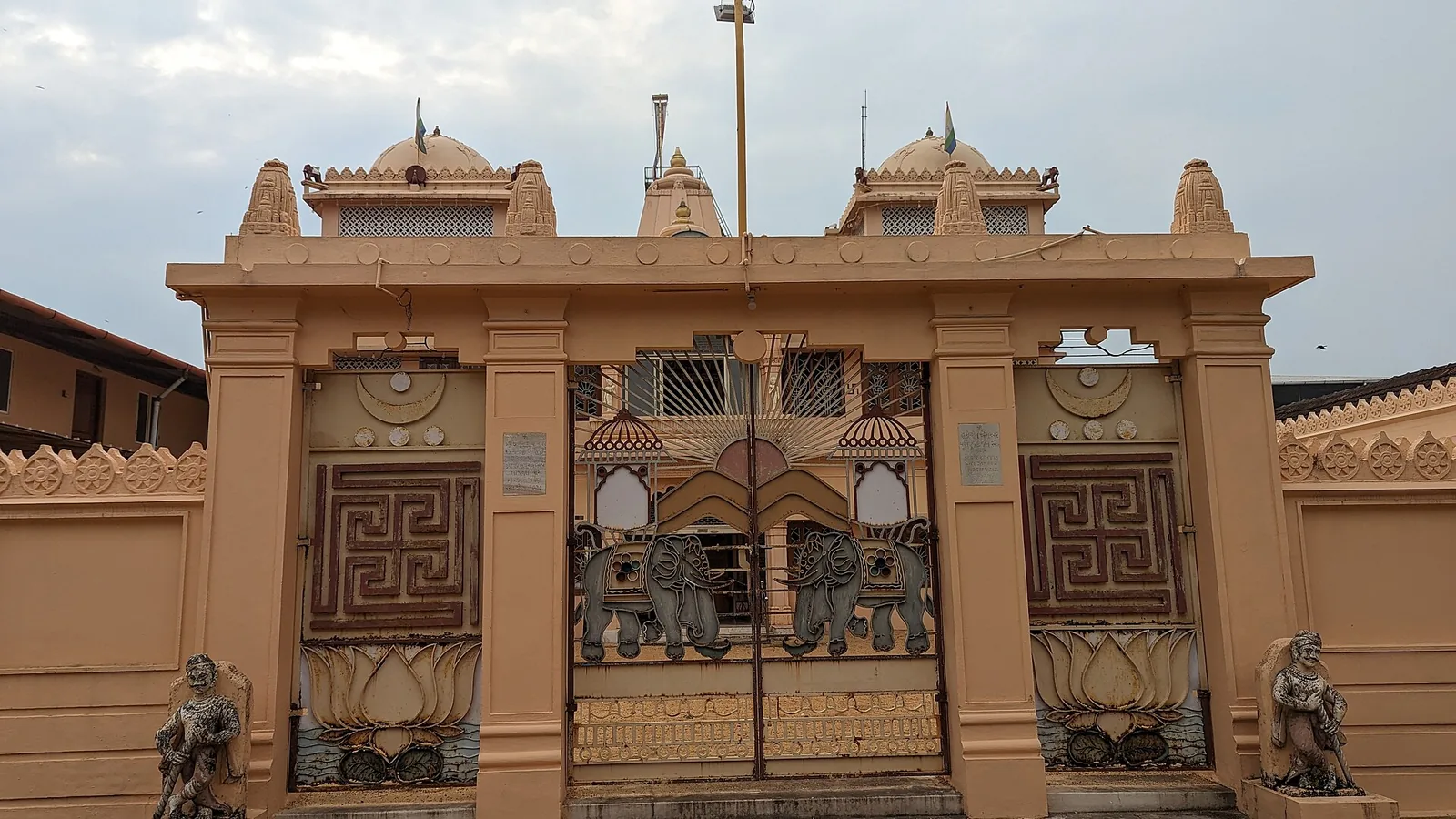
Before you go in, look at the gateway itself, because it is a compressed statement of the whole religion. Two large swastika panels sit on either side, and here the symbol is not decorative and it is not borrowed: it is one of the ashtamangala, the eight auspicious signs, and in Jain reading its four arms stand for the four states into which a soul can be born — heavenly, human, animal or plant, and hellish. It is a diagram of the cycle you are trying to get out of.
Below each swastika is a lotus, the standard emblem of a being that grows through mud and water and comes out unmarked by either. On the gates, elephants; at the foot of the piers, guardian figures. And above, on the roofline, domes and small shikhara spires that belong to western India rather than to Kerala.
Why it looks like Gujarat
Because it is meant to. The interior is faced throughout in white marble with carved pillars and Tirthankara figures, in the idiom of the Jain temples of Gujarat, and it has essentially nothing in common with Kerala’s own temple architecture of laterite walls, timber and sloped copper roofs.
The families who built it had come south from Kutch and Saurashtra to trade through the spice godowns of Mattancherry. A building that looks like home is what a merchant diaspora builds when it intends to stay but not to dissolve — the same instinct that has kept Konkani spoken at Gosripuram a few streets away, and Gujarati names on the shopfronts around this one.
The mulnayak, and the twenty-four
The word to know inside is mulnayak: the principal image of a Jain temple, the one the building is organised around. Here it is Dharmanatha, the fifteenth of the twenty-four Tirthankaras — the ford-makers, the teachers who cross over and leave a crossing behind them for everyone else.
Every Tirthankara has a lanchana, an emblem, carved on the pedestal beneath the figure, and that is how you tell them apart, because the figures themselves are deliberately near-identical. Dharmanatha’s is the vajra, the thunderbolt. In the second shrine within the complex, installed by Sheth Popatlal Govardhan Lalan, the deity is Chandraprabhu, the eighth Tirthankara, whose emblem is the moon. Look at the base of the pedestal rather than the face above it: a crescent means you are in the Chandraprabhu shrine, a thunderbolt means you are in front of the mulnayak. A Shantinath image here has a local reputation for answering petitions.
The eight days that structure the year
Paryushana is the most important observance in the Jain calendar, kept here annually: eight days for the Shvetambara tradition, of fasting, scripture and a deliberate audit of one’s own conduct. It ends on Samvatsari, the day of forgiveness, on which Jains ask pardon of everyone they may have harmed, in any way, deliberately or not, with the phrase Micchami Dukkadam — roughly, may whatever wrong I have done be without effect.
That is the frame the pigeons belong inside. The midday feeding is not a charming eccentricity bolted onto the temple; jiva daya, active compassion towards living beings, is a working principle of Jain practice, and feeding animals is among its most ordinary expressions. What this temple has added is scale and discipline — a purpose-built birdhouse of some thirty metres divided into around three hundred nesting compartments, which is a serious quantity of masonry to build for birds.
A note on dates, because you will be told the wrong one
If you are told the temple was built in 1960, it was not. It was built in 1904 — recorded in the Vikram era as VS 1960, which runs about fifty-seven years ahead of the Gregorian calendar. The number lost its era somewhere in translation and has been reprinted for decades since, including by state tourism material. Its builder was Hirubai Jivraj Dhanji, a Kutchi widow who raised it in memory of her husband, Jivraj Dhanji.
How to actually visit
Footwear comes off and leather is generally left outside — belts and wallets included, since ahimsa extends to what you are wearing. Dress modestly; scarves and dhotis are usually available at the entrance. Twenty to thirty minutes covers the building, forty-five if you wait for the birds at about a quarter past twelve.
And it sits well in the middle of a Mattancherry morning: the palace, this temple, Jew Town and the synagogue, the Konkani temple at Gosripuram, and the spice godowns of Bazaar Road. Five communities inside a few hundred metres, each of which built the thing it most missed.
Frequently asked questions
What does the swastika on the gate mean here?
It is a Jain auspicious symbol, one of the ashtamangala, and it long predates any twentieth-century European use. In Jain reading its four arms represent the four states into which a soul can be born — heavenly, human, animal or plant, and hellish — so it is a diagram of the cycle of rebirth that the religion aims to escape.
What is a mulnayak?
The principal image of a Jain temple, the one the building is organised around. Here it is Dharmanatha, the fifteenth of the twenty-four Tirthankaras.
How do I tell the Tirthankaras apart?
By the lanchana, the emblem carved on the pedestal beneath the figure, since the figures themselves are deliberately near-identical. Dharmanatha’s emblem is the vajra or thunderbolt. Chandraprabhu, the eighth Tirthankara, whose shrine is also within this complex, has the moon — so a crescent on a pedestal tells you which shrine you are in.
Why does it look like a Gujarati building?
Because it is one, deliberately. The white marble facing, the carved pillars and the domes and spires belong to the Jain temple architecture of Gujarat, and the community that built it came from Kutch and Saurashtra to trade through the Mattancherry spice godowns. Kerala’s own temple idiom of laterite, timber and copper roofing is nowhere in it.
What is Paryushana?
The most important observance of the Jain year, kept here annually — eight days in the Shvetambara tradition of fasting, scripture and self-examination. It ends on Samvatsari, the day of forgiveness, when Jains ask pardon for any harm caused with the phrase Micchami Dukkadam: may whatever wrong I have done be without effect.
When was the temple built?
1904, recorded in the Vikram era as VS 1960 — which is the origin of the very widely repeated claim that it dates from 1960 CE. It was built by Hirubai Jivraj Dhanji in memory of her husband, Jivraj Dhanji.
What are the rules for visiting?
Footwear off, leather items generally left outside including belts and wallets, and modest dress; scarves and dhotis are usually available at the entrance. Twenty to thirty minutes is enough for the building, or about forty-five if you stay for the pigeon feeding shortly after noon.