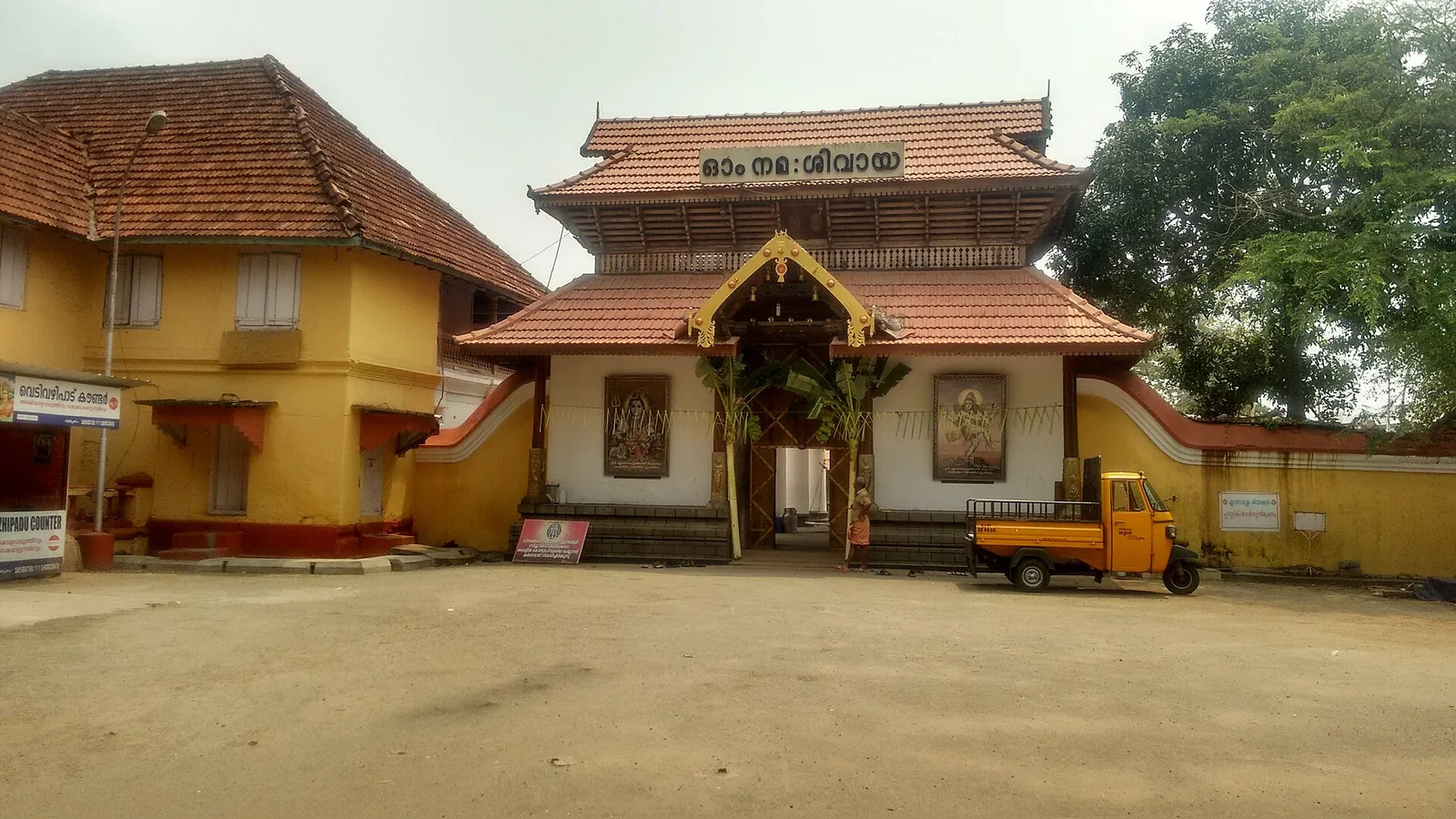
The city of Ernakulam — the mainland heart of Kochi, all traffic and towers and shopfronts — is named, if the old story is true, after a snake. Or rather, after a man condemned to live as one, and the pond in which he was finally freed. That pond belongs to Ernakulam Shiva Temple, whose deity, Ernakulathappan, is worshipped as the guardian of the whole city.
The sage who became a serpent
Legend tells of a man named Devala, cursed by a sage to carry the body of a snake. Shunned and stared at, he crawled away into a forest and there found a Shivalinga sunk deep in the mud. Taking it as his refuge, he worshipped it in fierce, unbroken penance, praying for release. People who glimpsed the strange snake-bodied man at his devotions called him Rishi Nagam — the Serpent Saint. At last, moved by his years of prayer, Shiva and Parvati appeared before him in their true forms and told him to bathe in the nearby pond. The moment he immersed himself, the curse dissolved and he was a man again.
How a pond named a city
That pond became sacred, and known as Rishinagakulam — the pond of the Serpent Saint. Over the long centuries, on Malayali tongues, Rishinagakulam is said to have worn down and down until it became Ernakulam. (Others trace the name to Eere-naal-kulam, “the pond that is always full of water,” after the same famous tank.) Either way, the city carries the memory of that legend in its very name, and the temple that grew around the pond has been its spiritual centre ever since.
A temple as old as the Cheras
This is no modern shrine. The temple is mentioned as far back as the Sangam age as one of the important temples of the Chera country, whose kings were devoted worshippers of Shiva. Its deity was formally regarded as the Nagara Devata, the protecting god of the town. The temple you see today owes much to a nineteenth-century rebuilding: in the 1840s the Diwan of Kochi, finding the ancient shrine fallen into disrepair, had it renovated, adding gopura mandapams in the classic Kerala style modelled on the royal Poornathrayeesa temple at Tripunithura, and reopening it in 1846.
The eight days of the Utsavam
Once a year the guardian god is honoured in style. The Ernakulathappan Utsavam runs for eight days in the Malayalam month of Makaram (January–February), opening with the Kodiyettam flag-hoisting and building through nights of Panchavadyam drumming and Sheeveli processions in which the deities ride out on a line of caparisoned elephants. It closes on the eighth day with the Aarattu — the ceremonial bathing of the god, elephants and drums in the small hours, and fireworks lighting the city sky at two in the morning. For a few days each year the busy modern city gathers, quite literally, around its ancient serpent-legend.
Visiting Ernakulathappan
The temple stands right in the centre of Ernakulam, near the Durbar Hall ground and the waterfront, easy to fold into any day in the city. Come during Makaram for the Utsavam, or on any evening for the lamplit calm of the guardian’s shrine. Details are on the Ernakulathappan place page; more of the district is on the Ernakulam hub.
Frequently asked questions
How did Ernakulam get its name?
The most popular tradition traces it to Rishinagakulam, “the pond of the Serpent Saint” — the sacred tank of the Ernakulam Shiva Temple where a cursed sage in a snake’s body was freed. Over centuries the name is said to have worn down to Ernakulam. An alternative derivation is Eere-naal-kulam, “the ever-full pond,” after the same tank.
Who is Ernakulathappan?
Ernakulathappan means “the Lord of Ernakulam.” It is the reverent name for Shiva as enshrined in the Ernakulam Shiva Temple, worshipped as the Nagara Devata, the guardian deity of the city.
When is the Ernakulathappan Utsavam?
The temple’s main festival is held over eight days in the Malayalam month of Makaram (January–February), beginning with the flag-hoisting (Kodiyettam) and ending with the Aarattu procession and a pre-dawn fireworks display on the eighth day.