Three names have been attached to the strip of waterfront beside the Ernakulam boat jetty, and each one belonged to a different idea of who the place was for. Subhash Park is the current one. It is worth knowing the other two, because all three are still physically present on the same eleven acres.
A maharaja’s park
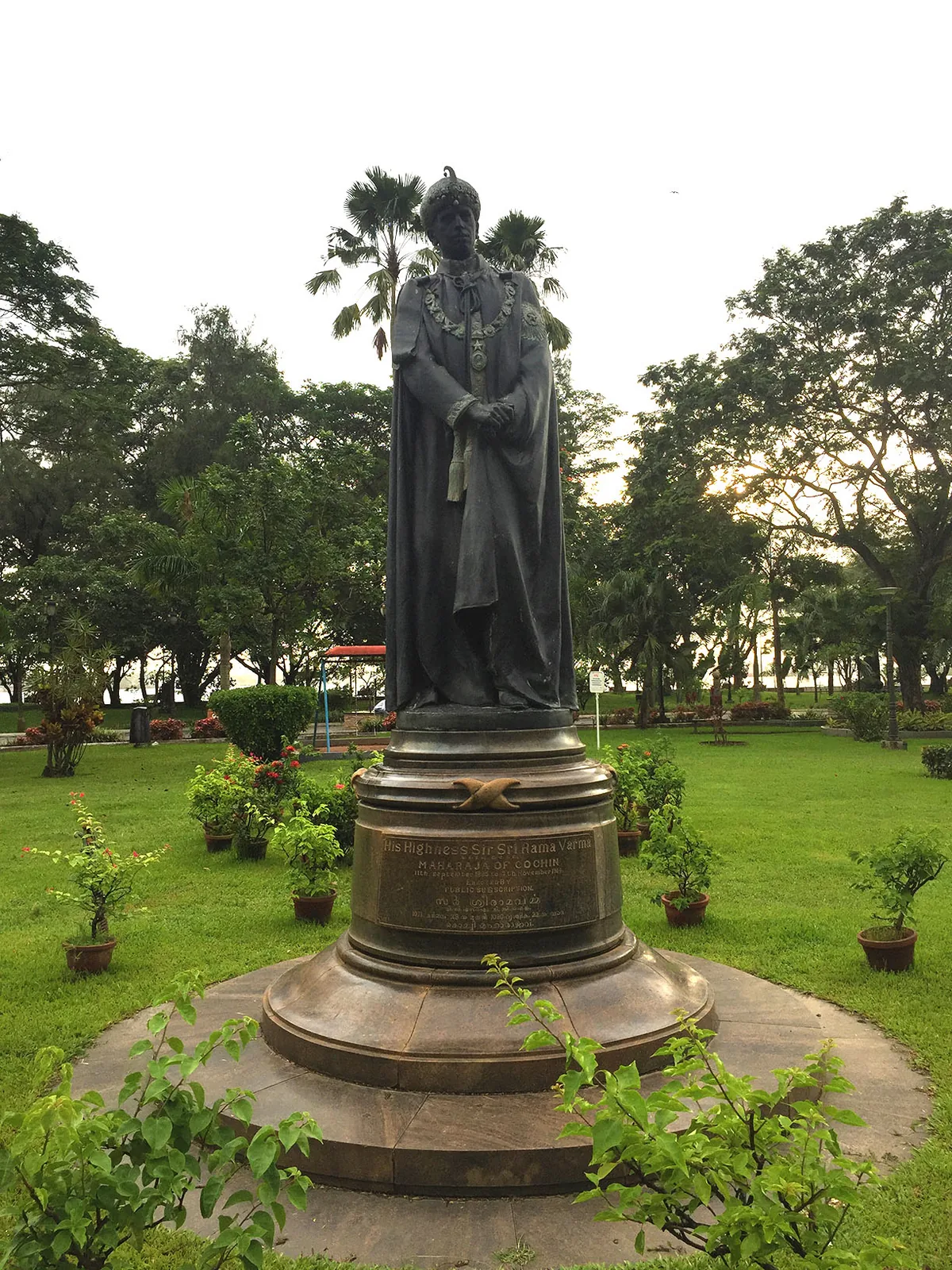
The park was started in 1903 by Rajarshi Rama Varma XV, Maharaja of Cochin from 1895 to 1914 — a reforming ruler remembered well enough that his statue stands in the grounds today, with an information board beside it. It opened under his own name, as Rama Varma Park. If you want to see the first layer of the park’s history, that is it: a princely gift of public green space on a working waterfront, carrying the giver’s name.
A viceroy’s park
Some time during Lord Irwin’s viceroyalty — he held the office from April 1926 to April 1931 — the park was renamed Irwin Park after him.
This is the point at which most accounts of the park stop making sense, because they run the 1903 founding straight into the Irwin name and leave you with a park apparently named at birth for a man who arrived twenty-three years later. The missing piece is simply the first name. We published that contradiction here as unresolved before we found it; the fuller account is in the name Subhash Park opened with.
- Rama Varma Park — from 1903, for the Maharaja of Cochin who ordered it. His statue is still in the grounds.
- Irwin Park — renamed during Lord Irwin’s viceroyalty, 1926–31, when the park was already a generation old.
- Subhash Chandra Bose — renamed after independence. The park is now known almost universally as Subhash Park or Subhash Bose Park.
What happened here in 1930
Maharaja’s College stands directly across the road. In 1930 its students held a demonstration in the park against the Kochi kingdom and were violently suppressed.
It is worth being precise about what that means. This was not a protest against the British in a British province. It was a protest by students of the maharaja’s own college, in a park given by a maharaja, against the princely government — and it was put down by force. The princely states are often described as a gentler order than direct colonial rule, and sometimes they were; this ground records an occasion when they were not.
The park was also a launching ground for the campaign to merge Cochin and Travancore, the beginning of the process that ended in the creation of Kerala in 1956. We cover that movement separately in how Kerala was made; what belongs to the park is that the argument was made out loud here.
The renaming was an answer
After independence the park was rededicated to Subhash Chandra Bose. This is usually presented as routine — one of hundreds of colonial names swapped out across Indian cities — and at the level of policy it was.
At the level of this particular park it reads as something sharper. A green space carrying the name of a serving Viceroy was given instead to the nationalist who raised an army against British India, on ground where students had been beaten for protesting against the government of the day. Of all the available names, that one. It is difficult to read as an accident.
What makes the park unusual is that nothing was erased in the process. Rama Varma’s statue stayed. The Irwin name is still remembered locally. Bose is on the gate. Most renamed public spaces in India lose the earlier layer; this one kept all three, and you can walk between them in about two minutes.
None of it is signposted
The 1930 demonstration is not marked. The Aikya Kerala connection is not marked. The renaming is not explained anywhere on site. What the park does have is a good view over the harbour, an unlabelled collection of 1990 international sculpture in its southern quarter, a children’s park, and a great many families after six in the evening.
It is free, it is immediately beside the boat jetty, and it is the right thing to do with the twenty minutes before a ferry — which is roughly how long it takes to find all three names.
Frequently asked questions
Why is it called Subhash Park?
It was renamed after independence for Subhash Chandra Bose. Before that it was Irwin Park, after Lord Irwin, Viceroy of India. And before that it was Rama Varma Park, the name it opened with in 1903, for Rajarshi Rama Varma XV, Maharaja of Cochin, who ordered it. Three names, in that order.
Was Subhash Park really founded in 1903?
Yes. The reason that date looks wrong alongside the Irwin name — Irwin only became Viceroy in 1926 — is that the park did not carry his name at the start. It opened as Rama Varma Park and was renamed for Irwin roughly twenty-three years later.
What happened at Subhash Park in 1930?
Students from Maharaja’s College, directly across the road, demonstrated in the park against the Kochi kingdom and were violently suppressed. Notably it was a protest against the princely government rather than against the British, and nothing on the site records it.
Whose statue is in Subhash Park?
Sir Sri Rama Varma XV of Cochin, the maharaja reported to have started the park in 1903, with an information board beside it. The statue stayed through both renamings, which is unusual — most renamed Indian public spaces lose the earlier layer.
Who was Lord Irwin?
Edward Wood, Lord Irwin, Viceroy of India from 1926 to 1931 — later Lord Halifax and British Foreign Secretary. The park carried his name until independence, though by what route nobody appears to have documented.
Is any of this marked in the park?
No. The 1930 demonstration, the Aikya Kerala connection and the renaming are all unmarked, as are the 1990 symposium sculptures in the southern grounds. The park reads as an ordinary city green unless you know what happened on it.