Almost every account of Subhash Park in Ernakulam contains a chronological impossibility, and repeats it without blinking. The park, we are told, was started in 1903 by the Maharaja of Cochin. The park, we are also told, was called Irwin Park after Lord Irwin, Viceroy of India. Irwin was not appointed Viceroy until April 1926.
We published that contradiction on this site and said plainly that we could not resolve it. We can now, and the answer is duller and better than any of the theories: the park had a name before Irwin, and the city has simply stopped using it.
Rama Varma Park
When the park opened it was Rama Varma Park, after the man who ordered it — Rama Varma XV, Maharaja of Cochin. The 1903 date and the Irwin name were never competing accounts of the same act. They are two different events roughly twenty-three years apart, and the first name dropped out of the retelling somewhere in between.
Once you know that, the sequence is ordinary. A princely gift of public green space in 1903, carrying the ruler’s name. A colonial renaming at some point during Irwin’s viceroyalty of 1926 to 1931, of the kind that was applied to thousands of Indian streets, parks and halls. Then, after independence, a nationalist renaming to Subhash Chandra Bose. Three names, in order, each one a different answer to the question of who the ground belonged to.
- Rama Varma Park — from 1903, named for the Maharaja of Cochin who ordered it.
- Irwin Park — applied during Lord Irwin’s viceroyalty, 1926–31, to a park already a generation old.
- Subhash Park — after independence, for Subhash Chandra Bose. The name on the gate today.
The plinth is the source
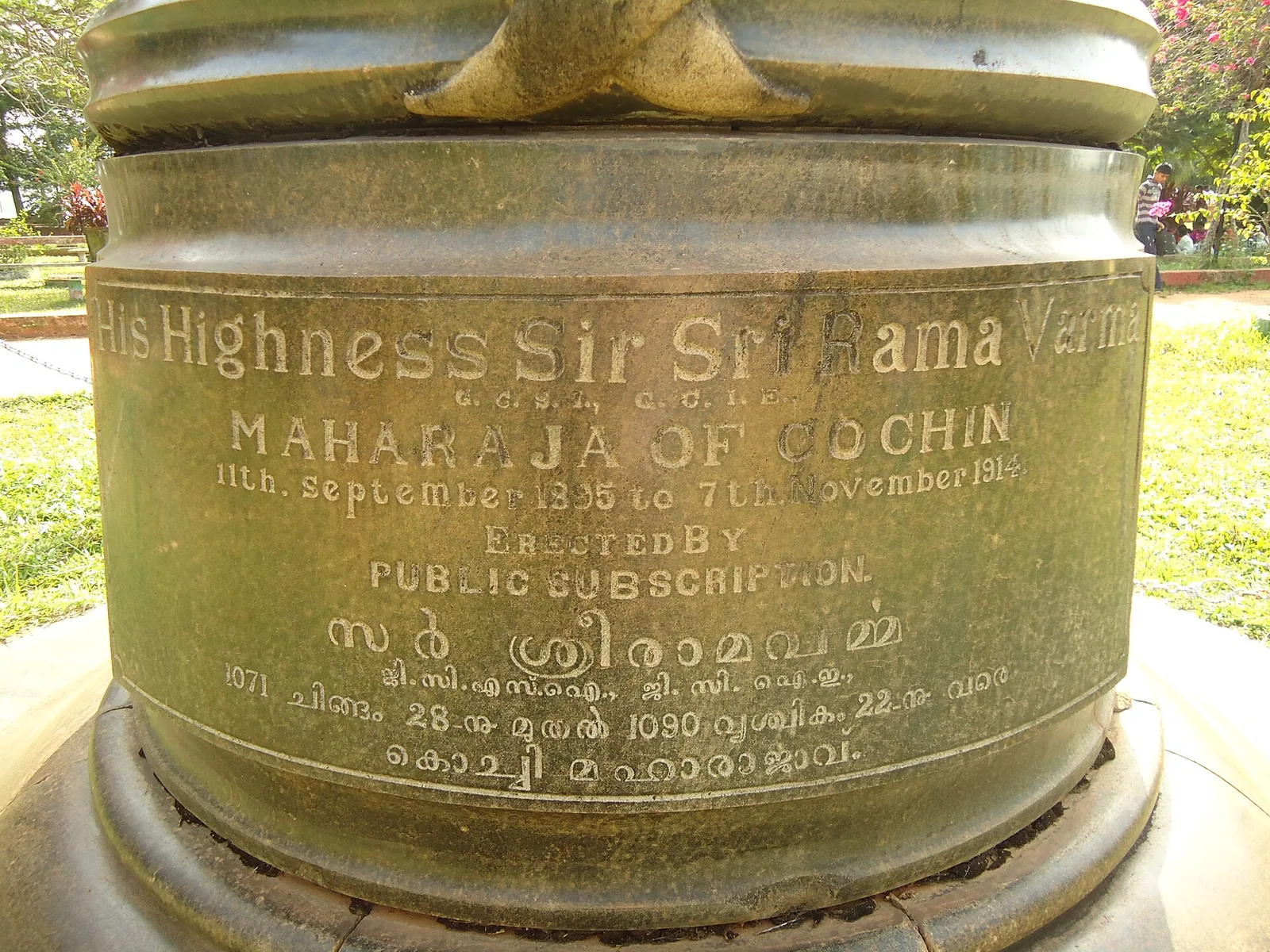
The statue standing in the grounds is not decoration; it is the most reliable document on the site, and it is legible if you walk up to it. The bronze plinth is inscribed, in English above Malayalam: “His Highness Sir Sri Rama Varma, G.C.S.I., G.C.I.E., Maharaja of Cochin, 11th September 1895 to 7th November 1914. Erected by public subscription.” The Malayalam text below gives the same span in the Malayalam era — 1071 Chingam 28 to 1090 Vrischikam 22.
Two things in that are worth pausing on. The first is “erected by public subscription”. This was not a state monument commissioned by a court to its own ruler; it was paid for by people putting money in. The second is that the inscription closes his reign in 1914 — which it can do, because he was still alive when it happened. He did not die in office.
The maharaja who resigned
Rama Varma XV ruled Cochin from September 1895 and abdicated in November 1914, which Indian ruling princes essentially did not do. Thrones were left by death or by British deposition, and voluntary retirement from one had no obvious script. He got a title out of it that no one else in the family carried: “Ozhinja Valiya Thampuran”, the Abdicated Highness, which is what he was called for the eighteen years he then lived as a private man. He died at his summer residence in Thrissur in January 1932.
He is remembered in Kerala as Rajarshi, the royal sage, a name attached to reformers rather than to conquerors. The year the park was conceived, 1903, was also the year of the Delhi Durbar, at which he was made a Knight Grand Commander of the Star of India — the G.C.S.I. cut into the plinth. The park is said to have come out of that period of travelling to imperial assemblies: a ruler who had seen how European and American cities used tree-lined public avenues, deciding that Ernakulam should have one.
And it produced a street name that survived
The avenue laid out alongside the park was planted up with gulmohar and other flowering trees, and it worked well enough that the British Resident of Cochin renamed the road Park Avenue. That name is still in use. So the odd result of all this is that the maharaja’s project kept its “street” name through both renamings and independence, and lost its “park” name to a viceroy who had nothing to do with building it.
Why the first name vanished
Nobody suppressed it. What happened is more like erosion. A renaming replaces the name in daily speech within a generation, and once the park was Irwin Park the earlier name survived only in records. The post-independence renaming then had its own logic — a colonial name had to go, and the obvious replacement was a nationalist one — so nothing pulled the original name back. By the time anyone wrote the park’s history for the internet, the surviving fragments were the 1903 date and the Irwin name, which is exactly the pair that does not make sense.
We would rather flag this than quietly fix it: our own pages on this park carried the contradiction as unresolved until we found the missing name. That is what the correction was.
What to do with this on the ground
Walk to the statue. It is in the grounds and it takes a minute to find. Read the plinth rather than the information board — the plinth carries the exact dates and the public-subscription line, which is the part that tells you how the city felt about him.
Then note what is “not” there. There is no marker for the 1903 founding, none for the original name, none for the 1930 demonstration by Maharaja’s College students that we cover in the beating and the renaming, and none for the fourteen international sculptors whose work stands in the southern quarter, covered in the sculptures nobody labelled. This is a park with four separate historical layers and no signage for any of them.
It is free, it is a two-minute walk from Ernakulam Boat Jetty, and it is the right use of the wait before a ferry to Fort Kochi.
Frequently asked questions
What was Subhash Park called before?
Two things, in order. It opened in 1903 as Rama Varma Park, for Rama Varma XV, Maharaja of Cochin, who ordered it. Some time during Lord Irwin’s viceroyalty — he was Viceroy of India from 1926 to 1931 — it was renamed Irwin Park. After independence it became Subhash Park, for Subhash Chandra Bose. Most accounts drop the first name, which is what creates the apparent contradiction between a 1903 founding and a viceroy who arrived in 1926.
So was the park founded in 1903 or not?
Yes, 1903 is the founding date, and there is no conflict with the Irwin name once you know the park did not carry that name at the start. The two claims describe events about twenty-three years apart.
Who was Rajarshi Rama Varma?
Rama Varma XV, Maharaja of Cochin from 11 September 1895 to 7 November 1914 — the dates are cast into the plinth of his statue in the park. He is remembered as Rajarshi, the royal sage, and for abdicating in 1914, which Indian ruling princes almost never did. He was afterwards known as the Ozhinja Valiya Thampuran, the Abdicated Highness, and died at Thrissur in January 1932.
What does the inscription on the statue say?
In English: “His Highness Sir Sri Rama Varma, G.C.S.I., G.C.I.E., Maharaja of Cochin, 11th September 1895 to 7th November 1914. Erected by public subscription.” The Malayalam below repeats it with the same span in the Malayalam era, 1071 Chingam 28 to 1090 Vrischikam 22. The public-subscription line is the interesting part — the statue was paid for by people, not commissioned by the court.
Why is the road outside called Park Avenue?
Because of this park. The avenue laid out beside it was planted with gulmohar and other flowering trees, and the British Resident of Cochin was impressed enough by it to rename the street Park Avenue. It has kept that name through two renamings of the park itself and through independence.
Is any of this explained in the park?
No. There is a statue with an information board, and that is the whole of it. The original name, the 1903 founding, the 1930 student demonstration and the 1990 international sculpture symposium in the southern grounds are all unmarked on site.