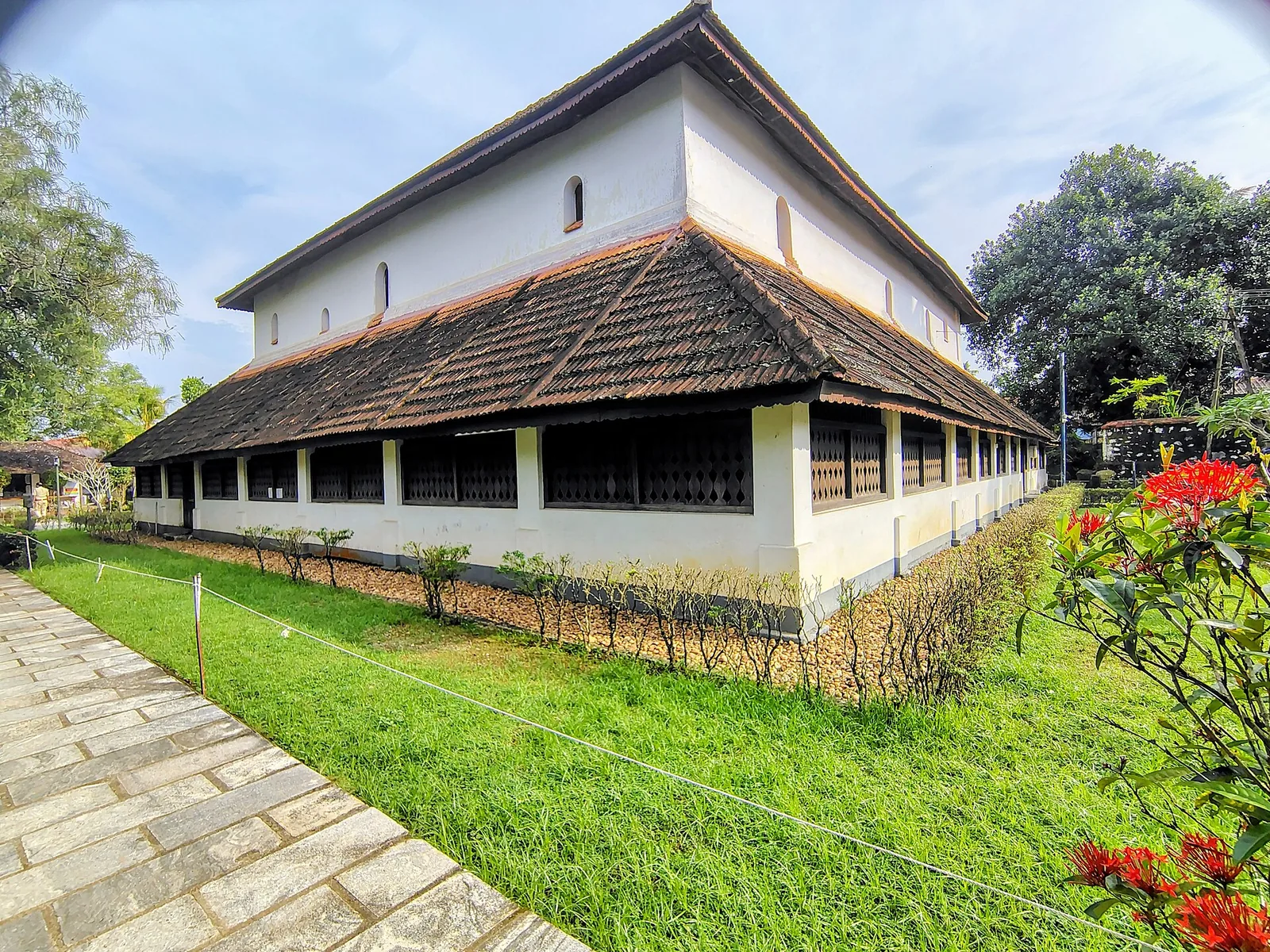
At Koyikkal Palace, the first exhibit is the building itself. Before concentrating on a coin or musical instrument, look at the house that holds the collections: sloping roofs, timber and rooms arranged around an open courtyard. This is a nalukettu at Nedumangad, where an old royal residence has acquired a public life as a museum.
The courtyard gives the house a centre
Kerala Tourism describes the traditional nalukettu form through its central courtyard and the rooms on four sides. The plan makes the open space a shared reference point. As a visitor moves through the permitted rooms, the house can be read as a connected arrangement rather than a row of unrelated galleries. Look back toward the centre and notice how the enclosed and open parts relate.
The department’s architectural account also describes sloping tiled roofs, carved timber elements and open verandahs. Roofs carry away monsoon rain; openings bring light and air into the building. Those functions are part of the story of a Kerala house. The architecture is not merely decoration behind the objects: it offers its own explanation of shelter and shared space.
A royal association, then another use
The palace is associated with Umayamma Rani of Venad. Kerala Tourism’s accounts disagree about its exact construction century, giving the sixteenth century in one description and the seventeenth in a 2009 feature. Neither supplies the building sequence needed to resolve that difference. The royal connection and surviving traditional form remain useful context without assigning every wall an exact date.
The later museum use adds a different history. The Department of Archaeology established folklore and numismatic collections here; the 2009 account dates the folklore museum to 1992. A residence became a place for preserving objects from domestic life, performance and money. The old rooms now ask visitors to follow histories that extend far beyond one royal household.
Read the house and collections together
The Chandravalayam story follows a percussion instrument connected with the telling of Rama’s story. The coin collection story approaches the palace through currencies from different places and periods. Their subjects differ, but each gives a reason to linger inside the same house.
Allow time for both architecture and displays when planning the Nedumangad visit. Confirm current museum access and opening arrangements before travelling, especially if stairs affect your visit. At the end, return your attention to the courtyard. The collections explain what the museum preserves; the building explains where those different histories have found a home.
- Kerala Tourism destination page: sixteenth-century description
- Kerala Tourism 2009 article: seventeenth-century description
- Neither page provides a dated architectural survey that resolves the difference.