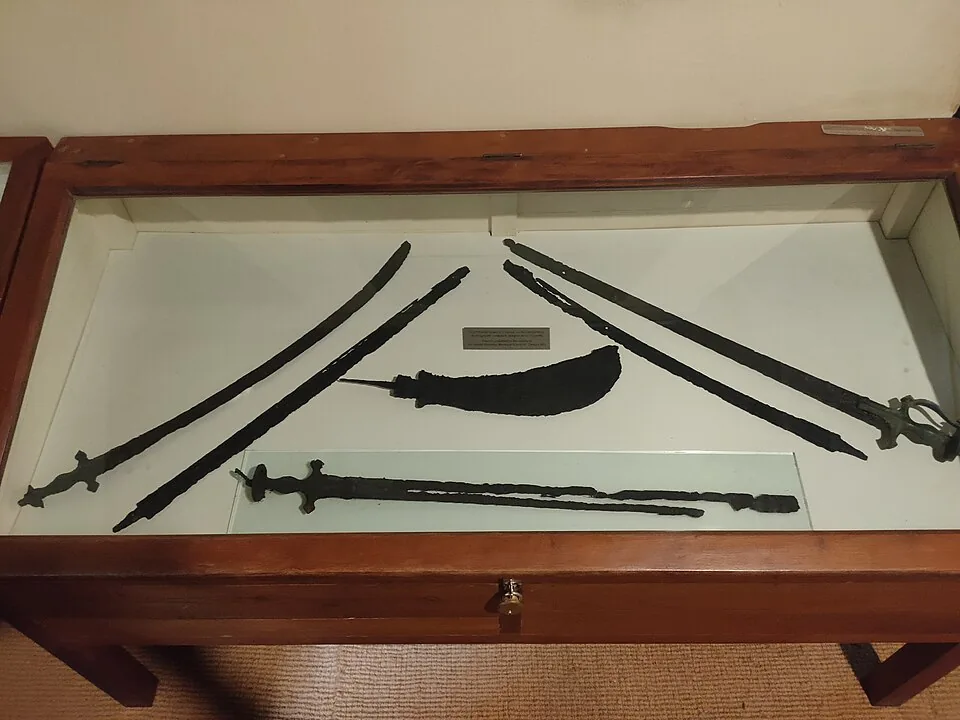
At Kottakkal, about five kilometres from Payyoli, a small house holds a sword, a few cannonballs and other relics from the time of the Zamorins. It is the Kunjali Marakkar Museum, set in the house of the most famous admiral of Calicut. The objects are few, but the story behind them covers most of a century and four men who carried the same title.
Marakkar was an honour given to a family of fighters who commanded the Zamorin's fleet. The family is said to have traded by sea from the Cochin side. After the Portuguese settled at Kochi, the family moved north to Kozhikode and made its base at Ponnani. The Portuguese now controlled the sea routes, and the Zamorin's trade with Egypt was suffering. He needed a navy, and the Marakkars gave him one.
The first Kunjali, Kutty Muhammad, is thought to have served from about 1524 to 1539. He did not fight the big Portuguese ships head on. Instead his light boats struck fast, set the enemy ships on fire and slipped away. In 1539 he was killed in a surprise attack by the Portuguese commander Miguel Pereira at Vithula in Sri Lanka.
The second Kunjali took over with a team of captains beside him. Within a year, his men destroyed more than fifty Portuguese ships. Yet in 1540 the Zamorin made peace with the Portuguese and lost his trade monopoly at Kozhikode. The Portuguese fort at Chaliyam, across the river from the city, became the gun pointed at the Zamorin's throat.
The third Kunjali, also called Pattu Marakkar, removed that gun. In 1571 his forces and the Zamorin's destroyed the Chaliyam fort. In return the Zamorin let him build a fort of his own at Kottakkal, near Vadakara. He raised a large fortress near the Iringal rock, and a town called Puthupattanam grew up around it.
The fourth Kunjali inherited the fort, and with it the Zamorin's distrust. Rumours, many of them spread by the Portuguese, told the Zamorin that his admiral had become a rival. In 1598 the Zamorin attacked Kottakkal with Portuguese help, and the attack failed.
In 1600 he came back, this time with Portuguese ships to support him. When his side was close to winning, the Zamorin offered Kunjali a pardon. Kunjali surrendered on that promise. The Zamorin did not keep his word, and handed him over to the Portuguese.
The Portuguese took Kunjali to Goa and beheaded him there. His head was preserved in salt water and put on public show in Kannur. The Kerala Tourism account of the museum says it plainly: the Portuguese caught him only through treachery.
That is why the museum matters more than its size. The sword and the cannonballs are what is left of four men who kept a small navy fighting a large one for most of a century. The Vadakara hub covers the coast around the fort site, and Lokanarkavu Temple is a short drive inland.
Frequently asked questions
Who were the Kunjali Marakkars?
Four members of the Marakkar family who commanded the Zamorin of Calicut's navy against the Portuguese in the sixteenth century.
Where was Kunjali's fort?
At Kottakkal near Vadakara, near the Iringal rock. The museum stands at Kottakkal, about five kilometres from Payyoli.
How did the last Kunjali die?
He surrendered in 1600 on a promise of pardon, was handed to the Portuguese, and was beheaded in Goa.
What is in the museum?
A history of Kunjali Marakkar, his sword, cannonballs and other relics from the Zamorin period.