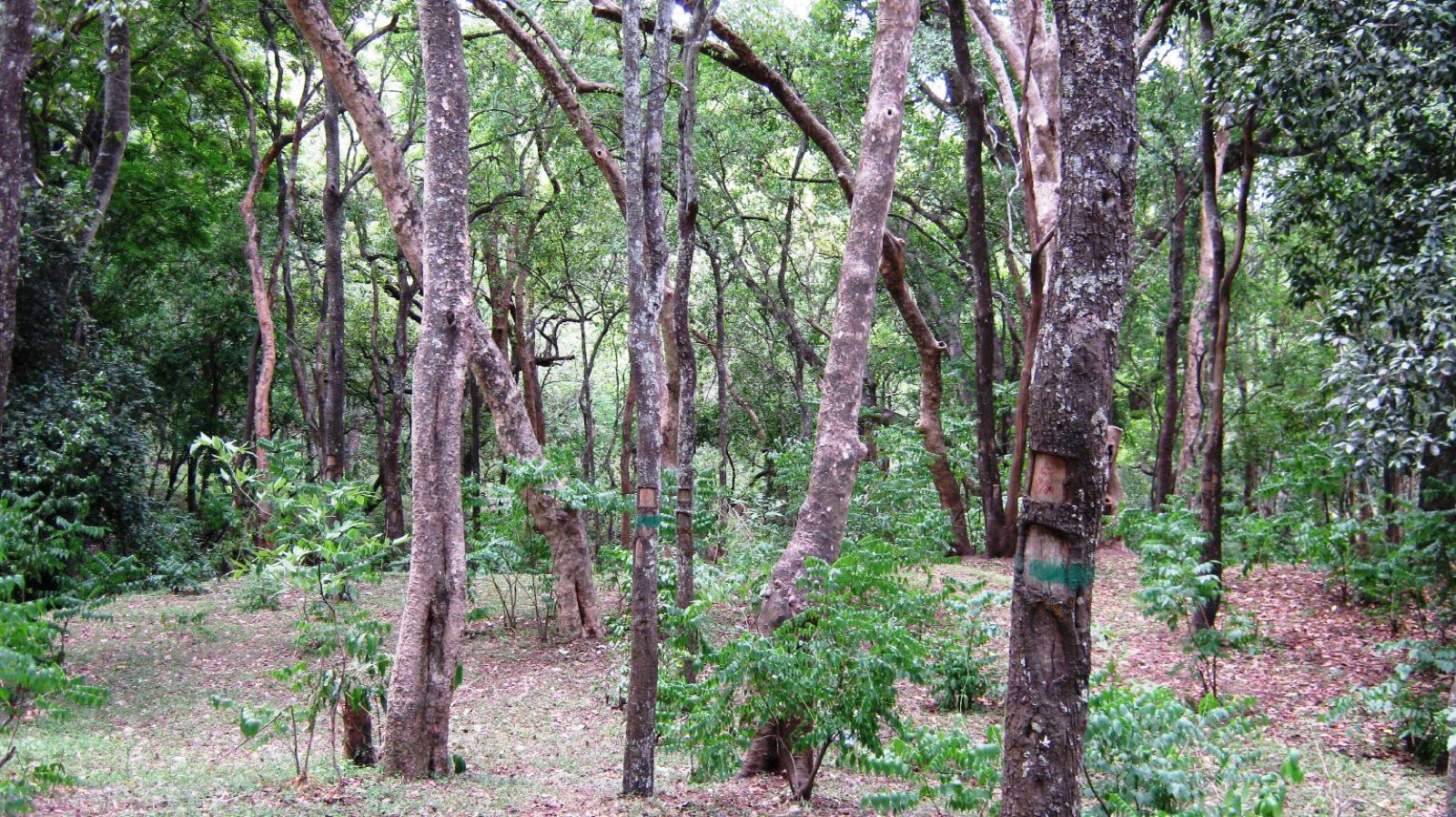
About 40 km beyond Munnar, the road drops out of the tea hills into a drier valley, and the air changes. This is Marayoor, and its fame rests on one tree. Kerala Tourism records that Marayoor is the only place in the whole state where sandalwood grows naturally, so the Marayoor sandalwood forest is guarded like a treasury rather than walked like a park.
The guarding is real and it never stops. Onmanorama reported in 2021 that the Marayur forest division covers 64 sq km, about 15 sq km of it sandalwood forest. Its officers patrol it from 6 pm to 7 am in every season. They do this because the losses were once heavy: the division lost 2,660 trees in 2004 and 2,490 in 2005. After the range became a full sandal division in 2005, the thefts fell, so that only 13 trees were stolen in 2020. The same report counted about 58,000 trees, the most in India now that disease has struck the old sandalwood belts of Mysore and Tamil Nadu.
The reason anyone takes such trouble lies inside the wood. The valley sits at about 580 m, in the rain shadow below Anamudi, and its low rainfall and sloping ground give Marayoor sandalwood more oil. Onmanorama noted that 100 kg of Marayoor wood yields 5 to 8 kg of oil, while the same weight from Karnataka yields about 3 kg. That is why every sandalwood tree felled anywhere in Kerala comes here, to the state's only sandalwood depot. Its three godowns behind a 12-foot wall hold up to 200 tonnes under cameras and guards. From there the Forest Department sells it by auction, and Karnataka Soaps and Detergents, the maker of Mysore sandal soap, buys about 98% of it.
The same dry warmth that thickens the sandalwood oil also ripens sugarcane, and that is the valley's second story. About 900 farmers grow cane on roughly 1,800 acres across Marayoor and Kanthalloor, and because the cane grows all year, the jaggery boils all year too. Onmanorama describes the method. The juice settles in drums, the clear part goes into a wide pan called a copra that holds 1,000 litres, and the fire beneath it burns the crushed cane left over from the press. Lime lifts the impurities to the top, the cooks skim them off, and when the water has gone the thick syrup is cooled and rolled into balls by hand.
Those hands leave their prints on every ball, and that is one way people tell Marayoor jaggery from the rest. It is dark brown rather than golden, because no chemical bleach is used, and it tastes sweeter and less salty. The farmer groups of Anjunadu, Mahad and Mapco applied for protection on 9 March 2018 with help from the Kerala Agricultural University's GI cell. Marayoor jaggery then became the 24th product from Kerala to win a Geographical Indication tag, so a ball sold under the Marayoor name must come from this valley.
Long before cane or guards, the people of this valley built in stone. Across the hillsides stand muniyaras, burial chambers of the megalithic age made of four stones set on edge with a fifth capstone laid on top. Kerala Tourism links them to the Iron Age and notes that some local tribal people believe they were homes of Stone Age people. Some hold several chambers, and the dry winters and hot summers have kept them standing for well over a thousand years. Nearby, at Attala, a rock shelter more than 1,500 m above sea level carries over 90 painted motifs.
So a single drive ties the three stories together: the sandalwood forest by the road, the cane fields and boiling pans, and the stone chambers on the slopes above. Many visitors carry on to the orchards of Kanthalloor, or to the dry thorn forest of Chinnar Wildlife Sanctuary, where the Chinnar dolmen trek walks among more muniyaras.
Frequently asked questions
How far is Marayoor from Munnar?
Kerala Tourism puts Marayoor about 40 km from Munnar.
Is Marayoor the only sandalwood forest in Kerala?
Yes. Kerala Tourism records it as the only place in Kerala with natural sandalwood.
Does Marayoor jaggery have a GI tag?
Yes. It became the 24th Kerala product with a Geographical Indication tag, through the Kerala Agricultural University's GI cell.
What is a muniyara?
It is a megalithic burial chamber of four stones on edge with a fifth capstone on top.