It is easy to treat the Napier Museum as a building with some objects in it — the architecture is that assertive. But the collection is one of the richest holdings of religious and decorative art in south India, and it rewards a slower pass than most visitors give it.
The bronzes
The core of it is metal. Nataraja, Surya, Parvati, Venugopala: the standard repertoire of south Indian bronze casting, in a state with one of the deepest traditions of it anywhere. What is worth holding in mind as you look is that almost none of these were made as art objects. They were made for worship, often for specific temples, and many of them were in use for centuries before they arrived in a case. A bronze in this room is a survivor of a living practice rather than a specimen of a dead one, and the difference shows in the wear.
A claim to treat gently
One of the bronzes, a Vishnu gathered from a temple in the backwater country to the north, is commonly described as the oldest metal image in Kerala. That is a very strong claim — it is a statement about an entire category of object across a state with an enormous surviving bronze corpus — and we have not found the dating that would establish it. It may well be right. But it is best read as a long-standing attribution rather than a settled fact, and we would rather say so than repeat a superlative because it appears on a label. The same caution applies to a good deal of museum signage of this vintage anywhere.
The chariot
The largest object in the halls is a carved wooden temple chariot — a rath, of the kind hauled through festival streets by hundreds of hands and then left standing for the rest of the year. Seeing one indoors, stationary, under a painted ceiling, is disorienting in a useful way: it is the quickest available lesson in the scale at which Kerala’s temple carpenters worked, and in how much of that work was structural rather than decorative. Stand under it and look at the joints rather than the carving.
Ivory, stone and the rest
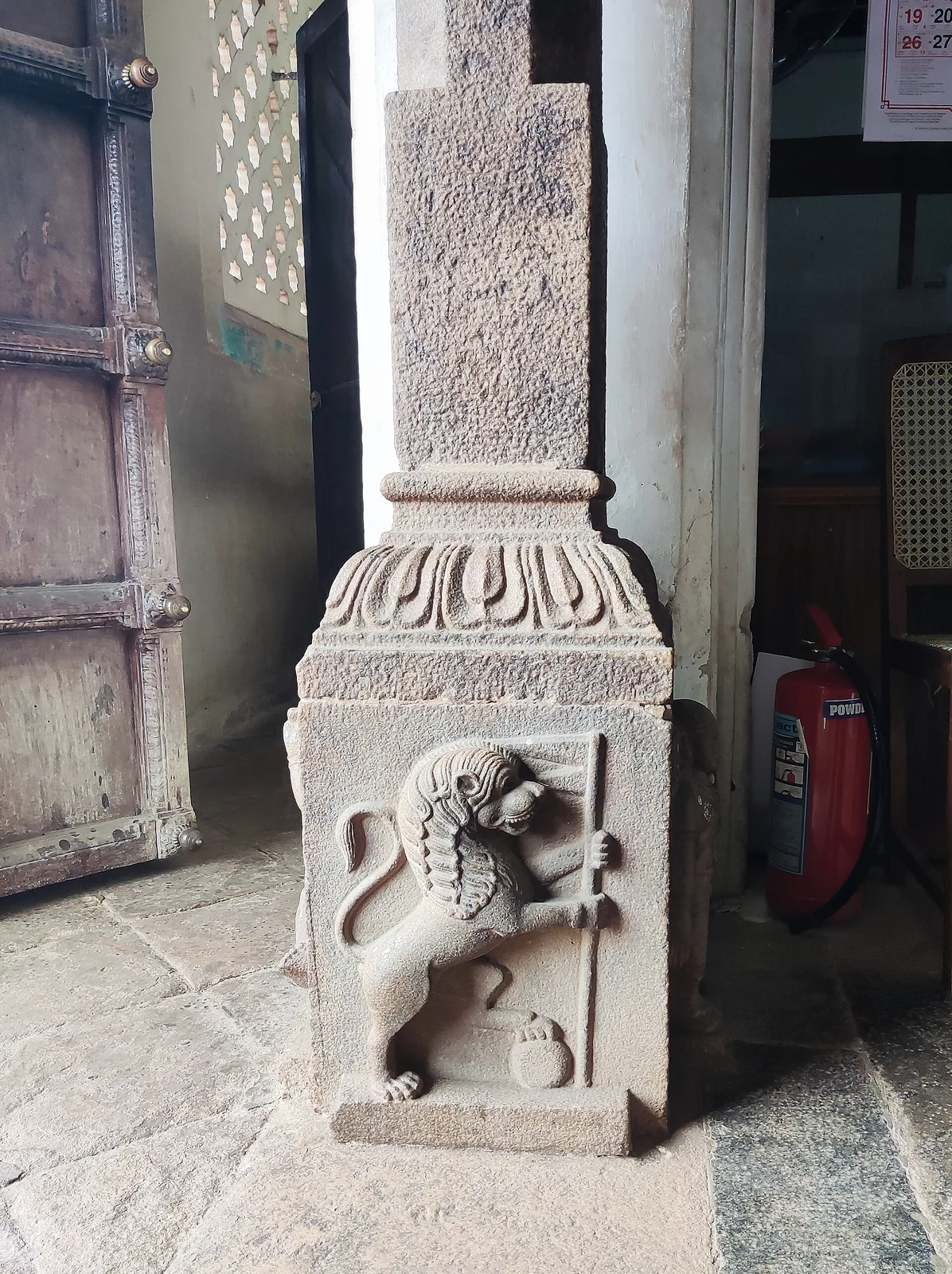
Beyond the bronzes are ivory carvings of considerable delicacy, wood sculpture, stone, lamps, textiles, Kathakali figures, koftgari metalwork and old musical instruments. The ivories repay attention partly because they cut across the assumption that a Travancore collection will be uniformly Hindu — among them are Christian subjects, including a small figure of St Francis, which is a reminder of how long and how ordinarily Kerala has been religiously plural. Carved granite pillar bases, one with a rampant lion holding a staff, stand about the halls at floor level where they are easy to walk past.
Giving it enough time
The Napier is not large and it is entirely possible to walk it in twenty minutes, which is what most people do and is a waste of a good building. An hour is closer to right: enough to do a slow circuit of the bronzes, stand under the chariot, look properly at the ivories, and then look up at the ceiling, which is covered separately in The Building That Breathes. The wider complex — the zoo, the art gallery, the grounds — is in A Victorian Campus in the Middle of a City. Timings and access are on the Napier Museum page.
Frequently asked questions
What is in the Napier Museum?
South Indian bronzes, ivory carvings, wood and stone sculpture, lamps, textiles, Kathakali figures, koftgari metalwork, old musical instruments, and a full carved wooden temple chariot — one of the richest holdings of religious and decorative art in south India.
Is the Vishnu bronze really the oldest metal image in Kerala?
It is commonly described that way, but we have not found the dating that would establish it. Treat it as a long-standing attribution rather than a settled fact — it is a very strong claim about an entire category of object in a state with a deep bronze tradition.
What is the temple chariot?
A rath — a carved wooden processional chariot of the kind hauled through festival streets by hundreds of people. It is the largest object in the museum and the best available illustration of the scale Kerala’s temple carpenters worked at.
How long should I allow?
About an hour. Twenty minutes is enough to walk through and is what most visitors take, but it does not leave time for the bronzes, the chariot, the ivories and the ceiling.