Almost everything written about Papanasam Beach describes the water seeping from the foot of the cliff as mineral springs with therapeutic properties. It is a phrase that has been copied so many times it now reads as a fact about the place. It is closer to a guess — and what the springs actually are is considerably more interesting than what the brochures claim for them.

A cliff built in layers

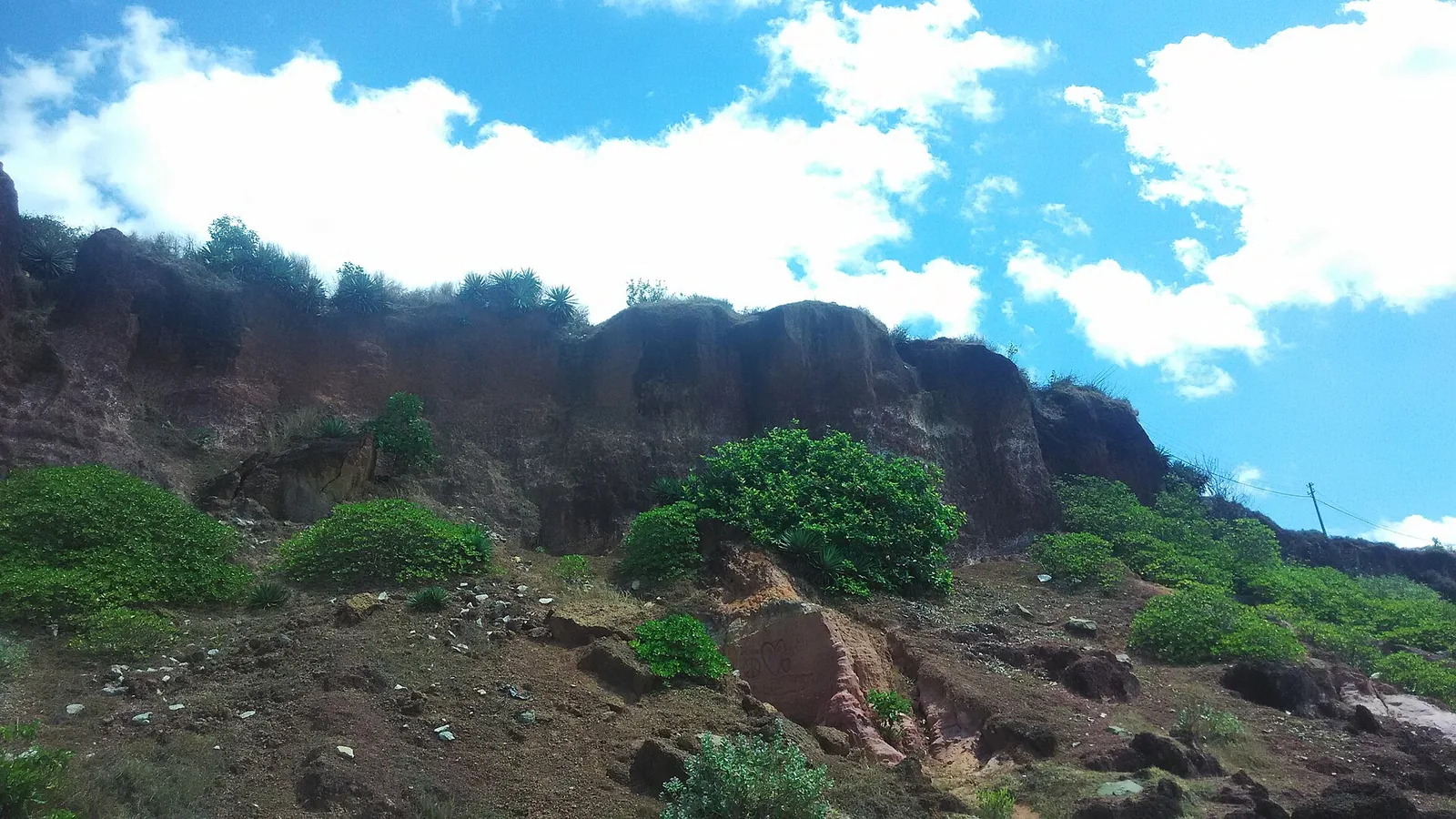
The Varkala cliff is the type section of the Warkalli Formation — the global reference exposure that geologists measure other outcrops of the same beds against. It is not one substance. From the top down it runs: a hard cap of laterite, several metres thick; beneath that, beds of ferruginous sandstone and grit; and beneath those, a bed of carbonaceous clay.

That third layer is the one that matters. Sandstone and grit are porous — water moves through them freely. Carbonaceous clay is not. Water reaching it stops going down.

This is also why the cliff is not, despite the shorthand, a laterite cliff. The laterite is only the lid. Most of what you are looking at is soft Mio-Pliocene sandstone, which behaves very differently when it gets wet.

Why the springs appear in a line

Rain falling on the clifftop soaks into the ground and travels downward through the sandstone. When it reaches the clay it cannot continue, so it turns and runs sideways instead, following the top of the clay bed until that surface intersects the open cliff face. There it emerges.

Because the beds lie close to horizontal, that intersection happens at roughly the same height all along the cliff. This is the detail worth carrying to the beach: the springs are not scattered at random. They form a line at one particular level on the rock, and once you know to look for it you can trace it — damp patches, algal staining, small channels of clear water crossing the sand.

It also explains why they are perennial. The sandstone holds water through the dry months and releases it slowly, so the seeps run all year rather than only after rain. What changes between seasons is the volume, not the existence.

So are they mineral springs?

The water picks up dissolved iron on its way through ferruginous sandstone — the same iron that gives the cliff its colour — so it is not pure rainwater by the time it reaches the beach. In that narrow sense there is something in it.

But "mineral springs with therapeutic properties" is a much larger claim than "fresh groundwater carrying some iron", and it is the larger claim that gets made. There is no published analysis behind the therapeutic reputation. It is belief, and belief of a kind that long predates anyone thinking about the chemistry.

That is not a reason to dismiss it. The springs are genuinely why this shore became sacred: fresh water arriving at the sea, out of solid rock, at a place already associated with the dead. The mechanism does not diminish the association. It just is not the same thing as a health claim.

The part nobody puts on a signboard

Here is the uncomfortable half. Groundwater seepage is one of the principal forces destabilising the Varkala cliff. Water moving through the sandstone raises pore pressure, softens the beds and lubricates the surfaces along which blocks slip. The literature on conserving the cliff lists groundwater seepage, water-table variation and the springs themselves among the factors controlling its stability.

The water that made this beach holy is the water that is taking the cliff apart. Those are not two processes. They are one process, seen from the bottom and from the top.

Which is why what happens on the clifftop reaches the sand. Buildings, paving, septic systems and drainage along the rim all change how much water enters the rock and where it goes. Concentrate the discharge into a few points and you get faster undercutting at those points. Seal the surface and you starve the springs. Both outcomes are visible at beach level long before anyone above notices.

The cliff was notified as a National Geological Monument in 2014, and the demolition and construction arguments that followed have mostly been argued as a heritage question. The springs are the reason they are also a hydrological one.

Finding them

They are undramatic and easy to walk past. Look along the base of the cliff for green algal streaks, persistently damp rock and thin channels of clear water crossing the sand towards the sea, at the height where the red laterite gives way to paler stone. Some have been informally walled or piped into a basin over the years; others are just a wet patch.

After heavy rain the same points run hard enough to cut small gullies through the beach. In March they may be barely a trickle. Nothing is signposted, and any given spring may have been altered by drainage work on the ground above it since the last time anyone wrote about it.

Frequently asked questions

Are the Papanasam springs really mineral springs?

They are fresh groundwater carrying dissolved iron picked up from ferruginous sandstone. The stronger claim — mineral water with therapeutic properties — is traditional belief rather than a published finding, and is best read that way.

Why do the springs emerge partway up the cliff rather than at the bottom?

Because they emerge at a boundary between layers, not at ground level. Water sinks through porous sandstone until it meets a bed of carbonaceous clay it cannot cross, then runs sideways along the top of that clay until the surface meets the open cliff face. The beds are nearly horizontal, so that happens at about the same height all along.

Do the springs run all year?

Yes. The sandstone stores water and releases it slowly, so the seeps are perennial. The volume changes a great deal between the monsoon and the dry months, but they do not stop.

Is the cliff really a laterite cliff?

Only at the top. The laterite is a cap a few metres thick over much softer Mio-Pliocene sandstone, which is most of the exposed height. The distinction matters because the soft rock beneath is what responds to water, and it is why drainage and clifftop construction affect stability so directly.

Do the springs damage the cliff?

The seepage that feeds them is among the factors that destabilise it. Water moving through the sandstone raises pore pressure and weakens the beds, and studies of conserving the cliff list groundwater seepage and the springs among the controls on its stability. It is the same water that makes the beach sacred.

Can you bathe in them?

People do, where the flow is strong enough to collect. It is informal — there is no bathing facility, no signage and no supervision — and what you find depends on the season and on whatever has been built or drained on the clifftop above.