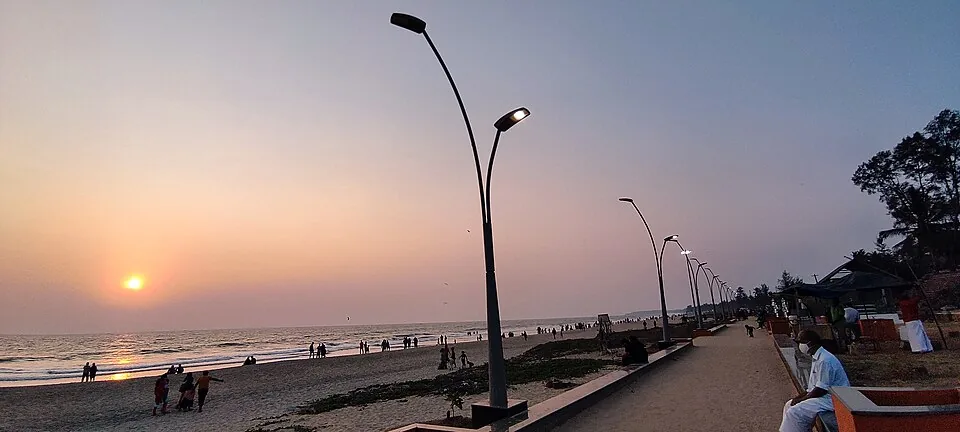
On the evening a hush falls over the Malabar coast, thousands of people drift toward the same stretch of golden sand — and above them, hewn larger than life, a stone mother lifts her child toward the sea. This is Payyambalam Beach, Kannur’s landmark shore, and it is unlike almost any beach in Kerala. It is where the district comes to watch the sun go down, where a celebrated sculptor left one of his gentlest monuments, and where the graves of Kerala’s most famous leaders rest a few metres from the tideline. To walk it is to read Kannur’s memory written into the sand.
Where Kannur’s coast meets the sea
Payyambalam sits barely two kilometres from the centre of Kannur town, on the western edge of the district where the North Malabar coast runs down to the Arabian Sea at roughly 11°52′ north. It is one of a cluster of beaches strung along Kannur’s seafront, but it is the broad one — a long, clean sweep of golden sand backed by a low green headland and swaying palms, with the town’s streets giving way abruptly to open water. That easy nearness is part of the beach’s character: unlike the remote coves of the Malabar coast, Payyambalam is a city beach, close enough that half of Kannur can wander down after work, yet wide enough that it rarely feels crowded even when it fills.
The mother who watches the waves
The beach’s most photographed feature is not the sea but a sculpture. Set in the landscaped garden above the sand stands a monumental figure of a mother cradling her child — titled Amma, and known to almost everyone simply as the “Mother and Child.” It is a tender, deliberately unheroic subject rendered at colossal scale, the sort of public art that turns a walk on the beach into an encounter. Families pose beneath it, children scramble around its base, and over the decades it has quietly become the emblem of Payyambalam itself. Its presence is what separates this beach from the dozens of others along the coast: it was conceived not as decoration but as a monument to something universal, planted where the whole district would pass it.
Kanayi Kunhiraman, the sculptor of giants
The mother is the work of Kanayi Kunhiraman, born in 1937 and among the most celebrated sculptors Kerala has produced. He is the artist behind the state’s best-known monumental figures — the towering Yakshi that has watched over the Malampuzha gardens near Palakkad since 1969, and the reclining Sagarakanyaka, the mermaid at Shanghumugham beach in Thiruvananthapuram. Twice chairman of the Kerala Lalithakala Akademi, in 1978 and 2001, and a member of the national Lalit Kala Akademi in New Delhi, Kanayi built a career out of placing enormous human forms in open public space, insisting that serious art belonged not in galleries but where ordinary people live. The Payyambalam mother belongs to that lifelong project: a giant, gentle figure given freely to the shoreline and the crowds who use it.
A shoreline of samadhis
Walk the green headland above the beach and the mood shifts from holiday to homage. Payyambalam is the resting place of an extraordinary roll-call of Kerala’s public figures, their memorials and samadhis set into the landscaped ground overlooking the sea. Buried or memorialised here are the former Chief Minister E. K. Nayanar; the communist leader A. K. Gopalan, universally known as AKG; the pioneering journalist Swadeshabhimani Ramakrishna Pillai; the writer and orator Sukumar Azhikode; and other leaders of the region including K. G. Marar and Azhikodan Raghavan. Few beaches anywhere serve so plainly as a civic pantheon — a place where a family outing and a moment of political remembrance happen within the same short walk.
Nayanar, AKG and the red coast
That these graves cluster at Kannur is no accident. North Malabar has long been one of the strongholds of Kerala’s Left, and the men remembered on the Payyambalam headland shaped the state’s modern politics. A. K. Gopalan was a towering figure of the freedom struggle and the early communist movement, remembered as a champion of the poor; E. K. Nayanar, a Kannur man, went on to become one of Kerala’s longest-serving Chief Ministers. To give them a resting place on the district’s most-visited beach — rather than a quiet cemetery — was a deliberately public gesture, keeping their memory in the daily path of the people they claimed to serve. The sea breeze, the sculpture and the samadhis together make Payyambalam as much a landscape of memory as of leisure.
The people’s evening
For all its solemn corners, Payyambalam is at heart the everyday joy of Kannur. It is widely regarded as one of the cleanest and most peaceful beaches in Kerala, and its landscaped park — with a section laid out especially for children — turns the seafront into a proper public garden rather than a bare strand. Come late afternoon it becomes the town’s living room: joggers on the walkway, families spreading out on the sand, vendors, kite-flyers, and everyone turning west as the sun drops into the Arabian Sea. Payyambalam is Kannur’s great sunset beach, and the daily gathering to watch the light go is as much a part of the place as the sculpture or the graves.
A coast woven from looms, beedi and Theyyam
The Payyambalam shore is the seaward face of a district with a deep and distinctive culture. Kannur is Kerala’s handloom heartland, its towns long humming with the clack of looms weaving the cotton the region is known for, and it was for generations a centre of the beedi-rolling trade whose workers were woven tightly into Malabar’s labour politics — the same politics remembered on the headland above the beach. Inland, through the cool months, the district blazes with Theyyam, the fierce ritual dance in which performers become gods. Payyambalam gathers all of this at the water’s edge: the weaver’s coast, the worker’s coast and the ritual coast, meeting where Kannur runs out of land.
Visiting Payyambalam Beach
Payyambalam lies about two kilometres from Kannur town and is easily reached by road or from Kannur railway station, making Payyambalam Beach one of the simplest day trips in North Malabar. Aim for the late afternoon so you can see the Mother and Child sculpture and the leaders’ memorials in daylight, then stay for the sunset that draws the crowds; the beach park is family-friendly, though as on any open sea beach you should be cautious of currents when bathing. Pair it with the fort, backwaters and Theyyam calendar covered on the Kannur hub to build out a fuller trip along the coast.
Frequently asked questions
Who made the “Mother and Child” sculpture at Payyambalam Beach?
It is the work of Kanayi Kunhiraman, one of Kerala’s most celebrated sculptors, also known for the giant Yakshi at Malampuzha and the Sagarakanyaka mermaid at Shanghumugham. The Payyambalam figure of a mother cradling her child, titled Amma, is the beach’s best-known landmark.
Which leaders are memorialised at Payyambalam Beach?
The headland above the beach holds the memorials and samadhis of several major Kerala figures, including former Chief Minister E. K. Nayanar, the communist leader A. K. Gopalan (AKG), the journalist Swadeshabhimani Ramakrishna Pillai and the writer Sukumar Azhikode, among others.
Is Payyambalam a good place to watch the sunset?
Yes. Payyambalam is Kannur’s main sunset beach — a broad, clean stretch of golden sand with a landscaped park and walkway that fills each evening with families and joggers gathering to watch the sun set over the Arabian Sea.