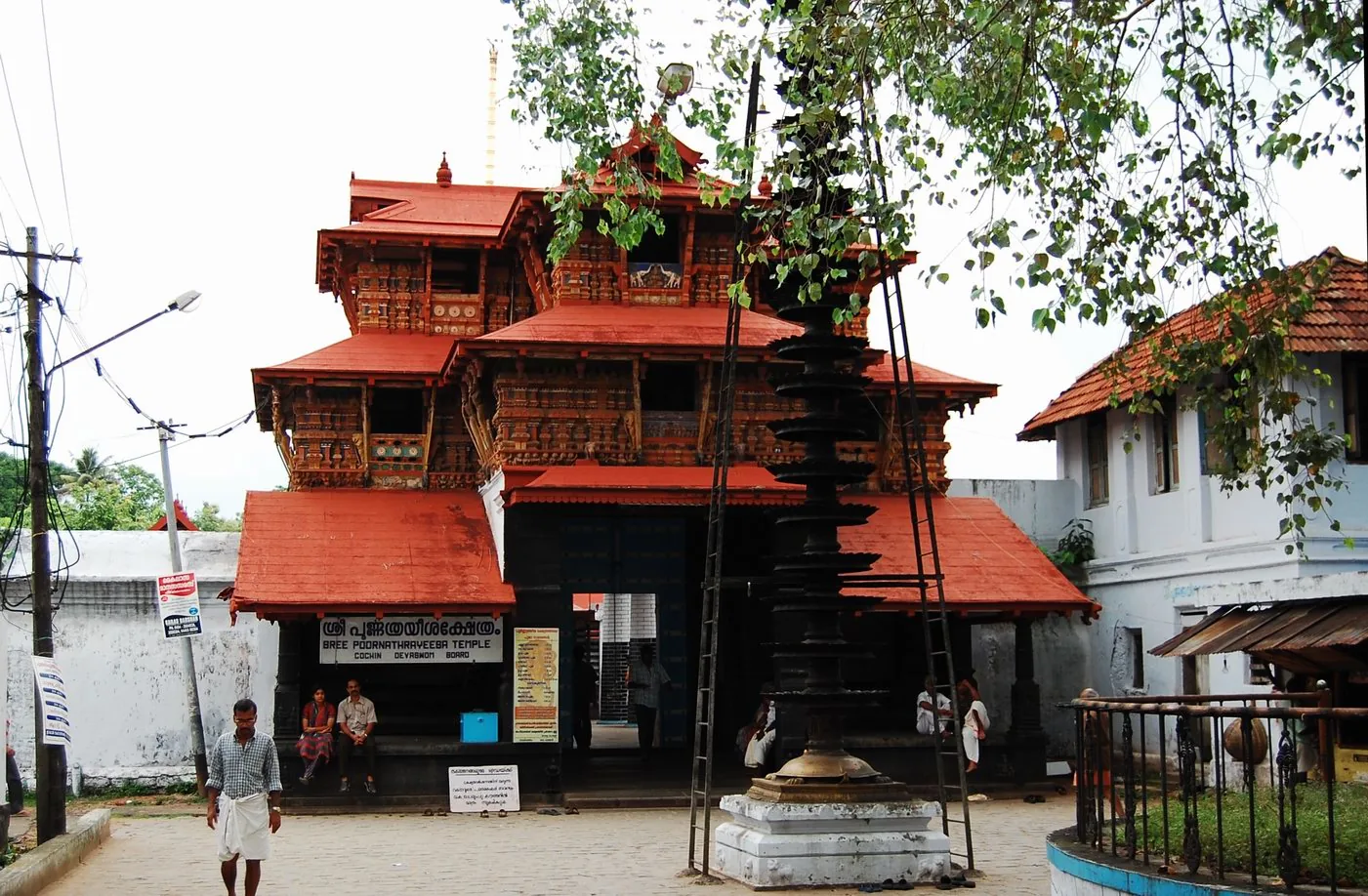
A Brahmin in Dwaraka had buried nine of his newborn sons, one after another; each infant died the moment it was born. When his wife grew heavy with the tenth, he came weeping to Krishna’s court, and Arjuna — proud, impulsive Arjuna — swore aloud that he would guard this child, and if it too died he would walk into fire. He failed. The baby vanished at birth like the others. And the god that Arjuna went to fetch to undo that failure is the one enshrined, to this day, at Sree Poornathrayeesa Temple in Tripunithura, just outside Kochi.
The vow, and the fire
This is the Santana Gopala legend, and it is one of the tenderest in the whole Krishna canon. Bound by his rash oath, Arjuna set every kind of barrier of arrows around the birthing house — and still, in an instant, the newborn was gone. Shamed, ready to keep his terrible promise and end his own life, Arjuna was stopped by Krishna, who told him the truth: this was no ordinary theft. Together they journeyed beyond the edge of the created world, to the abode of Maha Vishnu himself — and there sat all ten of the missing children, taken not by death but by a god who wished to draw Krishna and Arjuna to him.
The idol in the chariot
Vishnu returned the ten children, and gave Arjuna an idol of himself as Santana Gopala Murthy — a name that means, quite literally, the saviour of infants. Arjuna carried the living children and the sacred idol home in his chariot and placed the little ones in their father’s arms. In memory of that ride, the sanctum at Tripunithura was built in the shape of a chariot, a ratha in stone — and inside it Vishnu is not reclining, as he almost always is, but seated upright beneath the five hoods of the serpent Ananta, a posture you will find in scarcely any other temple in India.
The lord of the three Vedas
The deity’s grander name, Poornathrayeesa, unfolds like a riddle: poorna, complete; thraye, three; isa, lord — the complete Lord of the three Vedas, Rig, Yajur and Sama. The old name of the town itself, Poornavedapuram (“the town of the complete Veda”), softened over centuries into Tripunithura. There is even a legend for the temple’s odd geography: Ganesha, drawn by the holiness of this ancient Vedic village, tried to claim the spot for himself, and Arjuna pushed him firmly to the south of the sanctum — which is why, uniquely here, the elephant-headed god faces south.
The first temple of a kingdom
For all its mythic weight, Poornathrayeesa is also thoroughly royal history: it was the family deity of the Cochin dynasty and the first among the eight great royal temples of the erstwhile Kingdom of Cochin, whose rajas kept their seat at Tripunithura. That patronage shows in its scale and, above all, in its festival. The Vrischikotsavam, held over some fifteen days in the month of Vrischikam (November–December), is one of Kerala’s grandest — more than forty caparisoned elephants, drums and lamps and nights of temple art, a spectacle worthy of the god a hero once crossed the universe to bring home.
Visiting Poornathrayeesa
Tripunithura sits on the edge of Kochi and is easily reached, its temple standing amid the old royal quarter with its palace and heritage streets. Come during Vrischikam for the great festival, or on any ordinary day to sit before the seated god in his chariot-shrine. Details are on the Poornathrayeesa place page; more of the district is on the Ernakulam hub.
Frequently asked questions
What is the legend of Poornathrayeesa temple?
It enshrines Vishnu as Santana Gopala Murthy, “the saviour of infants.” In the legend a Brahmin’s newborn sons kept vanishing at birth; Arjuna vowed to save the tenth and failed, whereupon Krishna led him to Vishnu’s abode, where the missing ten children were found. Vishnu restored them and gave Arjuna the idol, which he carried home in his chariot — the reason the Tripunithura sanctum is shaped like a chariot.
Why is the Poornathrayeesa idol unusual?
Vishnu is shown seated upright beneath the five hoods of the serpent Ananta, rather than reclining as in almost every other Vishnu temple. The sanctum is built in the form of a chariot (ratha), and the temple’s Ganesha uniquely faces south.
When is the Poornathrayeesa festival?
The Vrischikotsavam is held over about fifteen days in the Malayalam month of Vrischikam (November–December). It is one of Kerala’s grandest temple festivals, with more than forty elephants taking part.
What does the name Poornathrayeesa mean?
It combines poorna (complete), thraye (three) and isa (lord) — the complete Lord of the three Vedas: Rig, Yajur and Sama. The town’s old name, Poornavedapuram, later became Tripunithura.